A sweater feels soft, the shop looks inviting, and the swing tag carries an Italian name. Before deciding whether the price makes sense, look inside the garment.
The small label sewn into a side seam often gives you more useful buying information than the logo. It can reveal how much wool a sweater contains, whether a jacket has a different lining, and whether your new trousers fit your laundry routine.
Learning how to read an Italian clothing label means separating three questions: What is it made of? What does its origin claim mean? How should you care for it? None of these answers, on its own, guarantees quality.
For the wider background, see Italia Mia’s guide to Italian fashion, its history and the meaning of Made in Italy.
Start With the Composition Label
Look for composizione, meaning composition. Check the side seam, neckline or waistband, and unfold any booklet of labels.
For most everyday textile clothing sold to consumers in the EU, fiber composition must be provided. The information generally lists fibers by their percentage by weight, in descending order, using recognized fiber names. Labels for the Italian market normally include Italian, often alongside other languages.
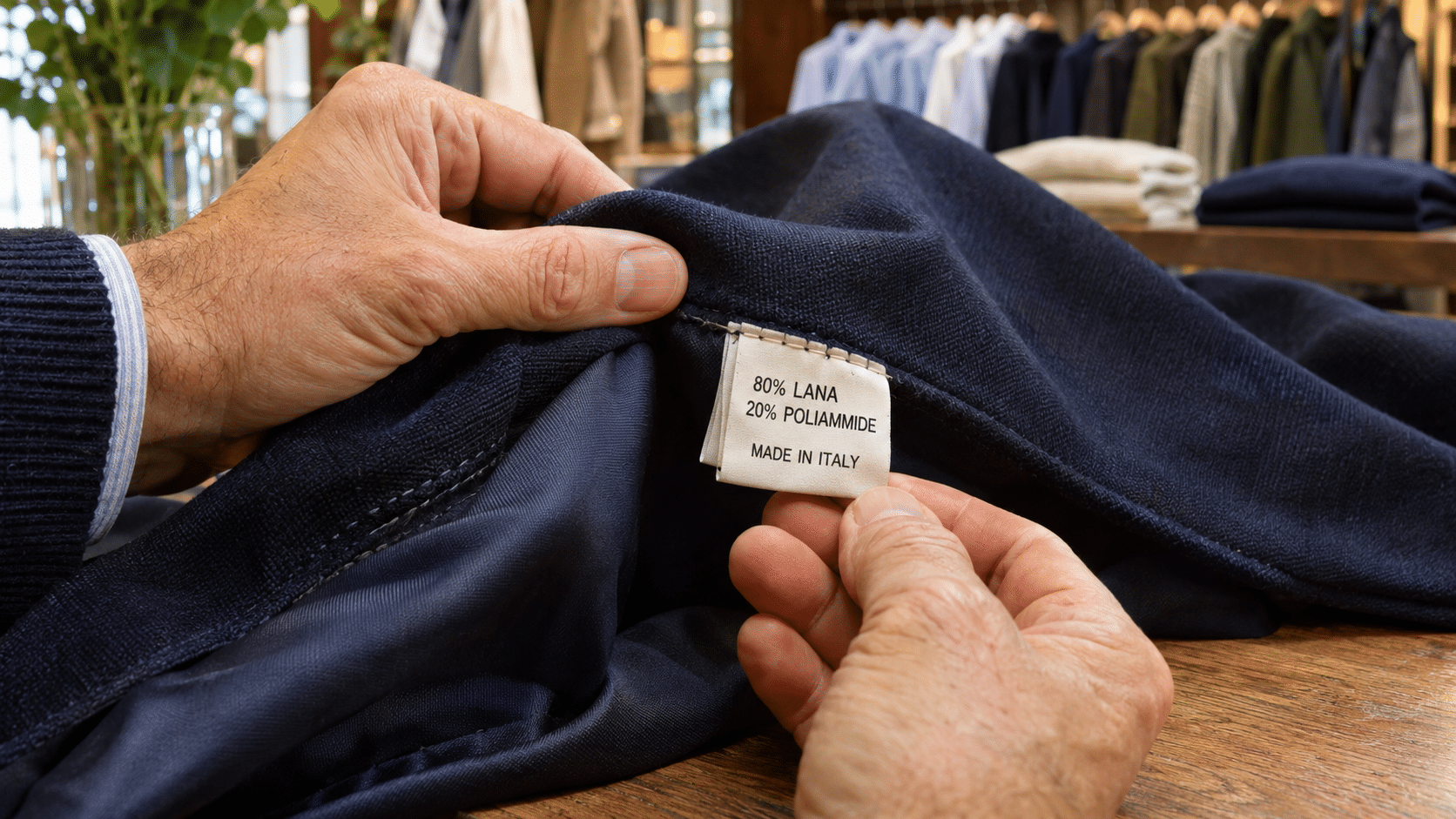
An example is 80% lana, 20% poliammide: 80% wool and 20% polyamide. It does not mean that the garment is pure wool, even if a display sign calls it a “wool sweater.”
The European Commission’s textile-labeling guidance explains the basic requirements. Read the composition before comparing prices between apparently similar garments.
Italian Fabric Words Worth Recognizing
You do not need fluent Italian to understand the most common entries.
| Italian label term | English meaning |
|---|---|
| Cotone | Cotton |
| Lino | Linen |
| Lana | Wool |
| Lana vergine | Virgin wool |
| Seta | Silk |
| Cashmere | Cashmere |
| Viscosa | Viscose |
| Modal | Modal |
| Lyocell | Lyocell |
| Poliestere | Polyester |
| Poliammide | Polyamide, including nylon |
| Acrilica | Acrylic |
| Elastan | Elastane, also called spandex |
| Altre fibre | Other fibers |
Keep the fiber name separate from words describing appearance or construction. Effetto seta means silk effect; it does not establish silk content. Satin describes a fabric structure rather than a particular fiber. A shiny surface alone cannot tell you what you are buying.
The expression altre fibre is permitted in specified circumstances under EU rules; it is not an invitation to leave the main composition unexplained.
What “Pure” and “Virgin Wool” Actually Tell You
Under the EU textile regulation, terms such as 100%, puro and tutto are reserved for single-fiber products, subject to defined technical allowances for unavoidable extraneous fibers.
Lana vergine has a specific meaning relating to wool that has not previously been incorporated into a finished product and meets the regulation’s processing conditions. It is not a grading system for softness, fineness or durability.
A label saying 100% lana vergine therefore provides useful material information, but it does not tell you whether the sweater will feel comfortable against your neck.
Likewise, a small cashmere percentage should not be mistaken for an all-cashmere garment. Read the complete blend rather than the most attractive word.
These distinctions come from EU Regulation 1007/2011.
Is a Blend a Bad Sign?
A blend is something to assess in relation to the garment’s purpose.
For trousers you will wear while traveling, consider how the material moves when you sit and walk. For a sweater, check whether the fabric feels comfortable and whether the shape suits you. For a summer shirt, try it on rather than judging comfort from the word “natural.”
Compare three imaginary labels:
- 98% cotone, 2% elastan: predominantly cotton with a small elastane component.
- 70% lana, 30% poliammide: a wool–polyamide blend.
- 50% viscosa, 30% poliestere, 20% poliammide: a three-fiber mixture containing no wool.
These examples identify different compositions. They do not establish a universal ranking.
Ask what you need the item to do, then judge its feel, fit, construction and care requirements together. Paying more for a particular fiber makes little sense if you dislike wearing the finished garment.
Read the Lining and Other Components
A jacket may have separate entries for different parts.
| Italian term | Meaning |
|---|---|
| Tessuto esterno / esterno | Outer fabric / shell |
| Fodera | Lining |
| Imbottitura | Padding or filling |
| Rivestimento | Covering or coating, depending on context |
For example:
Esterno: 100% lana
Fodera: 100% viscosa
This describes a wool outer fabric and a viscose lining. Read each percentage within its own component; do not add the two lines together.
You may also encounter “Contiene parti non tessili di origine animale”, the required wording for textile products containing non-textile parts of animal origin. A leather trim can trigger it. Wool and silk are themselves textile fibers, so this statement is not a complete guide to whether an item is vegan.
If animal materials matter to your purchase, ask about trims and components as well as the main fabric.
What “Made in Italy” Means—and What It Does Not
An Italian brand name, an Italian company address and Italian manufacture are different facts.
Where production involves several countries, origin is determined under applicable customs rules. The general principle concerns the last substantial, economically justified processing, with product-specific rules affecting the result. Simply attaching a label in Italy does not establish Italian origin.
Made in Italy does not, by itself, promise that every fiber was grown, every yarn spun and every fabric woven in Italy. It also does not certify working conditions or guarantee a particular level of craftsmanship.
Other expressions answer narrower questions:
| Wording | What to check |
|---|---|
| Designed in Italy | Where was the garment manufactured? |
| Italian fabric / tessuto italiano | Where was the finished garment made? |
| Italian brand | What origin is stated for this particular item? |
| Made in Italy | Is further supply-chain information available? |
Italian customs explains the principles of non-preferential origin. For the manufacturing background, explore Italy’s textile districts: Como, Biella and Prato.
Are Origin and Care Details Always Required?
Do not assume every label field has the same legal status.
Italy’s Ministry of Enterprises and Made in Italy explains that the EU textile-composition regulation does not itself impose requirements for sizes, care instructions or country of origin. Other legislation may impose additional obligations, and voluntary information must not mislead.
That distinction matters when shopping: composition labeling and a country-of-origin claim serve different purposes. The absence of a “Made in Italy” statement is not, by itself, proof of a counterfeit.
See the ministry’s textile-labeling overview for the regulatory background.
How to Read Clothing Care Symbols
Read care information before buying, especially if regular professional cleaning would make the garment inconvenient or expensive to own.
| Symbol description | Meaning |
|---|---|
| Wash tub with a number | Maximum washing temperature in Celsius |
| One bar beneath the tub | Mild washing process |
| Two bars beneath the tub | Very mild washing process |
| Hand in a tub | Hand washing; check the specific instructions |
| Crossed-out tub | Do not wash |
| Triangle | Bleaching instructions |
| Crossed-out triangle | Do not bleach |
| Circle inside a square | Tumble-drying instructions |
| Crossed-out circle inside a square | Do not tumble dry |
| Iron with dots | Permitted ironing heat |
| Circle, often containing a letter | Professional textile-care instructions |
A plain square or one containing lines can specify natural drying. Read it separately from the tumble-dryer symbol. Letters such as P and F guide professional cleaners; they are not washing-machine settings.
GINETEX provides the full care-symbol guide, including variations.
Do not assume that two garments with identical fiber percentages can be washed identically. Follow the finished garment’s instructions.
Useful Italian Care Instructions
Written instructions can add detail to the symbols.
| Italian wording | English meaning |
|---|---|
| Lavare a mano | Hand wash |
| Lavare a secco | Dry clean |
| Non candeggiare | Do not bleach |
| Non asciugare in asciugatrice | Do not tumble dry |
| Asciugare in piano | Dry flat |
| Lavare al rovescio | Wash inside out |
| Lavare separatamente | Wash separately |
| Non strizzare | Do not wring |
| Stirare al rovescio | Iron on the reverse |
| Non stirare | Do not iron |
Photograph the care label if you intend to remove it for comfort. Include the composition and model reference in the same set of photographs so you can identify the instructions later.
If wording and symbols appear contradictory, ask the retailer or manufacturer before washing.
What the Label Cannot Guarantee
Composition and origin information leave several buying questions unanswered.
Construction: Turn the garment inside out. Look for tidy seams, secure buttons and hems that lie properly.
Fit: Sit down, reach forward and walk around. Check the shoulders, waistband and sleeve length.
Durability: A fiber percentage does not predict exactly how long a garment will last or how quickly its appearance will change.
Authenticity: A convincing label can be copied. Consider the seller and any brand-supported verification process.
Environmental or labor standards: A composition statement is not a complete supply-chain audit. If a claim matters to you, ask what evidence supports it and which part of the product it covers.
This practical attention to fit and presentation connects with la bella figura: a recognizable logo is only one small part of dressing well.
A Quick Check Before Paying
- Find the complete composition, including the lining where relevant.
- Compare the percentages with the sales description.
- Read the exact origin wording.
- Check that the care routine suits your home and budget.
- Inspect construction and try the garment on.
- Ask the retailer to explain anything unclear.
The same habits are useful when vintage shopping in Italy, where older labels may be faded or incomplete. An unreadable label leaves you with uncertainty; it does not provide a reason to guess at a valuable fiber.
A useful question in a shop is: “Posso vedere l’etichetta con la composizione e le istruzioni di lavaggio?”—“May I see the label with the composition and washing instructions?”
External Links
- European Commission: Textile labels
- EU Regulation 1007/2011: Textile fiber names and labeling
- Italian Ministry: Textile labeling
- Italian Customs: Non-preferential origin
- GINETEX: Clothing care symbols