
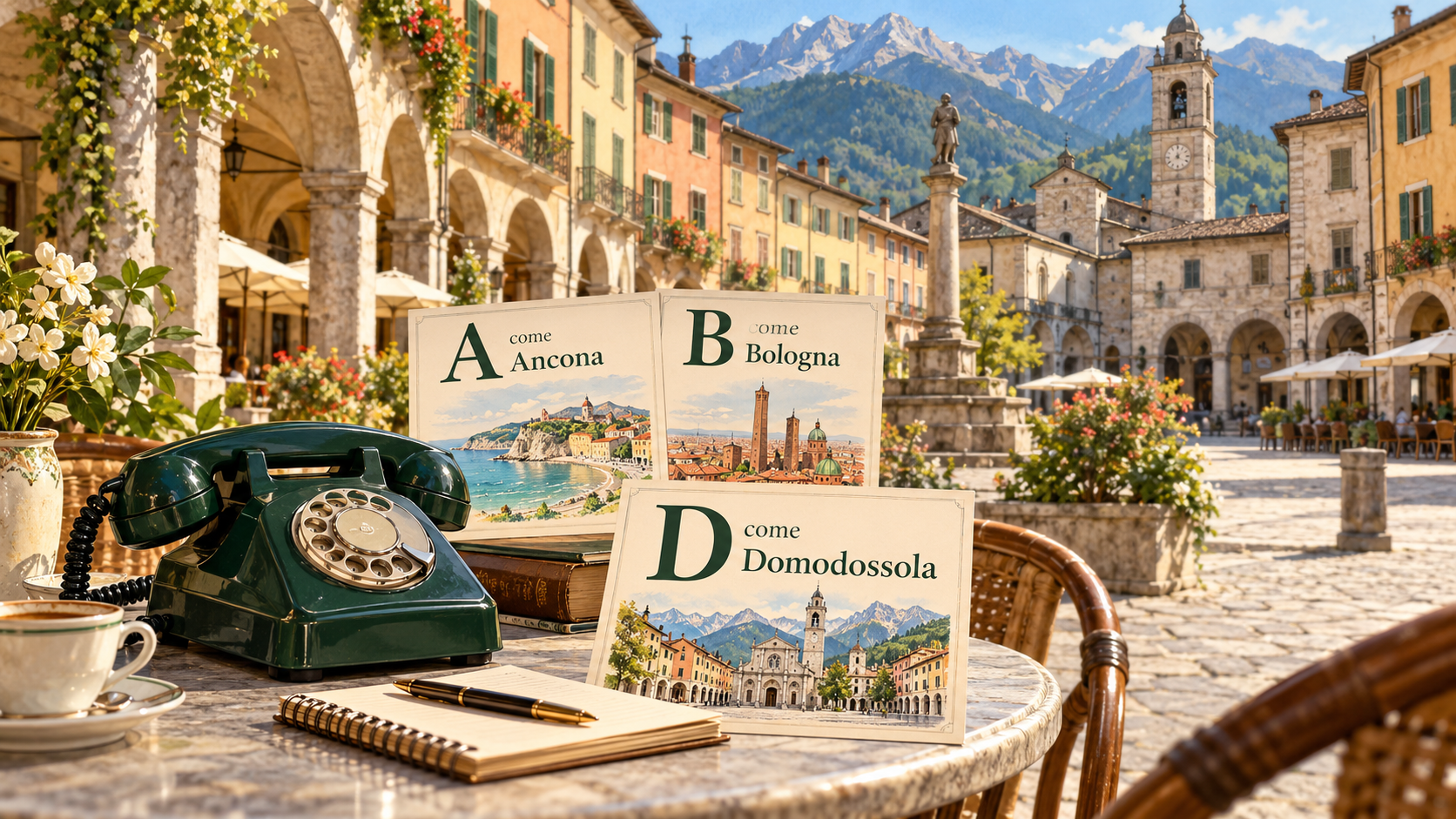
 You are calling a hotel in Italy, and the receptionist asks you to spell your surname. You begin saying individual letters, but the line is noisy. Then comes a question: “D come Domodossola?”
Welcome to the Italian spelling alphabet, a practical way of making letters clear by connecting them with familiar words, mostly town and city names. Instead of repeating a letter more loudly, you say “D as in Domodossola.” Suddenly, there is much less room for confusion.
Known as the alfabeto telefonico italiano, this everyday habit turns a simple conversation into a small journey around Italy. Ancona, Bologna, Como, and Domodossola become tools for spelling names, addresses, and booking references.
You do not need to memorize every entry before visiting Italy. Learning the words for the letters in your own name is an excellent place to start.
What Is the Italian Spelling Alphabet?
A spelling alphabet assigns a recognizable word to a letter. In English, you might say “B as in Boston.” In Italian, you can say “B come Bologna.” Here, come means “as in.”
The system helps when individual letter names sound similar, especially over the telephone. Italian bi, di, pi, and ti can be difficult to distinguish on a poor connection. Bologna, Domodossola, Palermo, and Torino are easier to tell apart.
This is a spelling aid, rather than a guide to how letters sound inside words. “C come Como” identifies the written letter C. It does not explain the different sounds of C in casa and ciao.
You may also hear the expression alfabeto fonetico italiano. For learners, “Italian spelling alphabet” is a clearer description because it avoids confusion with phonetic transcription.
Italian Spelling Alphabet: The Complete Table
The table below presents a useful everyday version. Some letters have familiar alternatives, and speakers do not always choose the same place name.
| Letter | Italian letter name | Common spelling cue |
|---|---|---|
| A | a | Ancona |
| B | bi | Bologna or Bari |
| C | ci | Como |
| D | di | Domodossola |
| E | e | Empoli |
| F | effe | Firenze |
| G | gi | Genova |
| H | acca | Hotel, or simply acca |
| I | i | Imola |
| J | i lunga | Jolly, or simply i lunga |
| K | cappa | Kenya, or simply cappa |
| L | elle | Livorno |
| M | emme | Milano |
| N | enne | Napoli |
| O | o | Otranto |
| P | pi | Palermo or Padova |
| Q | cu | Quarto |
| R | erre | Roma |
| S | esse | Savona |
| T | ti | Torino |
| U | u | Udine |
| V | vu or vi | Venezia |
| W | doppia vu or doppia vi | Washington |
| X | ics | Xilofono, or simply ics |
| Y | ipsilon or i greca | Yacht, or simply ipsilon |
| Z | zeta | Zara, or simply zeta |
For the full spoken formula, add come: “A come Ancona,” “F come Firenze,” and “R come Roma.” Pronounce the letter itself using its Italian name: effe come Firenze, for example.
The traditional Italian alphabet has 21 letters. J, K, W, X, and Y also occur in foreign words, names, and other everyday contexts, so they are included here.
Why Do Italians Say “D come Domodossola”?
Domodossola is a town in Piedmont, in northern Italy. Its name has become a familiar cue for D in the telephone alphabet.
For someone learning Italian, this can seem surprising. Why does a relatively small town appear alongside Rome, Milan, and Naples? The useful point is familiarity with the spelling convention: the chosen place does not need to be the largest or best-known destination beginning with that letter.
Learn Domodossola as the conventional partner for D, and you will recognize the expression immediately when someone uses it. There is no need to search for a complicated historical explanation before you can use it confidently.
Do You Have to Use Exactly These Cities?
No. Everyday usage allows alternatives. Bologna and Bari both work for B; Palermo and Padova both appear for P.
The aim is to make the letter unmistakable. If the other person understands the word and its first letter, the spelling cue has done its job. However, familiar examples are especially useful when you are still learning Italian.
Use the Italian names of places. Say Firenze, rather than Florence, and Napoli, rather than Naples. This keeps your wording consistent with what an Italian listener expects.
The list is not entirely made up of present-day Italian cities. Hotel is an ordinary word, while Washington is outside Italy. Zara is the Italian name for Zadar, in Croatia. Treat the alphabet as a collection of established spelling cues, rather than a strict geography exercise.
How to Spell Your Name in Italian
Imagine someone asks you to spell Marco. You could answer:
“M come Milano, A come Ancona, R come Roma, C come Como, O come Otranto.”
Once the purpose is clear, people sometimes shorten the sequence to the city names alone:
“Milano, Ancona, Roma, Como, Otranto.”
For a learner, the full version is easier to follow. Pause briefly after each letter so the listener has time to write it down.
For my first name, Ercole, the sequence would be:
“E come Empoli, R come Roma, C come Como, O come Otranto, L come Livorno, E come Empoli.”
Try writing out your own first name and surname in this format. Keep the list nearby when making your first few telephone calls in Italian.
Double Letters: How to Spell Rossi or Anna
Double letters deserve extra attention. When spelling Rossi, make clear that the surname contains two S letters.
You can give every letter separately:
“Roma, Otranto, Savona, Savona, Imola.”
Alternatively, spell the surname using Italian letter names:
“Erre, o, doppia esse, i.”
For Anna, you can say “a, doppia enne, a.” The word doppia means “double.”
If the connection is poor, repeating each letter separately and then confirming the double consonant is a useful precaution. The listener can read the name back before continuing with the reservation or form.
Useful Phrases for Spelling in Italian
These short phrases help you ask for clarification without needing a long explanation.
| Italian | English |
|---|---|
| Come si scrive? | How is it spelled? |
| Può fare lo spelling, per favore? | Could you spell it, please? |
| Può ripetere più lentamente? | Could you repeat that more slowly? |
| Le faccio lo spelling. | I’ll spell it for you. |
| Con una sola esse. | With just one S. |
| Con due esse. | With two S’s. |
| Tutto attaccato. | All together, with no spaces. |
| Con uno spazio. | With a space. |
| Maiuscola / minuscola. | Uppercase / lowercase. |
A simple hotel exchange might sound like this:
Receptionist: “Mi dice il cognome, per favore?”
Guest: “Davis. Le faccio lo spelling: Domodossola, Ancona, Venezia, Imola, Savona.”
Receptionist: “Davis, perfetto.”
Spelling Email Addresses and Booking References
City names help with letters, but email addresses also contain symbols. Learn these alongside the alphabet:
| Symbol or detail | Italian expression |
|---|---|
| @ | chiocciola |
| . | punto |
| – | trattino |
| _ | trattino basso |
| Number 0 | zero |
| Letter O | O come Otranto |
For example, the fictional address anna.rossi@example.com could be introduced as “anna punto rossi chiocciola example punto com.” Spell out any part the listener finds unclear, including the domain.
For booking references, distinguish letters from numbers explicitly. Say zero for 0 and O come Otranto for O. Read the code slowly, one character at a time, and ask the listener to repeat it back.
An Easy Way to Practice
Start with three things you might need to dictate: your surname, your email address, and a fictional reservation code. Read each aloud, using the table whenever necessary.
Next, practice listening. Ask a friend to say a sequence of cities while you write down their initials. This helps you understand the shortened version that speakers may use during a quick call.
To build your vocabulary alongside this practical skill, explore our Italian Word of the Day. For another aspect of everyday expression, browse our collection of Italian proverbs.
The next time someone asks “D come Domodossola?”, you will know exactly what they mean—and how to answer.
External Sources
- Noi parliamo italiano: Alfabeto – Mi scusi, come si scrive? — city-based spelling cues and common alternatives.
- Loescher Editore: Exercise audio transcripts, track 60 (PDF) — a complete spelling-alphabet example, including J, K, W, X, and Y.
- Lingoda: L’alfabeto italiano — the traditional alphabet and telephone spelling.