

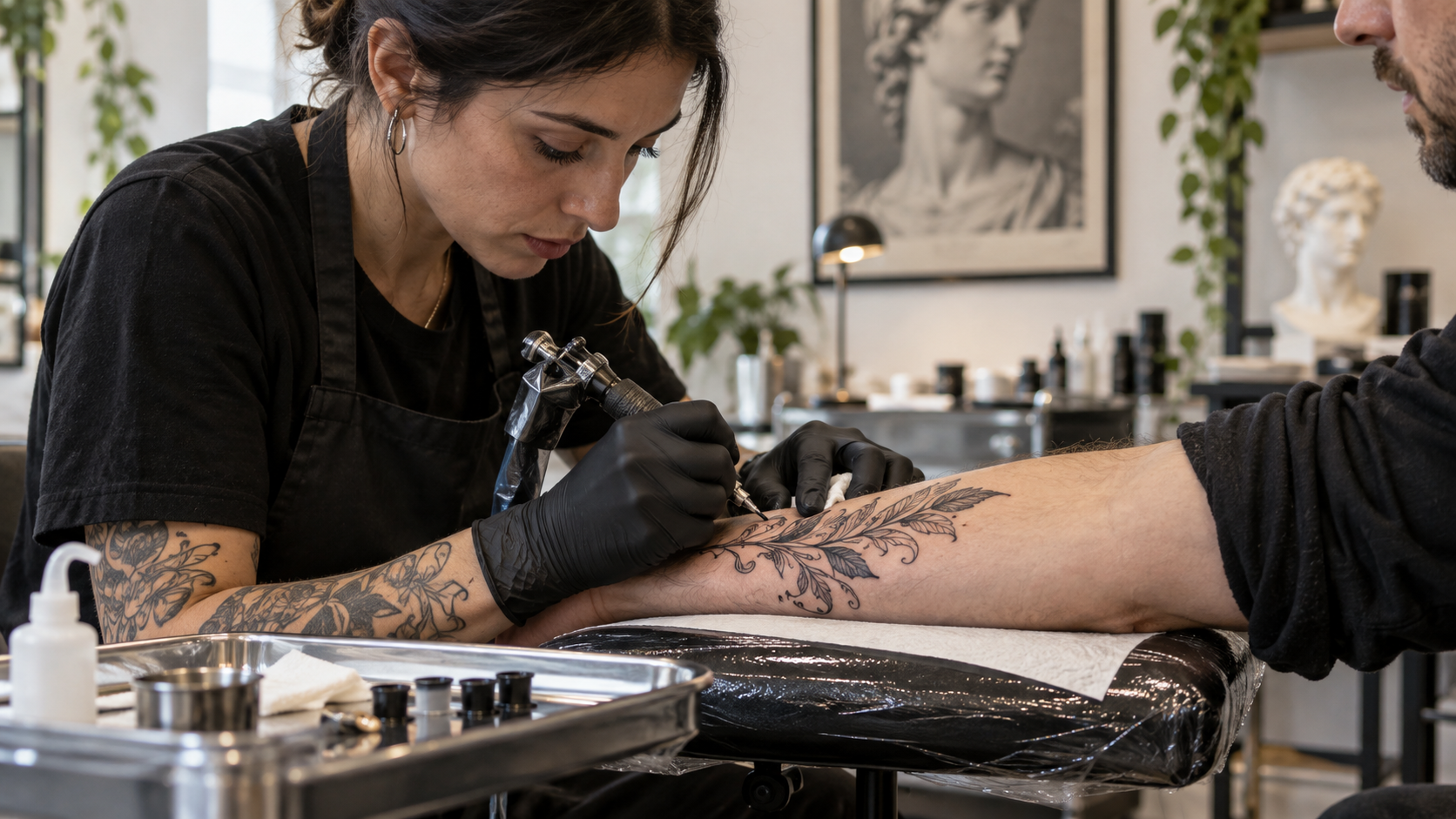
 Tattoos have become an unmistakable part of contemporary Italian culture. They appear on footballers and musicians, fashion professionals and university students, parents and grandparents. Walk through Milan, Rome, Naples, Bologna or a seaside town in summer and body art is visible everywhere—from discreet initials on a wrist to elaborate designs covering an arm or back.
Yet tattoo culture in Italy is about more than fashion. Tattoos can express family ties, religious faith, regional identity, personal loss, survival, rebellion or simply an appreciation of visual art. They also reveal how Italian attitudes toward the body have changed.
Once associated mainly with sailors, soldiers, prisoners and subcultures, tattoos have entered everyday life. They now occupy an intriguing place between private memory and public style, traditional symbolism and contemporary creativity.
From Ötzi to Modern Italy
The history of tattooing on the Italian peninsula begins thousands of years before the existence of Italy itself.
Ötzi the Iceman, whose naturally preserved body was discovered in the Alps near the Italian-Austrian border in 1991, lived more than 5,000 years ago. Researchers have identified 61 tattoos on his body, consisting mainly of groups of lines and crosses.
Unlike modern decorative tattoos, Ötzi’s markings were made through small incisions rubbed with charcoal. Many appear near joints or parts of the body showing physical wear. Researchers therefore believe they may have served a therapeutic or ritual purpose rather than being purely ornamental.
Ötzi can now be seen at the South Tyrol Museum of Archaeology in Bolzano. Readers interested in exploring the area can also consult Italia Mia’s guide to Trentino-Alto Adige.
Tattooing had different meanings in the ancient Mediterranean. Among Greeks and Romans, permanent marks could identify enslaved people, prisoners, criminals or members of particular groups. Tattoos were consequently associated for centuries with punishment and marginal status rather than fashionable self-expression.
Religious attitudes added another layer of complexity. Christianity generally discouraged permanent alteration of the body, yet religious tattoos also developed among pilgrims as lasting declarations of faith. Crosses, sacred hearts, images of saints and Marian symbols would eventually become part of European—and Italian—tattoo traditions.
How Tattoos Entered Modern Italian Culture
Modern tattoo culture emerged gradually in Italy during the twentieth century.
For much of that period, tattoos remained closely associated with military service, ports, prisons and working-class masculinity. Sailors might choose anchors, ships, hearts or the name of a loved one. Soldiers sometimes marked their bodies with dates, military insignia or reminders of home.
These tattoos were often simple and intensely personal. They recorded belonging, separation, loyalty and experiences that the wearer did not want to forget.
Public attitudes began changing more rapidly during the final decades of the twentieth century. International music, cinema, punk, rock, motorcycle culture and youth fashion introduced new styles and meanings. Professional tattoo studios became more visible, while specialized magazines and conventions helped tattooists exchange techniques and develop recognizable artistic identities.
Social media accelerated the transformation. Tattoo artists could suddenly present their portfolios to clients around the world, and customers arrived with visual references collected from many different cultures.
Today, Italian tattooing includes fine-line work, realism, geometric patterns, traditional Japanese imagery, old-school designs, ornamental compositions, lettering and experimental styles. Some Italian tattoo artists work internationally, while major cities host conventions attracting professionals and enthusiasts from many countries.
How Common Are Tattoos in Italy?
Reliable statistics require some caution because frequently repeated percentages come from surveys conducted in different years and with different methods.
The most useful nationwide study remains the survey completed by Italy’s Istituto Superiore di Sanità in 2015. Based on a representative sample of 7,608 people aged 12 and older, it estimated that approximately 6.9 million people in Italy had tattoos—12.8% of the population surveyed. The figure rose to 13.2% when people who had removed a tattoo were included.
The study also found that tattoos were slightly more prevalent among women:
- 13.8% of surveyed women had tattoos.
- 11.7% of surveyed men had tattoos.
- The average age at which respondents received their first tattoo was 25.
- The highest prevalence was recorded among people aged 35 to 44.
- Most respondents said they had chosen tattoos primarily for decoration or personal appearance.
These figures should not be presented as a current headcount. They describe the population at the time of the survey and provide a reliable benchmark rather than a real-time measurement.
What remains clear is that tattooing was already a mainstream phenomenon in Italy by the middle of the 2010s. Its continued visibility across popular culture suggests that it has become even more socially familiar, although a newer equivalent national survey would be needed to establish the present percentage precisely.
Why Italians Get Tattoos
There is no single “Italian tattoo,” just as there is no single Italian personality. Designs vary according to age, region, personal experience, artistic preference and family background.
Several themes nevertheless appear frequently.
Family and Personal Memory
Names, initials, birth dates and portraits are among the most intimate tattoo choices. A person may commemorate a parent or grandparent, celebrate the birth of a child or preserve the memory of someone who has died.
Family occupies an important place in Italian social life, so it is unsurprising that many tattoos make those relationships physically visible.
Italian and Regional Identity
Some people choose the outline of Italy, the tricolor, a map coordinate or words associated with their hometown. Regional symbols can be even more meaningful than national ones.
A Sicilian Trinacria, Sardinian Four Moors, Venetian lion or Neapolitan cornicello may express a precise connection to place. For Italians living abroad and descendants of Italian emigrants, these images can become symbols of ancestry and cultural continuity.
The red horn, or cornicello, is especially associated with Naples and protection against misfortune. Its cultural background is explored further in Italia Mia’s guide to Italian superstitions, luck and the evil eye.
Religion and Spirituality
Crosses, rosaries, sacred hearts, angels, saints and images of the Virgin Mary remain common motifs. Their meaning can range from formal religious devotion to remembrance, protection or family tradition.
Not every person wearing a religious tattoo practices the faith represented by it. In Italy, sacred imagery also belongs to art, local history and collective visual culture.
Italian Words and Quotations
Italian phrases are popular both in Italy and abroad. Common subjects include love, family, courage, destiny and the brevity of life.
Phrases such as La vita è bella, Sempre nel cuore or Vivi e lascia vivere may sound appealing, but anyone who does not speak Italian should verify grammar, spelling and intended meaning with a native speaker before making the words permanent.
Machine translation is particularly risky when a sentence involves gender, number, idiom or poetic language.
Art, Mythology and Classical Italy
Italy’s extraordinary artistic heritage supplies an almost unlimited source of tattoo imagery. Clients may request Roman statues, Renaissance figures, fragments inspired by Michelangelo, laurel wreaths, architectural details or characters from Greek and Roman mythology.
These designs connect contemporary body art to Italy’s broader visual tradition. Italia Mia’s guide to Italy’s art cities offers additional context for the artistic environments that continue to inspire painters, designers and tattoo artists.
Fashion and Personal Style
For some wearers, a tattoo does not need to represent a dramatic life event. It may simply be an aesthetic decision—a carefully placed element in someone’s overall appearance.
That approach fits naturally within a society where clothing, accessories and presentation often carry cultural importance. Tattoos can complement fashion while remaining more permanent and personal than anything in a wardrobe. The connection becomes easier to understand alongside the Italian concept of la bella figura and the country’s wider fashion tradition.
Italian Tattoo Style: Tradition Meets Experimentation
Italian tattoo artists are not confined to a single national school. Their work reflects international influences combined with the country’s strong traditions of drawing, composition and craftsmanship.
Popular approaches include:
- Fine-line tattoos with delicate outlines
- Black-and-grey realism
- Portraits and religious imagery
- Classical sculpture and Renaissance-inspired designs
- Old-school nautical tattoos
- Japanese-style compositions
- Geometric and ornamental patterns
- Minimalist lettering
- Botanical and natural subjects
- Abstract and contemporary body art
The best artists develop an individual visual language rather than reproducing images found online. A consultation should therefore involve more than selecting a picture. The artist should consider placement, scale, skin tone, how the body moves and how the design is likely to age.
Very small details and tightly spaced lines may lose clarity over time. A responsible tattooist will explain when a reference image needs to be simplified or enlarged.
Tattoos, Work and Social Acceptance
Tattoos are much more accepted in Italy than they were a generation ago, but attitudes are not identical everywhere.
Creative professions, hospitality, entertainment, fashion and technology may be relatively relaxed about visible body art. More conservative workplaces can still prefer that employees cover large or prominent tattoos, particularly in formal, customer-facing or institutional roles.
Age and setting matter as well. A tattoo that attracts little attention on a beach may be perceived differently during a job interview, religious ceremony or formal business meeting.
The broad trend is toward acceptance, but it would be misleading to claim that stigma has disappeared completely. Face, neck and hand tattoos remain more likely to affect how a person is perceived because they cannot be hidden easily.
Before choosing a highly visible placement, it is sensible to consider not only present circumstances but also future employment and lifestyle changes.
Tattoo Safety in Italy
A tattoo breaks the skin, so choosing a qualified and hygienic professional is more important than finding the lowest price.
The Italian Institute of Health reported that 76.1% of tattooed respondents in its national survey had used a specialized center, while 13.4% had been tattooed outside authorized establishments. The latter situation may present greater health risks.
Before proceeding, a client should look for:
- A professional studio operating under applicable local and regional requirements
- Individually packaged, sterile, single-use needles
- Fresh disposable gloves
- Clean and disinfected work surfaces
- Ink poured into single-use caps
- Clear information about the products being used
- Written consent and aftercare instructions
- An artist willing to discuss allergies, medication and health conditions
- A healed-work portfolio, not only photographs taken immediately after tattooing
European Union restrictions under REACH limit thousands of hazardous substances in tattoo inks and permanent makeup. These rules became applicable in 2022, with a later transition for two pigments. Regulation reduces chemical risk, but it does not replace correct hygiene, sterile technique or responsible aftercare.
A tattoo should not be performed over an unexplained skin lesion, infected area or suspicious mole. People who are pregnant, immunocompromised, taking certain medications or living with conditions that affect healing or blood clotting should seek medical advice before being tattooed.
Minors are subject to rules that can vary by region and circumstance. A reputable studio should verify age and any required parental consent rather than treating the procedure casually.
Healing and Aftercare
The tattoo artist should provide instructions appropriate to the procedure and the protective dressing used. General advice commonly includes:
- Wash your hands before touching the tattoo.
- Follow instructions about when to remove the dressing.
- Clean the area gently without scrubbing.
- Apply only the aftercare product recommended by a qualified professional.
- Avoid picking scabs or scratching peeling skin.
- Keep the tattoo away from swimming pools, seawater and prolonged soaking while it heals.
- Avoid intense sun exposure.
- Wear loose, clean clothing over the area when necessary.
- Seek medical advice if redness spreads or if severe pain, swelling, pus or fever develops.
After healing, sunscreen helps reduce fading and protects the skin. It is also important to continue checking the skin for changes rather than allowing a tattoo to obscure moles or lesions.
Tattoo Regret and Removal
Most participants in the Italian national survey were satisfied with their tattoos. However, 17.2% said they wanted to remove one, and 4.3% of that group had already done so.
Reasons for regret can include an impulsive decision, poor workmanship, a relationship ending, changing tastes or difficulties caused by a highly visible placement.
Laser treatment can lighten or remove many tattoos, but the process may require multiple sessions and can be expensive. Results depend on ink color, depth, skin characteristics and the age of the tattoo. Complete removal is not guaranteed, and scarring or changes in pigmentation may occur.
The safest strategy is prevention: research the artist, review healed examples, understand the design and avoid making the decision under pressure or while intoxicated.
Tattoos as a Living Part of Italian Culture
Tattoos in Italy no longer belong to one social group or generation. They can be devotional, fashionable, commemorative, artistic or deliberately provocative. Some celebrate Italian identity, while others have no specifically Italian meaning at all.
That diversity is precisely what makes modern tattoo culture interesting.
Italy has always treated the human body as a subject for artistic expression—from ancient sculpture and Renaissance painting to fashion, photography and cinema. Tattooing brings that creative impulse onto living skin, where the artwork changes and ages with the person carrying it.
The Italian culture of tattoos is therefore not a fixed collection of flags, quotations and religious symbols. It is an evolving conversation about identity, memory, beauty and belonging.
Frequently Asked Questions
Are tattoos common in Italy?
Yes. A national study completed by the Istituto Superiore di Sanità in 2015 estimated that 12.8% of the surveyed Italian population aged 12 and over had at least one tattoo. Because this is an older benchmark, it should not be presented as an exact current percentage.
Do more Italian women or men have tattoos?
In the ISS survey, tattoos were reported by 13.8% of women and 11.7% of men.
What are popular Italian tattoo symbols?
Popular choices include family names, dates, religious images, the outline of Italy, the Italian flag and regional symbols such as the Sicilian Trinacria, Sardinian Four Moors, Venetian lion and Neapolitan cornicello.
Can tourists get tattooed in Italy?
Yes, but they should research studios carefully, confirm hygiene procedures and allow enough time for healing. Getting a fresh tattoo immediately before swimming, sunbathing or undertaking strenuous travel activities is generally unwise.
Are tattoo inks regulated in Italy?
Tattoo inks used in Italy are subject to European Union chemical restrictions under REACH, in addition to applicable Italian and regional health requirements.
Can tattoos be removed completely?
Laser treatment can significantly fade or remove many tattoos, but results vary. Multiple sessions may be necessary, and complete removal cannot be guaranteed.
Related Italia Mia Articles
- Italian Culture: Traditions, Society and Everyday Life
- Italian Fashion: An Introduction
- La Bella Figura: The Italian Art of Making a Good Impression
- Italian Superstitions Explained: Luck, the Evil Eye and Strange Traditions
- Region of Trentino-Alto Adige
- Italy Art Cities: A Journey Through Art and History
External Sources
- Istituto Superiore di Sanità: Epidemiology of Tattoos in Italy
- Istituto Superiore di Sanità: Tattoo Safety and Prevention
- South Tyrol Museum of Archaeology: Ötzi’s Body and Tattoos
- European Commission: EU Action on Safer Tattoo Inks
- European Chemicals Agency: Tattoo Inks and Permanent Make-up