 Traveling the length of Italy sounds simple on a map. In practice, the question is how often you want to pack, change hotels, and give up an afternoon to reach the next place. I would plan a first north-to-south trip around a few bases connected by train, then add smaller towns as day trips.
The route below takes 14 nights: Milan (2), Bologna (1), Florence (3), Rome (3), Naples (3), and Salerno (2). It begins in the north, follows the main rail corridor through central Italy, and finishes on the Campanian coast. You can reverse it if flights work better in that direction.
This is a route through six bases, not a claim to have seen all of Italy. Venice, the lakes, rural Tuscany, Puglia, Calabria, Sicily, and Sardinia each deserve more time than a rushed detour would allow.
How much time do you need?
With 7 to 9 nights, choose three bases. Milan or Venice, Florence, and Rome make a coherent first trip; Rome, Naples, and one coastal base make a southern one.
With 10 or 11 nights, you can travel from Milan or Venice through Florence and Rome to Naples. I would give up the Bologna overnight and the final stay in Salerno before cutting Rome or Naples to a single night.
Fourteen nights allow the full itinerary below at a fairly active pace. With three weeks, keep those bases and add one substantial regional extension. Puglia, Calabria, or eastern Sicily will be more rewarding than adding a new hotel every night.
Before booking, consider arriving in one city and departing from another. An arrival in Milan and departure from Naples, for example, avoids using your last day to return north. Compare the total airfare and ground transport cost before committing.
Nights 1–2: Milan, your northern starting point
Milan is an easy place to begin if your flight lands at Malpensa or Linate. Give yourself the arrival day to settle in. On your full day, choose between the Duomo and its terraces, the Brera district, design and art museums, or a slower day exploring neighborhoods and cafés.
The tradeoff here is between Milan and Venice, rather than trying to squeeze in both. Milan fits a direct journey south and appeals to travelers interested in architecture, art, fashion, and contemporary city life. Venice is a compelling first stop if it is a priority, but allow it at least two nights. From Venice, travel through Bologna to Florence instead of doubling back to Milan.
Lake Como, Turin, Verona, and the Dolomites are possible northern additions, but each changes the pace or direction of this itinerary. Save one for a longer trip rather than treating it as a quick stop with luggage.
Night 3: Bologna, a pause between north and center
Take the train to Bologna and spend the afternoon walking beneath its porticoes. The historic center, food markets, and long evenings make this a worthwhile overnight stop. Its station is also a useful junction between northern Italy and Florence.
One night gives you a taste of the city. Two nights let you explore more comfortably and consider a day trip. If you have only 10 days in Italy, travel through Bologna and continue to Florence the same day.
Nights 4–6: Florence and a choice of Tuscany
Florence needs at least two full days if you want time for its major museums and churches alongside ordinary wandering. Book any essential timed admissions before you arrive. On one day, concentrate on the historic center; on another, explore across the Arno or visit a museum that matters most to you.
Use your third night to decide what “Tuscany” means for this trip. Pisa, Lucca, and Arezzo are straightforward choices by train. Siena works well as a day trip, though a bus can be more convenient for its historic center. Chianti vineyards, Val d’Orcia villages, and a countryside agriturismo take more planning; a guided excursion or a short car rental may be useful.
That distinction matters. A rail itinerary can give you Florence and several Tuscan towns, but it cannot make every hill village an easy spontaneous stop. For more detail, see Tuscany Without a Car.
Nights 7–9: Rome without racing through it
Travel from Florence to Rome and make Rome a three-night base. Allow one day for the ancient city, another for the Vatican area if it interests you, and a third for neighborhoods, churches, markets, or a slower return to somewhere you enjoyed.
Three nights are still a short introduction. I would resist adding a long day trip here unless you have already been to Rome. A north-to-south route becomes tiring when every day has an early departure, a timed entrance, and a late return.
Check station names when booking. Your train may use Roma Termini or Roma Tiburtina, and the best choice depends partly on where you are staying. Italia Mia’s train travel guide explains operators, reservations, regional tickets, and station transfers in more detail.
Nights 10–12: Naples and the Bay
Continue south to Naples. I would stay three nights because the city deserves time of its own; it is more than a station on the way to Pompeii or the Amalfi Coast. Spend a day in its historic streets, churches, and museums, with time to stop for food without following a rigid checklist.
For another day, choose Pompeii or Herculaneum. On the third, either explore more of Naples or make a deliberate excursion to an island or another place around the bay. Trying to combine ruins, an island, and the coast in one day gives you more transfers than experiences.
Naples also presents a useful decision. If history and city life are your priorities, keep all three nights here. If a coastal stay matters more, move one night to Salerno or another carefully chosen base. Italia Mia’s Campania guide can help you choose which places deserve your limited time.
Nights 13–14: Salerno and the coast
Salerno gives this itinerary a southern finish without requiring a car for the whole journey. Its train station and waterfront make it a practical base for a coastal stay. Depending on season and conditions, plan a day around a ferry or local transport, and keep enough flexibility to change plans if the weather disrupts service.
Choose Salerno if you value straightforward rail access and want to visit the coast from a working city. Choose a town on the Amalfi Coast if waking up there matters more to you than easy transfers and luggage handling. Choose Sorrento if your priorities lie around its peninsula and the Bay of Naples. None is the right base for everyone.
I would finish with a quiet evening rather than schedule one more distant day trip. After two weeks moving south, having time to enjoy your last stop is part of the itinerary.
How to travel between the stops
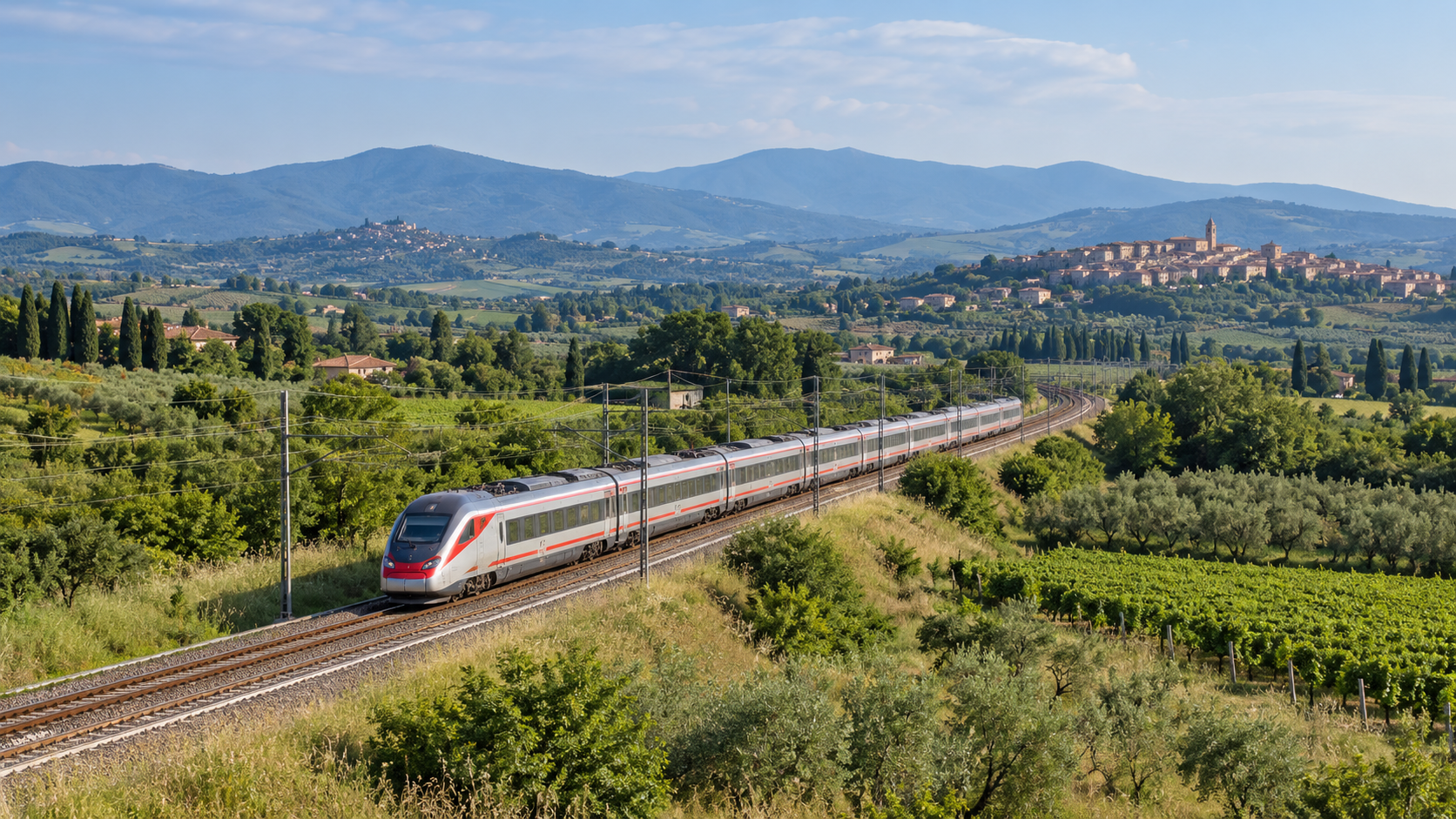
Trains are the simplest backbone for this particular route. Trenitalia’s Frecciarossa network follows the Milan–Bologna–Florence–Rome–Naples–Salerno corridor, and other operators serve parts of it. Compare the actual departure time, arrival station, fare conditions, and total journey before buying. Schedules and fares vary by date. trenitalia.com
Book long intercity legs once your hotel dates are settled, particularly if you want a specific departure or a lower advance fare. Leave room around transfers when changing between operators or connecting to a smaller regional service. Check the ticket rules for each train rather than assuming all Italian tickets work alike; Trenitalia publishes separate guidance for its Digital Regional Ticket. trenitalia.com
I would not rent a car for Milan, Bologna, Florence, Rome, and Naples. A car becomes useful for a focused countryside segment, such as several nights among Tuscan villages, or for smaller southern towns with limited connections. Arrange that segment separately instead of paying to park a car during city stays. Read Driving in Italy before booking one.
If you want to continue farther south
Puglia: Add at least four or five nights rather than attempting a single side trip from Naples. Bari and Lecce can serve as rail bases, while smaller inland towns and some beaches take more effort without a car. This is a distinct southeastern branch of the journey; compare routes and travel days before adding it.
Calabria: Continue down the western side if you want the mainland journey itself to be the focus. Pick a small number of bases and check the final connection to each beach or hill town. Train access along a main line does not mean every nearby village is easy to reach.
Sicily: Allow at least another week if you want more than an arrival and departure city. Mainland Intercity and night services reach Sicily, but crossing the strait and traveling around the island add time. Flying south can also be sensible when your vacation days are limited. Trenitalia
Sardinia: Plan it as a separate island extension, usually reached by air or ferry. It does not fall naturally on this mainland rail route. Italia Mia’s Puglia, Sicily, or Sardinia comparison is useful when choosing where to spend an extra week.
Which stops should you change?
Choose Venice instead of Milan if this may be your only chance to see it. Give Florence an extra night if art or Tuscan day trips matter most. Give Rome more time if you have never visited. Keep Naples if you want a fuller picture of southern urban life; extend your coastal stay if rest and sea views are the purpose of the trip.
I would make those choices before booking hotels. North to south works best when it gives each place enough time to feel different. The route is a framework: follow the rail line for easy travel, then spend your extra days in the region that most interests you.
External Sources
Trenitalia: Frecciarossa routes
Trenitalia: Intercity routes
Trenitalia: Digital Regional Ticket
Trenitalia: Reaching Sicily by train


![Sicily Map [Italy] (National Geographic Adventure Map, 3310)](https://m.media-amazon.com/images/I/51BgDnbdeaL._SS500_.jpg)