
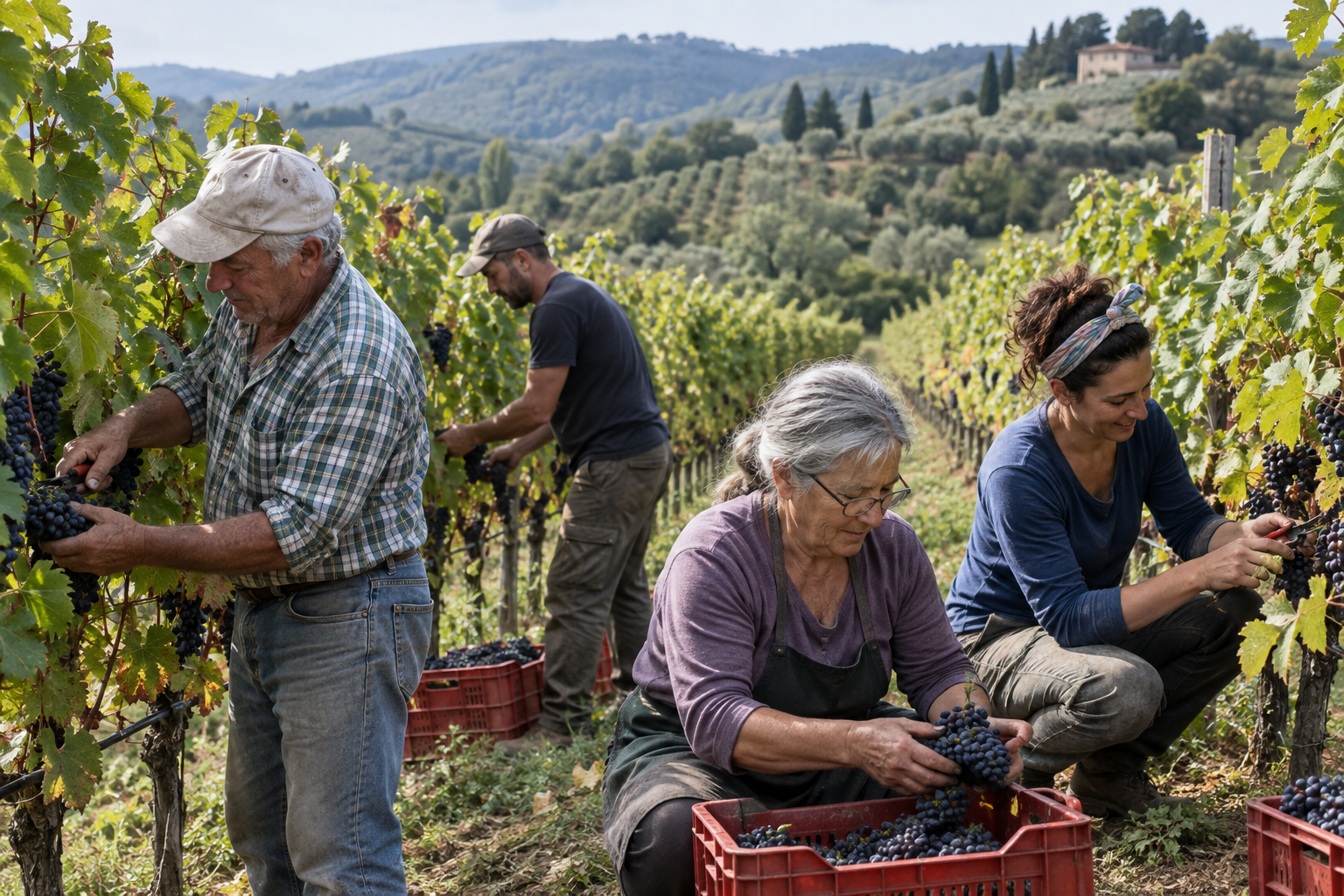
 Vendemmia is one of the most important moments in Italy’s agricultural calendar. Vineyards become working landscapes filled with pickers, tractors, crates of grapes and the aroma of freshly pressed must. In many wine regions, the harvest is also marked by shared meals, local festivals and special winery events.
For travelers, vendemmia can be a memorable time to visit the Italian countryside. However, it is a real agricultural operation rather than a performance arranged for tourists. Harvest dates depend on the weather, grape variety, altitude and type of wine being produced, and visitors should never assume they can enter a vineyard or begin picking without permission.
What Does Vendemmia Mean?
The Italian word vendemmia refers specifically to the grape harvest, as well as the period during which grapes are collected. Its roots lie in the Latin word vindemia, associated with taking or gathering grapes for wine. The Treccani Italian dictionary’s definition of vendemmia also includes the quantity of grapes gathered during a particular harvest.
In everyday conversation, Italians may say:
- È tempo di vendemmia — It is harvest time.
- Fare la vendemmia — To take part in the grape harvest.
- Annata — The vintage or growing year.
- Millesimo — The harvest year shown on a wine label.
- Mosto — Freshly pressed grape juice before or during fermentation.
- Cantina — A winery, wine cellar or wine-producing business.
Vendemmia is the culmination of an entire year’s work. Pruning, flowering, fruit development, vineyard management and weather conditions all influence what finally arrives at the winery.
When Is the Grape Harvest in Italy?
Most Italian wine grapes are harvested between late August and October, but there is no single national harvest date.
Grapes intended for sparkling wines and some early-ripening white varieties are often collected first. Sangiovese, Nebbiolo, Aglianico and other later-ripening grapes may remain on the vines until late September, October or, in particular conditions, even later.
A general harvest calendar looks like this:
| Approximate period | What may be happening |
|---|---|
| Late August to early September | Early white grapes and grapes for sparkling-wine bases; harvesting in warmer areas |
| September | A major harvest month across northern and central Italy |
| Late September to October | Many important red varieties, including Sangiovese and Nebbiolo |
| Late October and occasionally November | Late-ripening grapes, selected southern vineyards and some sweet or late-harvest wines |
These dates are only a guide. Winemakers examine sugar, acidity, flavor development, grape health and the weather forecast before choosing when to pick. Different plots belonging to the same winery may be harvested several weeks apart.
Warmer summers have also caused some Italian harvests to begin earlier than they once did. The annual Cantine Aperte in Vendemmia program follows the active harvest from the earliest grapes used for whites and sparkling wines to later harvests in southern Italy.
For travelers hoping to see active harvesting, the second half of September usually provides the broadest range of possibilities. Anyone interested in Nebbiolo, Etna wines or Aglianico may have better luck later, but the winery should always confirm what is likely to be happening.
What Happens During an Italian Vendemmia?
Deciding When to Pick
The romantic image of a family suddenly deciding that the grapes look ready is largely outdated. Professional growers test the fruit repeatedly and consider:
- Sugar and potential alcohol
- Acidity
- Tannin and skin maturity
- Aroma development
- Weather forecasts
- Vineyard elevation and exposure
- The style of wine being produced
Grapes for sparkling wine are generally picked with higher acidity than fruit intended for a rich, full-bodied red. Grapes destined for sweet wines may follow an entirely different schedule.
Picking the Grapes
Hand harvesting remains essential in vineyards that are steep, terraced, difficult to reach or planted with varieties requiring careful selection. Pickers cut individual bunches and place them in crates or small containers to reduce crushing before the fruit reaches the winery.
Mechanical harvesting is common in vineyards whose terrain and vine-training systems permit it. A machine can cover large areas quickly, which is valuable when rain is approaching or grapes must be collected during a narrow window.
Manual harvesting should not automatically be treated as superior in every situation. Speed, temperature control, vineyard conditions and careful handling all influence quality.
Sorting and Transporting the Fruit
Harvested grapes must reach the winery quickly and in good condition. They may be sorted in the vineyard, again at the winery or both.
Damaged, underripe or unhealthy fruit can be removed. Some wineries use refrigerated transport or collect grapes during the cooler morning hours to preserve freshness.
Destemming, Crushing and Pressing
At the winery, grapes may be separated from their stems, gently crushed or sent directly to a press, depending on the wine.
White grapes are generally pressed before fermentation so that the juice can be separated from the skins. Red grapes commonly ferment with their skins, which contribute color, tannin and flavor.
Traditional foot-stomping, or pigiatura con i piedi, survives mainly as a symbolic or educational harvest activity. Modern commercial wineries normally use hygienic mechanical equipment designed to crush or press grapes with greater control.
Fermentation Begins
Once yeasts begin converting grape sugars into alcohol, the cellar becomes intensely active. Tanks must be monitored, temperatures controlled and fermentations checked.
Visitors may smell fresh must and fermentation during a harvest tour, but production areas can contain machinery, wet floors, hoses and naturally produced carbon dioxide. Restricted cellar areas should be entered only with winery staff.
Italian Grape Harvest Traditions
A Communal Occasion
Historically, vendemmia brought together extended families, neighbors and seasonal workers. Several generations might spend the day cutting grapes before sharing a substantial meal.
Commercial wineries now depend heavily on trained employees and professional seasonal labor. Nevertheless, the idea of vendemmia as a communal event remains strong, especially on smaller family estates.
The Harvest Meal
Food is an important part of harvest day because picking begins early and involves physical work. The meal varies by region and family but may include bread, cheese, cured meats, pasta, roasted meat, seasonal fruit and the estate’s own wine.
In Tuscany, schiacciata con l’uva is closely associated with harvest season. This slightly sweet bread is baked with wine grapes, sugar and olive oil. Seeds are traditionally left inside the grapes, giving the finished bread a distinctive texture.
Piedmontese harvest events may feature local cheeses, salumi, hazelnuts, bagna cauda and amaretti. In southern Italy, the meal may be accompanied by regional breads, vegetables, cheeses and dishes prepared with local olive oil.
Grape-Stomping and Harvest Festivals
Foot-stomping appears at some educational harvest days, family events and grape festivals. It is enjoyable and photogenic, but visitors should understand that it is usually a reenactment rather than the winery’s principal production method.
Many towns also organize a festa dell’uva or sagra dell’uva. These celebrations may include decorated carts, music, parades, food stands and tastings. Dates change annually, and a grape festival may take place after the actual picking in nearby vineyards.
The First Wine
Vendemmia does not end when the final bunch leaves the vineyard. Fermentation, pressing, clarification and cellar work continue for weeks.
The young wine may later be celebrated around November, when the Italian proverb A San Martino ogni mosto diventa vino—“By Saint Martin’s Day, every must becomes wine”—marks the symbolic transition from grape juice to new wine.
Italy’s Major Vendemmia Regions
Piedmont: Langhe, Roero and Monferrato
Piedmont offers one of Italy’s most atmospheric autumn wine experiences. The hills around Alba, Barolo, Barbaresco, Asti and Monferrato produce Nebbiolo, Barbera, Dolcetto and Moscato.
Nebbiolo is normally among the later important varieties to be picked. This can extend the feeling of harvest season into October, when the Alba area is also entering white-truffle season.
The vineyard landscape of Langhe-Roero and Monferrato has been recognized by UNESCO for its centuries-old relationship between native grapes, soils, villages, cellars and winemaking knowledge. Italia Mia’s guide to the Langhe wine and food region introduces the area’s principal villages and traditions.
Good bases include Alba, La Morra, Barolo and Asti. Winery reservations are essential, especially during harvest and truffle season.
Tuscany: Chianti, Montalcino and Montepulciano
Tuscany is the classic destination for travelers dreaming of cypress-lined roads, stone farmhouses and Sangiovese vineyards.
The best-known wine areas include:
- Chianti and Chianti Classico
- Montalcino, home of Brunello di Montalcino
- Montepulciano, associated with Vino Nobile di Montepulciano
- San Gimignano, known for Vernaccia
- Bolgheri and the Tuscan coast
- Montecucco and the Maremma
Sangiovese is generally harvested from September into October, depending on the location and vintage. Harvest experiences may combine grape picking, a cellar visit, lunch and a tasting, while family-oriented events sometimes include symbolic foot-stomping.
The official Visit Tuscany wine itinerary connects Montalcino, Montepulciano and Greve in Chianti. The Italia Mia guide to the best places to visit in Tuscany can help travelers combine wine country with historic towns.
Veneto and Friuli-Venezia Giulia
Veneto offers several very different harvest landscapes. The steep Prosecco hills around Conegliano and Valdobbiadene contrast with the vineyards of Valpolicella, Soave and the area around Lake Garda.
UNESCO describes the Prosecco Hills of Conegliano and Valdobbiadene as a landscape of steep slopes, narrow grassy terraces called ciglioni, forests and villages. Manual vineyard work remains important because of the difficult terrain.
Valpolicella is associated with Corvina and other grapes used for Valpolicella and Amarone. Grapes intended for Amarone are carefully harvested and later dried before fermentation.
Farther east, Friuli-Venezia Giulia is particularly rewarding for white-wine enthusiasts. Friulano, Ribolla Gialla, Malvasia and international varieties grow around the Collio, Colli Orientali and Carso areas.
Read more about the region of Veneto and Friuli-Venezia Giulia before selecting a base.
Lombardy, Trentino-Alto Adige and Emilia-Romagna
Franciacorta in Lombardy produces traditional-method sparkling wine from grapes commonly harvested relatively early to retain acidity. Oltrepò Pavese is another important Lombard wine area, particularly for Pinot Nero.
Trentino-Alto Adige combines high-altitude vineyards, dramatic temperature variations and varieties including Pinot Grigio, Gewürztraminer, Chardonnay, Schiava and Lagrein. Vineyard conditions can change significantly with elevation.
Emilia-Romagna provides a more informal harvest atmosphere. Lambrusco country around Modena and Reggio Emilia, together with the Sangiovese vineyards of Romagna, is well suited to travelers interested in wine, country cooking and farm hospitality. Italia Mia’s Emilia-Romagna regional guide provides a broader introduction.
Umbria, Marche and Abruzzo
These central regions are excellent alternatives to Tuscany.
Umbria produces Sagrantino around Montefalco, along with Sangiovese, Grechetto and Orvieto wines. Marche is known for Verdicchio, Rosso Conero and Rosso Piceno, while Abruzzo is associated with Montepulciano d’Abruzzo, Trebbiano and Cerasuolo.
Wine estates here can feel less crowded than those in the best-known parts of Tuscany. Perugia, Assisi, Spoleto, Ancona and Pescara can serve as gateways, but many wineries require a car or arranged transfer.
Campania, Basilicata and Puglia
Southern Italy’s harvest may begin early in warm coastal vineyards while continuing much later for particular varieties and higher-altitude sites.
Campania produces Fiano, Greco, Falanghina and Aglianico. The Aglianico used for Taurasi is a late-ripening grape, as is the Aglianico del Vulture grown on volcanic terrain in Basilicata.
Puglia’s harvest includes Primitivo, Negroamaro, Nero di Troia and several white varieties. Travelers can combine winery visits with masserie—historic rural estates—and the towns described in the Italia Mia guide to Puglia.
Sicily and Sardinia
Sicily can offer an unusually long and varied harvest. Warm areas may begin early, while elevated vineyards on Mount Etna can ripen considerably later. Important grapes include Nero d’Avola, Nerello Mascalese, Carricante, Grillo, Catarratto and Frappato.
On Pantelleria, Zibibbo grapes are cultivated using low, head-trained bush vines adapted to wind and dry conditions. UNESCO recognizes this traditional vite ad alberello cultivation practice as intangible cultural heritage.
Sardinia’s principal varieties include Cannonau, Vermentino, Carignano and Monica. Vineyard experiences may be combined with archaeological sites, mountain landscapes and coastal travel.
The Italia Mia guide to Sicilian culture and traditions provides additional context for an island itinerary.
Vendemmia Experiences Available to Visitors
An organized harvest experience may include:
- A guided walk through the vineyard
- An explanation of grape maturity and harvesting
- Supervised picking
- Transporting a small crate of grapes
- A demonstration of sorting, destemming or pressing
- Traditional foot-stomping
- A cellar tour
- Tasting finished wines from earlier vintages
- Lunch, a picnic or a harvest snack
- Activities designed for children
- Music or a local harvest celebration
Read the description carefully. A “vendemmia experience” may be a full participatory day, a two-hour winery visit or simply a tasting offered during harvest season.
Movimento Turismo del Vino organizes the recurring Cantine Aperte in Vendemmia program through participating wineries across several regions. Individual estates and regional wine-tourism associations publish their own dates and reservation procedures.
How to Book an Authentic Harvest Experience
Contact the winery directly and ask:
- Will harvesting actually be taking place during the visit?
- Can guests pick grapes, or is the experience observation only?
- Is the program available in English?
- How long does it last?
- Are a tasting and meal included?
- Is the activity suitable for children?
- Can the winery accommodate mobility limitations?
- What happens if it rains?
- Is transportation available?
- What shoes and clothing are recommended?
A winery cannot guarantee the exact harvest schedule months in advance. Grapes may need to be picked earlier than expected, or rain may postpone the work. Choose an experience that remains worthwhile even if the program changes to a cellar tour, tasting or meal.
Staying on a working farm can provide closer contact with rural life. The Italia Mia guide to choosing an agriturismo explains how farm stays differ from hotels and vacation rentals.
Practical Advice for Vendemmia Travelers
Reserve Early
September and early October are popular for food and wine travel. Small agriturismi and vineyard accommodations may have limited availability, particularly in Chianti, Montalcino, the Langhe and around Etna.
Wear Practical Clothing
Bring closed-toe shoes with good grip, comfortable clothing, sun protection and a light waterproof layer. Vineyards can be muddy after rain, and mornings may be much cooler than afternoons.
Avoid delicate clothing and strong perfume. Perfume can interfere with wine tasting, while grape juice and vineyard soil can stain fabrics.
Plan Transportation Before Tasting
Many wineries are outside towns and cannot be reached easily by public transportation. Rural taxis may require advance reservations.
If driving, one person should abstain from alcohol. Otherwise, arrange a private driver, transfer or organized excursion. Review the Italia Mia driving guide covering ZTL zones, tolls and parking before renting a car.
Travelers who prefer not to drive can stay in a regional center and book a winery excursion with transportation. The guide to traveling in Italy without a car explains which areas work well as public-transportation bases.
Respect the Working Vineyard
Do not cut or taste grapes without permission. Harvest crews work quickly, and visitors should follow instructions, remain clear of machinery and supervise children closely.
Photography is normally welcome in visitor areas, but ask before photographing workers at close range or entering production spaces.
Learn a Little Before You Go
Some links in this article are affiliate links. Italia Mia may earn a commission if you make a purchase or booking, at no additional cost to you.
A current Italian wine guidebook can help travelers recognize regional grape varieties, wine classifications and appellations during tastings.
Is Vendemmia Worth Planning a Trip Around?
Vendemmia is worth experiencing when you are interested in the work behind Italian wine rather than only the finished bottle. The countryside is active, restaurants begin serving autumn dishes, and visitors can observe a part of rural life that is invisible during the rest of the year.
The best approach is to choose a region based on the wines and landscapes that interest you, reserve an organized winery experience and keep the schedule flexible. Harvest timing belongs to the grapes and the weather—not to a tourist calendar.
Frequently Asked Questions
What is the best month to experience vendemmia in Italy?
September offers the broadest likelihood of active harvesting somewhere in Italy. Early varieties may be picked in late August, while Nebbiolo, Aglianico and grapes in cooler or higher locations may continue into October.
Can tourists help pick grapes in Italy?
Yes, but only during an organized experience that explicitly includes supervised picking. Visitors should never arrive at a working vineyard expecting to participate without prior permission.
Do wineries remain open for tastings during harvest?
Many do, but schedules may be reduced because the staff is occupied in the vineyard and cellar. Reservations are particularly important during vendemmia.
Is grape-stomping still used to make Italian wine?
It is not a normal production method at modern commercial wineries. Foot-stomping survives primarily as a traditional demonstration, educational activity or festival experience.
Are harvest activities suitable for children?
Some wineries organize family-oriented vendemmia didattica activities with grape picking, juice, games and simplified explanations. Age restrictions and supervision requirements vary, so parents should confirm before booking.
Can a harvest experience be canceled because of rain?
Yes. Rain can postpone picking and make vineyard paths unsafe. Ask about cancellation, refunds and alternative indoor activities before reserving.
External Sources
- Treccani definition and usage of vendemmia
- Movimento Turismo del Vino and Cantine Aperte in Vendemmia
- Visit Tuscany wine itinerary
- UNESCO Vineyard Landscape of Piedmont: Langhe-Roero and Monferrato
- UNESCO Prosecco Hills of Conegliano and Valdobbiadene
- UNESCO traditional vine cultivation on Pantelleria