
At an Italian funeral in Tampa’s Ybor City, the procession sometimes stopped twice. The first stop was the house of the person who had died. The second was the Italian Club, where the flags of Italy and the United States flew at half-mast. A stranger watching from the sidewalk could have understood the farewell at the family home. To understand the stop at the club, it helped to know who had paid for the burial.
L’Unione Italiana, founded in 1894, helped members through sickness and contributed to the funeral expenses of those who died. Across the United States, Italian immigrants made similar arrangements with their neighbors. In New Orleans, societies helped newcomers find work. In Boston, fishermen from one Sicilian port organized a feast their descendants still carry through the streets. Each city kept a different kind of record of what one family could ask of another.
The name of a town opened doors in New Orleans
On June 19, 1887, immigrants from Cefalù, on Sicily’s northern coast, founded the Società Italiana di Mutua Beneficenza Cefalutana in New Orleans. Its name told a newcomer two things worth knowing. Mutua beneficenza meant that members undertook to help one another. Cefalutana identified the people who had made that promise. Someone newly arrived from Cefalù could look for the society by the name of the hometown just left behind.
The choice of a single town made sense in a port with several Sicilian communities. As Italia Mia’s account of why Italians came to America and where they settled explains, an address supplied by a relative could bring people from the same Italian town to the same American street. A hometown society extended the circle of people a newcomer could approach beyond the relatives at that first address.
A historical study of New Orleans in Studi Emigrazione lists job referrals among the services Italian societies offered there. The distinction between finding a job and finding someone who knew of a job mattered to an immigrant learning English. A member already familiar with local employers could pass along word of an opening. For someone arriving without family, the association offered a place to begin asking. The same study records medical assistance and help during illness. Finding work solved one household problem. Keeping food on the table when the wage earner fell sick was another.
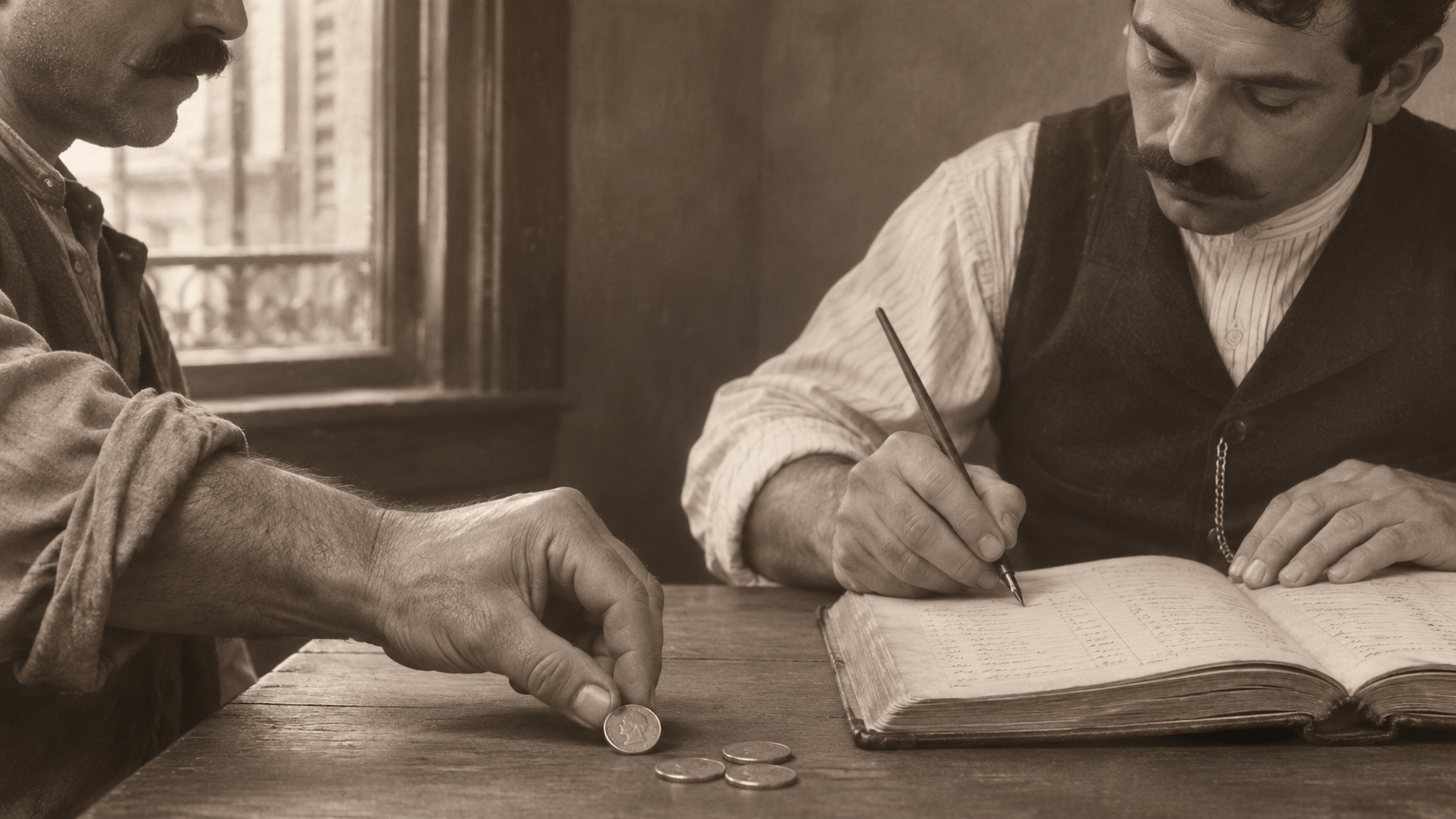
The Cefalutana society’s own history recalls members helping one another with language difficulties as well as money. Its first officers included a treasurer, Salvatore Glorioso, and a financial secretary, Salvatore Messina. Those two names are a small but telling detail. Families trusting the society with their contributions had entrusted specific neighbors with keeping the accounts.
What a funeral benefit bought in Tampa
Some of the Italians who settled in Tampa came by way of New Orleans. In Ybor City, L’Unione Italiana offered assistance during illness, money for the families of deceased members, and opportunities to study at night. Its records, preserved by the University of South Florida, put education alongside the society’s other responsibilities. The same organization could help an adult continue learning after work and help that worker’s family meet a sudden expense.
In 1896 the club bought land for a cemetery from the Armwoods, a prominent African American family in Tampa. Buying the land gave the burial benefit a permanent address. Families had somewhere to visit after the mourners went home. The cemetery also contains a parcel belonging to another mutual aid society, a reminder that even within one neighborhood an Italian family might have belonged to a different association from the family next door.
Hundreds of people sometimes walked in the funeral processions. The surviving account on Florida’s historical marker gives no sum for the benefit a particular widow received. What it does preserve is the route. The neighbors who walked from the house to the club made visible a relationship that usually surfaced in quieter circumstances, when someone paid dues or a family asked for help. For a child or grandchild retracing that route today, the clubhouse belongs on the family map alongside the home and the grave.
How a dance helped pay the bills
In New Orleans, allegiance to a particular Sicilian town still left room to share a building. In 1908 the Cefalutana society joined other Italian organizations to form the Italian Hall Association. Four years later the association bought 1020 Esplanade Avenue. Several societies could now meet under one roof while keeping their own names and memberships.
The Cefalutana society remembers parties and dances at the hall that raised money for people in need. That detail explains how two apparently different activities ended up on the same calendar. A family could spend an evening dancing and help another household pay its bills through the same event. The hall gave members somewhere to gather in good times, when it was easier to raise money than on the day a neighbor needed it.
The society also kept a date of its own. In Cefalù, August 6 is the feast of Gesù Salvatore. In New Orleans the society observes it on the nearest Sunday, with Mass and a banquet. Families on opposite sides of the Atlantic can recognize the occasion even though they celebrate it differently. Burial in the society mausoleum and the annual feast remain among the purposes the organization identifies today.
The fishermen who brought Sciacca to Boston
In Boston’s North End, another Sicilian hometown set the calendar. Fishermen from Sciacca brought their devotion to the Madonna del Soccorso, Our Lady of Help, and began celebrating the Fisherman’s Feast in 1910. The blessing of the fishing waters makes particular sense once you know who established it. The harbor was where these families earned a living and where they had reason to fear for someone they loved.
A century later, the work of putting on the feast still fell to recognizable people. In 2013, Kenny Palazzolo told The Boston Globe that he devoted two weeks away from work each August to organizing it. His great-grandfather had come from Sciacca in the 1930s, joining a neighborhood where the feast was already underway. A family could arrive after the founding generation and, within a few generations of its own, take responsibility for keeping the celebration going.
Visitors know the feast for its closing Flight of the Angel. For relatives who have moved away, the occasion also answers a more ordinary question. When will everyone be back in the old neighborhood at the same time? A fixed weekend, a familiar street and a procession that follows a family’s own devotion give people an answer they can pass on to their children.
That helps explain why a feast can outlast the working neighborhood that created it. The need for a first job passes. The society’s contribution to a funeral may survive only as an entry in its accounts. A procession returns every year, giving descendants another chance to ask who carried the statue before them. In Boston the answer leads back to fishermen from Sciacca. At a cemetery in Tampa or a banquet in New Orleans, the same question leads to other families and the obligations they chose to share.
External Links
Books at Amazon
As an Amazon Associate, Italia Mia earns from qualifying purchases.
- The Madonna of 115th Street, by Robert A. Orsi. For readers drawn to the Boston feast, Orsi follows a different Madonna through Italian Harlem and explores what the annual celebration meant inside family homes.
- Immigrant Women in the Land of Dollars, by Elizabeth Ewen. Ewen looks at work and family life among Italian and Jewish women on New York’s Lower East Side, bringing household experiences into a history often told through male club officers.
Society histories and archives
- Società Cefalutana of New Orleans — founding officers, Italian Hall and the feast of Gesù Salvatore
- Studi Emigrazione — historical research on immigrant associations and job referrals in New Orleans
- University of South Florida — L’Unione Italiana records
- Florida Division of Historical Resources — Italian Club Cemetery
- Boston Fisherman’s Feast — the organizers’ history
- The Boston Globe — North End families recall the Fisherman’s Feast