
On November 7, 1933, a New Yorker voting for Fiorello La Guardia had a choice to make even after settling on a candidate. His name appeared on two ballot lines, Republican and City Fusion. More than 446,000 people chose the Republican line. Another 421,000 chose Fusion. Either group on its own would have lost to the incumbent mayor. Together they sent the son of a musician from Foggia and a Jewish woman from Trieste to City Hall.
It was an unusually candid piece of electoral arithmetic. New Yorkers could agree on whom they wanted to run the city while disagreeing about which party deserved their vote. La Guardia had spent much of his life among people who resisted easy classification, starting with his own family. Now he had twelve years to show what such an alliance could do.
From Greenwich Village to the other side of Ellis Island
Fiorello Henry La Guardia was born in Greenwich Village in 1882. His parents had arrived two years earlier. His father, Achille, came from Foggia in Puglia. His mother, Irene Coen, grew up in Trieste, an Adriatic port then ruled by Austria-Hungary. The couple raised their children in the Episcopal Church. An Italian surname told a New Yorker something about Fiorello, but it would have taken a fairly long conversation to get the rest right.
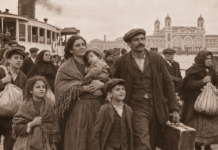
Even his childhood followed an unexpected route. Achille served as a bandmaster in the United States Army, and Fiorello went to school in Prescott, Arizona. After Achille left the service, the family moved to Trieste. By his early twenties Fiorello was working for the American consular service in Fiume, today Rijeka in Croatia. He encountered emigrants on the European side of the Atlantic before taking a job on the American side as an interpreter at Ellis Island.
Between 1907 and 1910, while he studied law, La Guardia helped immigration officials and arriving passengers understand one another. For families following a relative to an unfamiliar city, a name and a street address could be their most valuable possessions. Italia Mia’s account of why Italians came to America and where they settled traces how those addresses drew people from the same Italian town to the same American block. La Guardia saw what happened one step earlier, when someone still had to explain to an inspector who was waiting there.
What an East Harlem Republican sounded like
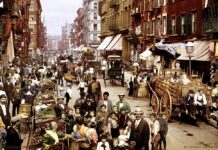
Italian New York extended well beyond Mulberry Street. One of its largest communities lived uptown in East Harlem, where La Guardia built a political base. The neighborhood belongs alongside the downtown, Bronx and Brooklyn communities in the story of New York’s Little Italys. Its history also poses a question that a tour of shops and churches can miss. Once immigrant families had the vote, who could speak for them?
Tammany Hall, Manhattan’s Democratic organization, had a persuasive answer. Its district leaders knew which family needed a job and which official might listen. A favor could earn years of loyalty. The arrangement also gave the people who distributed jobs and access considerable power over their neighbors. An opposition candidate promising honest government had to explain how a working family would get help once its district leader lost influence.
La Guardia’s record in Congress gave voters something to judge. First elected in 1916, he later represented East Harlem, winning most often as a Republican and once on an American Labor ticket. In 1932 he helped carry the Norris–La Guardia Act, which restricted federal judges’ power to issue injunctions in labor disputes. A worker who had seen a strike stopped by court order had a concrete reason to remember his name. So did Italian American veterans who knew that, during the First World War, he had taken leave from Congress to fly on the Italian front.
The three-way race that opened City Hall
La Guardia had already tried to become mayor in 1929. Jimmy Walker beat him easily. Four years later, Walker had resigned amid a corruption investigation, the Depression had put thousands of households in need of relief, and the Democrats could no longer agree on a candidate. Incumbent John P. O’Brien had the regular organization behind him. Joseph V. McKee, a former acting mayor, ran on the Recovery ticket. A voter angry with Tammany now had more than one place to go.
The Fusion campaign gave civic reformers and independent voters a way to support La Guardia without joining the Republican Party. Republicans brought an established ballot line and a citywide organization. In East Harlem, La Guardia’s ally Vito Marcantonio appealed directly to Italian American voters, challenging the insinuation that an Italian name made a candidate less American. On the same Fusion ticket, Bernard S. Deutsch, president of the American Jewish Congress, ran successfully for president of the Board of Aldermen.
Neither Italians nor Jews voted as a bloc. Historian Ronald Bayor’s estimates put La Guardia’s share among Italian voters at roughly three in five, compared with a little over one in three among Jewish voters. Those figures are reconstructions from voting patterns. No ballot recorded a voter’s ancestry. They do, however, explain why it took both an energetic neighborhood campaign and a divided opposition to win. La Guardia finished first with about 40 percent of the citywide vote. Most New Yorkers had marked somebody else’s name.
What the New Deal looked like under the Park Avenue tracks
Taking office in January 1934, La Guardia needed money from Washington to put New Yorkers back to work. His congressional experience proved valuable. A Republican mayor could work with Franklin D. Roosevelt’s Democratic administration, and a city with projects ready to build could make a strong claim on federal relief funds. New Yorkers saw the results in swimming pools, playgrounds, bridges and the municipal airport in Queens that eventually took his name.
For a closer look at his idea of government, go back to East Harlem. In 1936 the city opened the Park Avenue Retail Market beneath the elevated railroad tracks. Vendors who had sold from pushcarts could rent a stall under cover. Shoppers could buy vegetables or fish out of the rain. City inspectors gained a fixed address to visit. From City Hall, each part of that arrangement looked like progress.
A pushcart merchant had a different calculation to make. A cart could follow the customers. A stall obliged customers to find the merchant, and rent came due whether business was good or bad. Some vendors booed La Guardia at the opening. There is room in the history of the market for their verdict, too. Later, Puerto Rican merchants and shoppers made the place their own. The name by which New Yorkers know it today, La Marqueta, belongs to that next chapter.
A mayor on the family radio
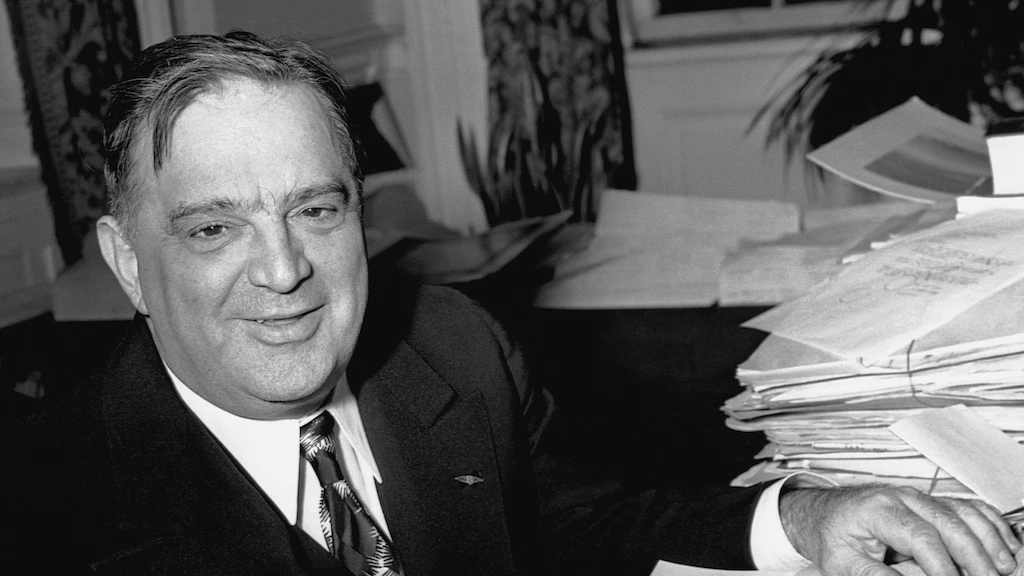
One of the best photographs of La Guardia shows him seated at a WNYC microphone. The subject of this particular broadcast was Grade A milk. It is hard to imagine a district boss summoning the whole city to discuss what went into a family’s milk bottle. La Guardia regarded a municipal radio station as precisely the place for such a conversation. In July 1945, when a newspaper delivery strike interrupted the Sunday funnies, he famously used the microphone to read the comics aloud.
The broadcasts help explain the affection behind his nickname, the Little Flower, a translation of Fiorello. They also capture an important change in the relationship between a New Yorker and City Hall. A family once accustomed to hearing about city business from a neighborhood intermediary could now hear the mayor in its own kitchen, explaining himself in a voice nobody was likely to mistake for anyone else’s.
La Guardia left office at the end of 1945 and died in 1947. Millions of travelers have since learned his name from a boarding pass. The better place to understand his mayoralty may be under the tracks on Park Avenue. There, within walking distance of his old constituents, New Yorkers can still see the result of a decision he made, understand why some neighbors objected, and buy groceries in a market another generation of immigrants helped keep alive.
External Links
- New York City Municipal Archives — Guide to the records of Mayor Fiorello H. La Guardia
- U.S. House of Representatives — Fiorello Henry La Guardia
- Ronald H. Bayor — Neighbors in Conflict, including estimates for the 1933 election
- Simone Cinotto — The Italian American Table, on neighborhood markets and their vendors
- Library of Congress — Fred Palumbo’s photograph of La Guardia at the WNYC microphone