

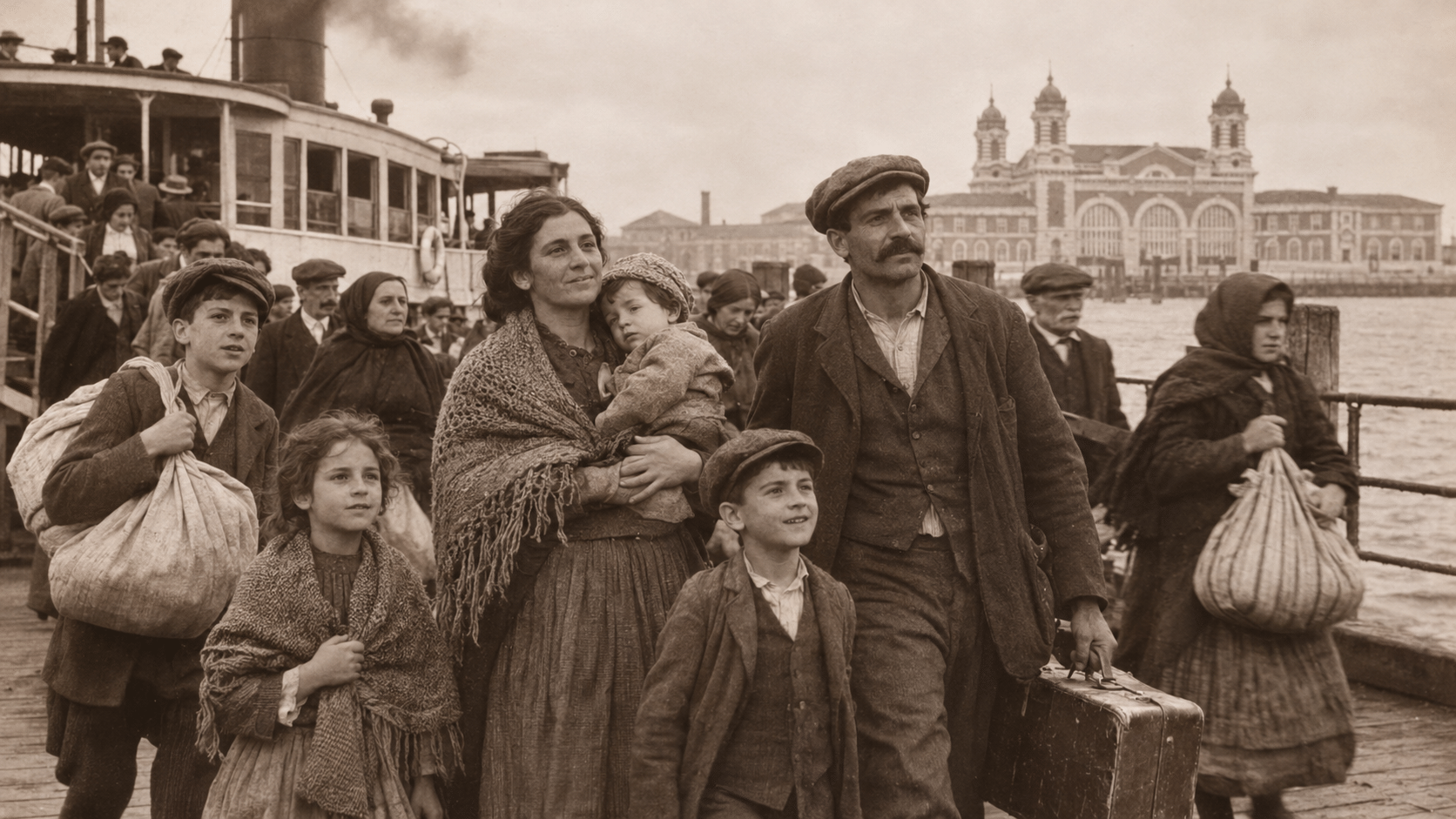
A passenger list can tell you that an Italian immigrant landed in New York. The address beside the name may tell you more about where that person intended to go. It might belong to a brother in Manhattan, a cousin in Philadelphia or a neighbor from the same village who had found work in Pennsylvania. Those addresses help explain how people from one Italian town could end up living on the same American street, thousands of miles from home.
The largest wave of Italian immigration to the United States unfolded from the 1880s through the early 1920s. Smaller migrations came before and after it, including a substantial postwar movement. Across these decades, the decision to leave and the choice of destination often came down to different things. Work and family finances could make leaving Italy worthwhile. Knowing someone in America could make a particular town, neighborhood or job possible.
Why Italians Left Italy
Italy’s unification in the nineteenth century brought much of the peninsula under one government, but economic conditions varied widely. In many rural districts, families depended on seasonal agricultural work, rented land or plots that yielded too little to support everyone. A poor harvest, debts or a stretch without wages could turn a difficult year into a household crisis. Earnings abroad could cover expenses at home, help repay debts or give a family a chance to buy land.
During the peak years, many U.S.-bound migrants came from southern mainland regions such as Campania, Calabria and Basilicata, and from Sicily. Northern and central Italians also emigrated, and the mix of origins varied by decade and destination. Local circumstances mattered. The 1908 earthquake that devastated Messina and Reggio Calabria, for example, displaced people on both sides of the Strait of Messina and prompted some to leave for the United States.
American employers needed labor for construction, railroads, factories, mines and agriculture. Steamship routes made the crossing more regular, while letters from people already abroad brought news about wages and jobs. The United States was one of several destinations. Other Italians went to Argentina, Brazil or elsewhere in Europe, often along routes established by people from their own districts. For the wider picture, see Italians in the World.
The Major Waves of Italian Immigration to America
Before the 1880s, migration was smaller and dispersed. Individual merchants, artisans, political exiles and other migrants arrived before Italian unification and in the decades that followed. Established communities in places such as New Orleans and San Francisco show that Italian life in America was already taking shape ahead of the mass arrivals through New York.
From the 1880s through the early 1920s, migration reached its peak. The Library of Congress estimates that more than four million Italians had come to the United States by 1920. More than two million arrived in the first decade of the twentieth century alone. Many early travelers were men seeking wages, sometimes with a plan to go home after a season or several years. Women also migrated, and spouses, children and other relatives joined earlier arrivals or crossed together. Some people went back to Italy permanently. Others crossed more than once or changed their plans and settled in America.
The quota laws of 1921 and 1924 sharply reduced arrivals. The 1924 law used national-origins quotas that particularly restricted immigration from southern and eastern Europe. For Italian families with members on both sides of the Atlantic, decisions about when to reunite increasingly depended on who could qualify for admission. The U.S. communities built during the peak years continued to grow and change as children born in America came of age and families moved for work or housing.
After World War II, immigration resumed on a smaller scale. Roughly 426,000 Italians arrived from 1946 to 1970, according to research cited in New Italian Migrations to the United States. These arrivals had a visible local impact. In Boston’s North End, for example, newcomers helped sustain the use of Italian and renewed connections with Italy. The 1965 immigration law replaced national-origins quotas with a system emphasizing family relationships and skills. Later migration included students, professionals and other workers, alongside people joining relatives.
How Family and Village Networks Shaped Settlement
Historians call this process chain migration. Imagine a worker who boards with a man from his village and finds a job through him. Once established, he can send home the name of an employer, offer a bed to a younger brother or tell a cousin which ship to take and whom to meet. Each arrival gives the next person more information and someone to call on. A city that means little to people in the next valley can become a familiar destination in one village.
These networks were often built around paesani, people from the same hometown or area. They could help find a room or a job, translate a letter, or introduce a newcomer to a parish or mutual-aid society. In Philadelphia, historians have traced some early Italian associations to particular villages. A neighborhood described from outside as simply Italian could contain separate groups with different dialects, patrons and feast days.
The route could also change after arrival. A worker might spend a few months at a relative’s address, then move to a mill town or take a railroad job. A family might later leave a crowded neighborhood but still return for church, shopping or a patron saint’s feast. The first address, the place of steady employment and the neighborhood later generations remembered could all be different.
Where Italians Settled in the United States
New York and northern New Jersey. New York was a major port of entry, and many Italians stayed in its metropolitan area. Manhattan’s Little Italy became the best-known neighborhood, while Italian communities also grew in East Harlem, Brooklyn, the Bronx and northern New Jersey. Construction, garment work, manufacturing and neighborhood businesses helped support households. A New York arrival on a manifest can also be the opening entry in a family history that continues in another state.
Boston and Philadelphia. Boston’s North End and South Philadelphia became prominent centers of Italian American life. A neighborhood address could put families close to people who spoke a familiar dialect, knew their relatives or could help them get work. Churches, shops and associations gave neighbors reasons to keep returning even after some households moved elsewhere.
Pennsylvania and the industrial Midwest. Italian migrants settled in Pennsylvania coal and industrial towns and in cities such as Chicago and Cleveland. Railroads, mines, mills, factories and construction provided jobs. A report of steady work could draw several people from the same Italian town to a small American community whose name rarely appears in national histories of immigration.
New Orleans and southern Louisiana. Many Sicilians followed routes into Louisiana. Some took agricultural work, including on sugar plantations, while others built livelihoods in trade and food businesses. Produce markets and groceries became especially visible parts of Italian life in New Orleans. Families who passed through New Orleans can leave records in rural Louisiana as well as in the city itself.
San Francisco and California. San Francisco’s North Beach became a center of Italian settlement on the Pacific Coast. Italian immigrants and their descendants also worked in waterfront trades, fishing and agriculture in California. For some families, the American destinations that mattered were a fishing port, an agricultural district or a West Coast city.
How to Trace Your Family’s Route from Italy to America
Start with the earliest U.S. address you can verify. A census entry, marriage record, obituary, city directory or naturalization file can establish where an ancestor lived at a particular time. Compare it with the original passenger manifest if you find one. Depending on the year and form, the manifest may give a last residence, a birthplace, a destination or the name and address of a person the traveler planned to join. Check the column headings, and read both pages if the entry spans a two-page form.
If the record says only “Italy,” look for siblings, cousins, fellow passengers, marriage witnesses or neighbors who turn up repeatedly. A sibling’s naturalization papers may name a town that your direct ancestor’s records omit. A familiar city in family lore may be the departure port or the nearest large city. Italia Mia’s guide to finding your ancestor’s town in Italy explains how to compare those clues and narrow the search to a comune, the municipality where many records were created.
Once you have a likely town, use the guide to Italian civil records to look for birth, marriage and death acts. Compare parents’ names and dates across documents before deciding you have the right person. If civil coverage runs out or you want to investigate sponsors and witnesses, try Italian parish records. For the full process, start with How to Research Your Italian Ancestors.
Record the addresses, names and relationships alongside travel dates. A U.S. marriage witness and a passenger’s contact can turn out to be the same person. When an Italian register places that person in the same village, you have a documented connection between two households and a possible explanation for why the family settled where it did.
Recommended Books on Italian-American History and Genealogy
As an Amazon Associate, Italia Mia earns from qualifying purchases.
- The Italian Americans: A History by Maria Laurino. A broad introduction to Italian immigration and the lives of later generations, including how Italian Americans were portrayed and how they saw themselves. View on Amazon
- From Ellis Island to JFK: New York’s Two Great Waves of Immigration by Nancy Foner. A closer look at how Italian and Jewish immigrants built lives in New York, with a comparison to the city’s later immigration wave. View on Amazon
- The Family Tree Italian Genealogy Guide by Melanie D. Holtz. A practical next step if you’ve found your family in U.S. records and want to continue the search in Italian civil and parish records. View on Amazon
For gift ideas that celebrate Italian-American heritage, browse Show Your Italian American Pride.
External Links
- Library of Congress — Early Arrivals
- Library of Congress — The Great Arrival
- U.S. Department of State, Office of the Historian — The Immigration Act of 1924
- University of Illinois Press — New Italian Migrations to the United States
- 64 Parishes — Italians in Louisiana
- U.S. National Archives — Passenger Arrival Records