

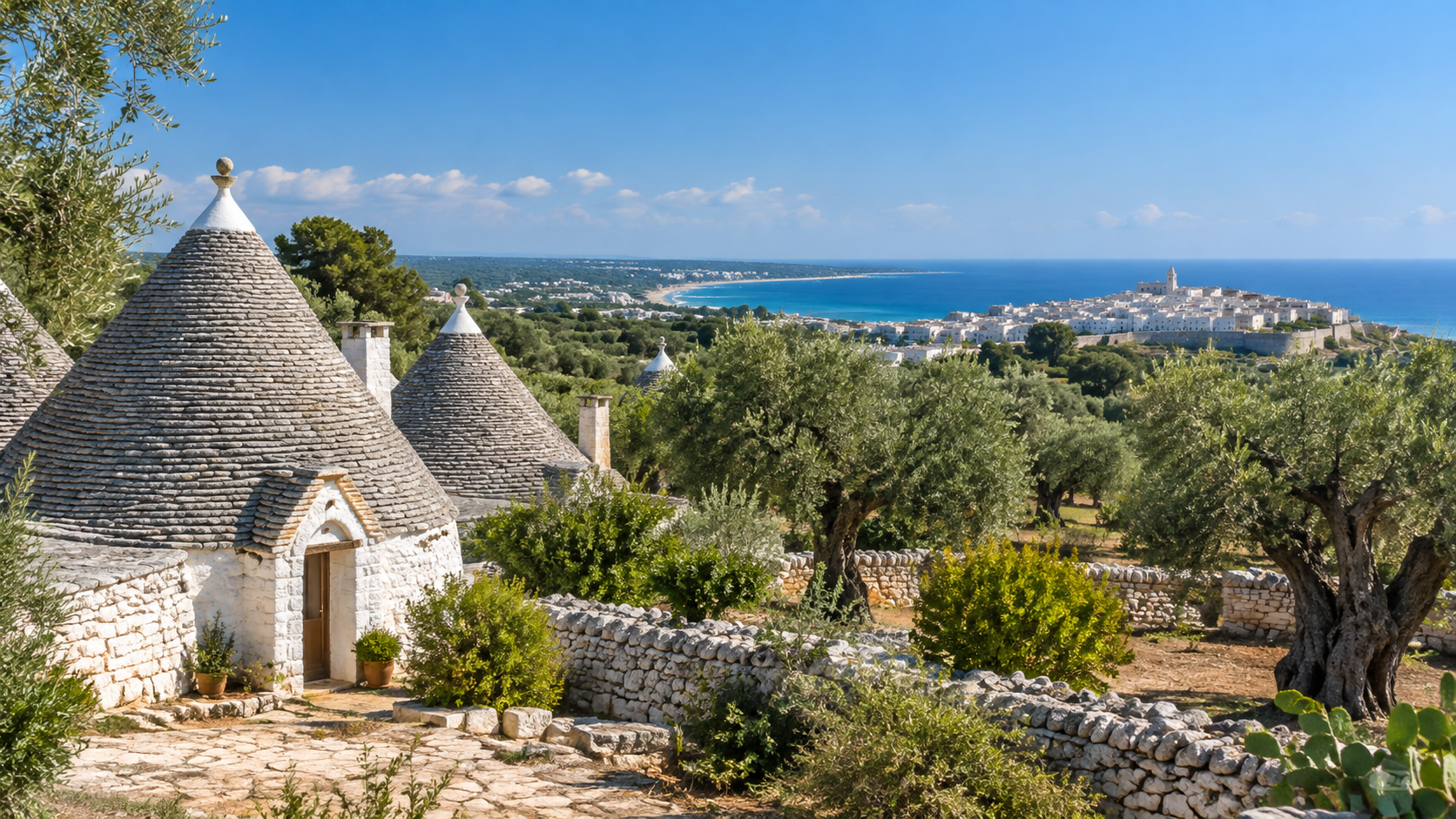
 Puglia—known as Apulia in English—is the long, sun-washed region forming the heel of Italy’s boot. With the Adriatic Sea on one side and the Ionian Sea on the other, it offers an extraordinary mixture of whitewashed towns, ancient olive groves, Baroque cities, traditional masserie and hundreds of kilometers of coastline.
What I find most appealing about Puglia is its variety. In one journey, you can walk through the lively streets of Bari, sleep beneath the conical roof of a trullo, explore a mysterious medieval castle, eat freshly made orecchiette and swim in water that often looks more Caribbean than Mediterranean.
Puglia is no longer the undiscovered corner of southern Italy it once was. Alberobello, Polignano a Mare, Ostuni and parts of Salento can become extremely busy in summer. Yet the region is large enough to reward travelers who slow down, travel outside July and August or explore beyond the most photographed destinations.
For a closer look at individual destinations, see my guide to the best places to visit in Puglia.
Puglia at a Glance
- Regional capital: Bari
- Provinces: Bari, Barletta-Andria-Trani, Brindisi, Foggia, Lecce and Taranto
- Main airports: Bari Karol Wojtyła Airport and Brindisi Salento Airport
- Coastlines: Adriatic Sea and Ionian Sea
- Famous for: Trulli, masserie, olive oil, orecchiette, Baroque architecture and beaches
- Best months to visit: May, June, September and early October
- Recommended stay: At least seven days
- Best transportation: Train for major towns; car for beaches, villages and the countryside
- Good bases: Bari, Monopoli, Ostuni, Lecce, Gallipoli and Vieste
Why Visit Puglia?
Puglia provides a different experience from the familiar route through Rome, Florence and Venice. The region is less about checking famous monuments off a list and more about moving through changing landscapes.
A typical day might begin with coffee in a town square, continue through countryside divided by dry-stone walls and finish with dinner beside a fishing harbor. You can stay in a fortified farmhouse, visit vineyards producing Primitivo and Negroamaro, wander through a medieval village or follow coastal roads overlooking the Adriatic.
Puglia is particularly rewarding for:
- Independent road trips
- Beach vacations
- Food and wine travel
- Historic towns and architecture
- Countryside stays
- Cycling and walking holidays
- Romantic escapes
- Travelers returning to Italy for a less familiar experience
Its size should not be underestimated. The distance from the Gargano Peninsula in northern Puglia to Santa Maria di Leuca at the southern tip of Salento makes it difficult to see the entire region in a short vacation.
If you have one week, I recommend concentrating on central Puglia and Salento. To include Bari, the Valle d’Itria, Lecce, both Salento coasts and the Gargano, allow at least ten days—preferably two weeks.
A Brief History of Puglia
Puglia’s location between western Europe and the eastern Mediterranean has shaped its history for thousands of years.
Greek settlers established important cities along the Ionian coast, especially Taranto, which became one of the leading centers of Magna Graecia. The Romans later developed roads, ports and agricultural estates across the region.
After the fall of Rome, Puglia passed through periods of Byzantine, Lombard, Norman, Swabian, Angevin and Aragonese control. Each civilization left traces in the region’s castles, cathedrals, archaeological sites and fortified towns.
The Normans built some of southern Italy’s finest Romanesque churches. Frederick II of Hohenstaufen left behind castles, including the enigmatic Castel del Monte. Spanish influence contributed to the elaborate architectural style now known as Barocco Leccese.
Away from the grand monuments, trulli, masserie, underground olive presses, rural chapels and dry-stone walls preserve the story of generations who worked the land.
Bari: The Gateway to Puglia
Many visitors arrive in Bari and leave almost immediately for the coast or the Valle d’Itria. I think that is a mistake. Puglia’s capital deserves at least one full day and can easily justify two.
The most atmospheric part of the city is Bari Vecchia, the compact old town between the modern center and the sea. Its lanes twist between churches, courtyards, shrines, bakeries and family homes.
Along streets such as Arco Basso, women still prepare orecchiette by hand outside their homes. Although the scene has become a visitor attraction, it remains closely associated with Bari’s culinary identity.
The Basilica di San Nicola is the city’s most important religious landmark. It contains the relics of Saint Nicholas and welcomes both Catholic and Orthodox pilgrims.
Other places worth seeing include:
- Bari Cathedral
- Castello Svevo
- Piazza Mercantile
- Piazza del Ferrarese
- Teatro Petruzzelli
- The Lungomare seafront
- The Murat shopping district
Bari is also a practical base for excursions to Trani, Polignano a Mare, Monopoli and Castel del Monte.
Polignano a Mare and Monopoli
South of Bari, Polignano a Mare occupies a magnificent position above the Adriatic. Its historic center stands on limestone cliffs broken by caves and narrow inlets.
The classic view overlooks Lama Monachile, the small pebble beach beneath the old town. It is unquestionably beautiful, but it can become exceptionally crowded during summer. I would visit early in the morning, in the evening or outside the peak season.
Nearby Monopoli receives slightly less international attention but works better as a base for many travelers. It has a larger historic center, a working fishing harbor, defensive walls, Baroque churches and several small beaches within or close to town.
From Monopoli, it is relatively easy to reach Alberobello, Castellana Grotte, Locorotondo, Cisternino and Ostuni.
Alberobello and the Trulli
Alberobello is the town most closely associated with Puglia. Its trulli—white limestone buildings topped by conical dry-stone roofs—create one of Italy’s most recognizable landscapes.
The Trulli of Alberobello are recognized by UNESCO for their exceptional example of a building tradition that has survived into the modern era.
The town has two principal trulli districts:
- Rione Monti contains hundreds of trulli, many converted into shops, cafés and accommodations.
- Aia Piccola is quieter and preserves more of its residential atmosphere.
The Trullo Sovrano is an unusual two-story structure, while the Church of Sant’Antonio was built in the style of a trullo.
Alberobello is one of the busiest places in Puglia. Arriving before the tour buses, remaining after sunset or spending the night can transform the experience.
The Valle d’Itria
The Valle d’Itria is the landscape many travelers imagine when they think of rural Puglia. Olive trees, vineyards and orchards stretch between low hills, trulli appear across the countryside and white villages rise above valleys divided by dry-stone walls.
Locorotondo
Locorotondo is a circular hill town with white houses, narrow lanes and balconies overflowing with flowers. The historic center is small enough to explore without a plan, while viewpoints along its edge look across the surrounding countryside.
Cisternino
Cisternino combines a charming medieval center with one of the Valle d’Itria’s most enjoyable food traditions. Local butchers known as fornelli pronti allow customers to choose meat that is grilled and served at nearby tables.
Bombette—small rolls of pork usually filled with cheese and seasonings—are a local specialty.
Martina Franca
Martina Franca is the largest historic town in the valley. Its elegant center contains Baroque and Rococo palaces, decorated balconies and the Basilica di San Martino.
The town is also associated with the Festival della Valle d’Itria, an established summer festival devoted to opera and classical music.
Ostuni: The White City
Ostuni rises above a plain covered with olive trees, some of which are believed to be centuries old. Its white historic center is visible from far across the countryside, earning it the name La Città Bianca.
Inside the old town, stairways, arches, courtyards and steep lanes lead toward Ostuni Cathedral. The cathedral’s façade, with its large rose window, combines Gothic, Romanesque and Venetian influences.
The panoramic viewpoint along Corso Vittorio Emanuele II offers one of the best views of the white city.
Ostuni is also a useful base. From here, travelers can reach the Valle d’Itria, the Adriatic beaches, the Torre Guaceto nature reserve and numerous countryside masserie.
Lecce: The Baroque Heart of Salento
Lecce is the cultural center of the Salento peninsula and one of the most beautiful cities in southern Italy.
Its churches and palaces were constructed from soft local limestone that could be carved into remarkably elaborate forms. The resulting Barocco Leccese style fills façades with columns, flowers, fruit, animals, angels and mythological creatures.
Important landmarks include:
- Basilica di Santa Croce
- Piazza del Duomo
- Lecce Cathedral
- The Roman amphitheater
- Castello Carlo V
- Porta Napoli
- The Church of Santi Nicolò e Cataldo
Despite its architectural richness, Lecce does not feel like an open-air museum. Its university population, cafés, craft workshops, restaurants and evening passeggiata keep the center lively throughout the year.
While you are there, try a caffè leccese—espresso poured over ice with almond syrup—and a pasticciotto filled with custard.
Otranto and the Adriatic Coast of Salento
Otranto is an ancient port near Italy’s easternmost point. Its small historic center is enclosed by defensive walls and overlooked by the Aragonese Castle.
Inside Otranto Cathedral is a remarkable 12th-century floor mosaic filled with biblical figures, animals, legends and a vast Tree of Life. The cathedral’s Chapel of the Martyrs remembers the inhabitants killed following the Ottoman capture of the city in 1480.
North of Otranto are the Alimini lakes, pine woods and Baia dei Turchi. South of town, the Adriatic coast becomes rockier and more dramatic, passing Porto Badisco, Santa Cesarea Terme and Castro before reaching Santa Maria di Leuca.
This eastern coastal road is one of my favorite drives in Puglia. The pleasure comes not from reaching one famous attraction but from stopping at coves, towers, small harbors and viewpoints along the way.
Gallipoli and the Ionian Coast
Gallipoli’s historic center occupies an island connected to the modern town by a bridge. Its compact network of streets is surrounded by waterfront walls overlooking the Ionian Sea.
The city has a long history connected to fishing and olive oil. Underground olive presses recall the period when Gallipoli exported lamp oil across Europe.
Nearby beaches include:
- Baia Verde
- Punta della Suina
- Lido Pizzo
- Rivabella
- Padula Bianca
Gallipoli is also known for summer nightlife. July and August can be crowded and noisy, particularly around the most popular beaches. Travelers more interested in architecture, food and coastal scenery may prefer May, June or September.
Santa Maria di Leuca
Santa Maria di Leuca stands at the southern end of Salento, where the landscapes of the Adriatic and Ionian coasts meet.
The town is known for its lighthouse, sanctuary, monumental staircase and collection of ornate 19th-century villas. Boat tours explore caves along both sides of the peninsula, providing views that are impossible to appreciate fully from the road.
Leuca works particularly well as the final stop on a journey down either Salento coast.
The Gargano Peninsula
Northern Puglia looks completely different from the dry plains and olive groves farther south. The Gargano Peninsula rises above the Adriatic with wooded mountains, white cliffs, sea caves and beaches hidden beneath pine-covered slopes.
Vieste
Vieste is the main coastal destination in the Gargano. Its historic center occupies a rocky promontory between long beaches, while the Pizzomunno sea stack rises dramatically from the sand.
Peschici
Peschici is a smaller whitewashed town built above the sea. Its lanes descend toward a harbor surrounded by beaches, cliffs and forested hills.
Foresta Umbra
The Foresta Umbra forms the green heart of Gargano National Park. Its woodland trails provide a cool alternative to the coast, particularly during summer.
Monte Sant’Angelo
Monte Sant’Angelo is best known for the Sanctuary of Saint Michael the Archangel, an ancient pilgrimage destination built around a sacred cave. The sanctuary is part of UNESCO’s serial site dedicated to the Lombards in Italy.
Tremiti Islands
The Tremiti Islands lie off the northern coast of the Gargano. San Domino and San Nicola are the principal islands visited by travelers, offering coves, clear water and opportunities for swimming, snorkeling and diving.
The Gargano deserves several days of its own. I would not try to add it to a hurried one-week itinerary through Bari, the Valle d’Itria and Salento.
Castel del Monte
Castel del Monte stands alone on a hill near Andria. Built during the reign of Frederick II in the 13th century, it is famous for its octagonal plan, eight towers and geometric symmetry.
Its exact purpose remains debated. Although described as a castle, it lacks several features expected of a conventional medieval fortress.
UNESCO recognizes Castel del Monte as an exceptional example of medieval architecture reflecting the broad cultural interests of Frederick II’s court.
The castle can be combined with Andria, Trani or an excursion into Alta Murgia National Park.
Taranto and the Legacy of Magna Graecia
Taranto is one of Puglia’s most historically important cities, although it is frequently overlooked by international visitors.
Founded by Spartans, ancient Taras became one of the most powerful cities of Magna Graecia. Its archaeological heritage is displayed in the National Archaeological Museum of Taranto, commonly called MArTA.
The museum’s collections include Greek pottery, sculptures, mosaics and the celebrated Ori di Taranto—intricate gold jewelry created by ancient craftsmen.
Taranto’s old city occupies an island between the Mar Grande and Mar Piccolo. Some areas remain visibly neglected, but restoration projects are gradually drawing attention back to its churches, palaces and waterfront.
The Best Beaches in Puglia
Puglia’s long coastline includes limestone cliffs, rocky swimming platforms, small coves and broad sandy beaches.
Among its best-known coastal locations are:
- Baia delle Zagare
- Vignanotica
- Pizzomunno
- Lama Monachile
- Torre Guaceto
- Torre dell’Orso
- Baia dei Turchi
- Porto Badisco
- Pescoluse
- Porto Cesareo
- Punta Prosciutto
- Punta della Suina
The Adriatic side tends to offer a mixture of cliffs, rocks, coves and sandy sections. The Ionian side of Salento is particularly known for pale sand, shallow water and long beaches.
For a more detailed comparison, read my guide to the best beaches and coastal towns in Puglia.
What to Eat in Puglia
Puglian cooking is closely connected to the region’s wheat fields, olive groves, vegetable gardens and surrounding seas. Traditional dishes are often made from a small number of good ingredients rather than elaborate preparations.
Orecchiette
Puglia’s best-known pasta is shaped like a small ear. The classic version combines orecchiette with cime di rapa, garlic, olive oil, chili and sometimes anchovies.
Focaccia Barese
Bari’s version of focaccia has an airy interior, a crisp olive-oil base and a topping of tomatoes, olives and oregano. It is eaten as a snack or light meal throughout the day.
Burrata
Created around Andria, burrata has a mozzarella-like exterior filled with stracciatella and cream. It is best eaten very fresh.
Panzerotti
Panzerotti are folded pieces of dough traditionally filled with tomato and mozzarella and then fried. They are particularly associated with Bari and its surrounding towns.
Bombette
Typical of the Valle d’Itria, bombette are small pork rolls filled with cheese, herbs or other seasonings and grilled.
Seafood
Along the coast, menus feature mussels, octopus, sea urchins, cuttlefish and locally caught fish. Bari’s distinctive riso, patate e cozze layers rice, potatoes and mussels in a baked dish also known as tiella barese.
Puglian Wine and Olive Oil
Puglia is one of Italy’s most important agricultural regions. Olive groves have shaped its economy, cuisine and appearance for centuries, while its vineyards produce some of southern Italy’s most characteristic wines.
Wines to look for include:
- Primitivo di Manduria
- Negroamaro
- Salice Salentino
- Nero di Troia
- Castel del Monte Bombino Nero
- Locorotondo DOC
- Verdeca
Wine experiences are available around Manduria, Salice Salentino, Castel del Monte and the Valle d’Itria. Many masserie also organize olive-oil tastings, cooking classes and meals made with ingredients grown on the property.
When to Visit Puglia
Spring
April and May are excellent for sightseeing, road trips and countryside travel. Temperatures are generally comfortable, wildflowers appear across the landscape and towns are quieter than in summer.
The sea may still feel cool early in the season.
Early Summer
June is one of the best months for combining beaches and cultural sightseeing. The days are long, most seasonal businesses are open and crowds are usually more manageable than in August.
High Summer
July and August provide the warmest water and liveliest resort atmosphere. They also bring intense heat, busy roads, crowded beaches, limited parking and higher hotel prices.
August is the most demanding month for anyone hoping for a quiet vacation.
Autumn
September is an excellent month for Puglia. The sea is usually warm, temperatures become more comfortable and the largest summer crowds begin to disappear.
October is better suited to towns, food, wine and countryside exploration than to a guaranteed beach holiday.
Winter
Winter is quiet and generally mild near the coast. Bari and Lecce remain interesting cultural destinations, but many beach establishments, excursions and seasonal accommodations close.
My month-by-month guide to the best time to visit Italy can help you compare Puglia with other regions.
Getting to Puglia
By Air
Bari Karol Wojtyła Airport is the most convenient airport for Bari, Polignano a Mare, Monopoli, the Valle d’Itria and northern Puglia.
Brindisi Salento Airport is generally better for Lecce, Ostuni, Otranto, Gallipoli and southern Salento.
For a longer road trip, flying into one airport and departing from the other can prevent unnecessary backtracking. Current routes and airport transportation are available through Aeroporti di Puglia.
By Train
Intercity and high-speed trains connect Bari, Brindisi and Lecce with Rome, Bologna, Milan and other Italian cities.
Regional trains serve many towns along the Adriatic corridor. Smaller inland destinations may require slower local services, a change of train or a combination of train and bus.
My guide to traveling by train in Italy explains tickets, operators, reservations and regional train rules.
By Car
A car is the easiest way to reach rural masserie, isolated beaches, countryside trulli and smaller villages. It is less useful inside Bari and Lecce, where parking and restricted-traffic zones can complicate a visit.
Before renting, read the Italia Mia guides to driving in Italy and using the Italian autostrade.
My Suggested Seven-Day Puglia Itinerary
Day 1: Bari
Explore Bari Vecchia, the Basilica di San Nicola, Castello Svevo and the seafront.
Day 2: Polignano a Mare and Monopoli
Visit Polignano early, continue to Monopoli and stay overnight near the coast.
Day 3: Alberobello and the Valle d’Itria
See Alberobello before the largest crowds, followed by Locorotondo, Cisternino or Martina Franca.
Day 4: Ostuni and the Adriatic Coast
Explore Ostuni and spend the afternoon near Torre Guaceto or another beach along the Brindisi coast.
Day 5: Lecce
Give Lecce a full day for its Baroque churches, Roman remains, streets, cafés and restaurants.
Day 6: Otranto and Eastern Salento
Visit Otranto and follow the coast south through Porto Badisco and Castro toward Santa Maria di Leuca.
Day 7: Gallipoli and the Ionian Coast
Explore Gallipoli’s old town before spending time at Punta della Suina, Porto Cesareo or another Ionian beach.
This itinerary deliberately excludes the Gargano. Adding Vieste, Peschici, Monte Sant’Angelo and the Tremiti Islands requires at least three or four additional days.
Where to Stay in Puglia
The best base depends on which part of this extensive region you want to explore.
- Bari: Best for transportation, urban life and short visits
- Monopoli: Excellent for beaches, restaurants and day trips
- Valle d’Itria: Best for trulli, masserie and rural scenery
- Ostuni: A convenient compromise between countryside and coast
- Lecce: The best cultural base in Salento
- Otranto: Ideal for southeastern Salento
- Gallipoli: Best for Ionian beaches and summer nightlife
- Vieste: The main base for exploring the Gargano
A masseria stay is one of Puglia’s most distinctive experiences. These former fortified farms often combine historic architecture with guest rooms, olive groves, restaurants and swimming pools.
Find a Hotel in Puglia
Before booking, compare the hotel’s exact location with your itinerary. A beautiful countryside masseria may require a car, while a hotel in central Bari or Lecce can be much easier for travelers relying on public transportation.
Compare hotels and accommodations for your Italian vacation
Italia Mia may earn a commission from qualifying reservations made through selected links, at no additional cost to you.
Recommended Books About Puglia
- The Mini Rough Guide to Puglia – A compact planning guide with suggested itineraries, sightseeing information and practical advice.
- Michelin Map Italy: Puglia 363 – A useful paper map for road trips through the region, especially when exploring small towns and rural areas.
- Food of the Italian South by Katie Parla – Recipes and stories exploring the food traditions of southern Italy, including Puglia.
- Flavors of Puglia by Nancy Harmon Jenkins – A deeper introduction to Puglian ingredients, cooking and regional food culture.
- A Curious Absence of Chickens by Sophie Grigson – A personal account of living, eating and cooking in the Puglian countryside.
- Moroseta Kitchen – Recipes and stories inspired by a modern farmhouse near Ostuni.
As an Amazon Associate, Italia Mia may earn from qualifying purchases.
Practical Advice
- Reserve rental cars early for July and August.
- Ask your accommodation about parking before booking.
- Check whether a hotel is located inside a ZTL.
- Visit Alberobello and Polignano a Mare early in the day.
- Avoid trying to combine Gargano and Salento in a few days.
- Reserve popular masserie and beach clubs during peak season.
- Carry water when sightseeing during summer afternoons.
- Confirm seasonal ferry schedules before visiting the Tremiti Islands.
- Leave room for unplanned stops in smaller towns.
- Consider using two or three bases instead of changing hotels every night.
Is Puglia Worth Visiting?
Puglia is one of the best Italian regions for travelers who want to combine beaches, historic towns, regional food and countryside in a single journey.
Bari introduces the region’s energetic urban character. Alberobello and Castel del Monte reveal two very different forms of architectural heritage. The Valle d’Itria offers trulli, olive groves and whitewashed villages, while Lecce and Salento combine Baroque art with two distinct coastlines. Farther north, the Gargano adds forests, cliffs and island landscapes.
Puglia’s greatest attraction is not one monument or beach. It is the experience of traveling between all these places—the coastal roads, village squares, olive groves, family restaurants and unexpected stops that connect them.
Whether you spend a week traveling from Bari to Lecce or two weeks exploring the entire region, Puglia offers a memorable introduction to southern Italy.
Related Italia Mia Guides
- Best Places to Visit in Puglia: Towns, Beaches and Hidden Gems
- Best Beaches and Coastal Towns in Puglia
- Italy for First-Time Visitors
- Best Time to Visit Italy
- How to Travel by Train in Italy
- Italian Autostrade Guide
- Region of Basilicata
- Complete Italy Travel Guide
External Links
- Puglia on the Official Italian Tourism Website
- Official Puglia Tourism Portal
- UNESCO: The Trulli of Alberobello
- UNESCO: Castel del Monte
- Gargano National Park
- Alta Murgia National Park
- National Archaeological Museum of Taranto
- Trenitalia Puglia Regional Services
- Aeroporti di Puglia