
 Staying in Italy for a month or longer changes what makes a destination “best.” Famous sights become less important than walkability, supermarkets, transportation, comfortable housing and enough everyday life to keep the town interesting after the first week.
For a one-month stay, one well-chosen base is usually ideal. With two months, two contrasting towns provide variety without constant packing. For a stay approaching three months, three regional bases create a satisfying journey through Italy while preserving the slower pace.
Most U.S. citizens do not need a tourist visa for a short visit. They may generally enter Italy visa-free for tourism for up to 90 days, but the limit applies to the entire Schengen Area and is calculated as 90 days within any rolling 180-day period. Arrival and departure days both count. Read Italy’s entry requirements and the Schengen 90-day rule before committing to a long rental.
Three calendar months can exceed 90 days, so a prudent “three-month” itinerary should normally be planned for approximately 87 to 89 days unless the traveler holds a visa or residence status permitting a longer stay.
Some links in this article are affiliate links. Italia Mia may earn a commission if you make a purchase or booking, at no additional cost to you.
The Best Italian Towns for a Long Stay at a Glance
| Town | Best for | Is a car necessary? | Best timing |
|---|---|---|---|
| Lucca | Walkable Tuscany and easy day trips | No | Spring and fall |
| Parma | Food, culture and railway connections | No | Spring, early summer and fall |
| Trieste | Seafront life, cafés and Central European atmosphere | No | Late spring and early fall |
| Perugia | Medieval Umbria and cultural immersion | Optional | Spring and fall |
| Lecce | Baroque architecture and southern Italian life | Optional | October through May |
| Siracusa | Seaside history and southeastern Sicily | Optional | Spring, fall and winter |
| Arezzo | Quieter Tuscany with excellent rail access | No | Spring and fall |
| Ferrara | Cycling, Renaissance architecture and daily life | No | Spring and early fall |
“Optional” means that a car is unnecessary for ordinary daily life but can be useful for occasional countryside excursions.
What Makes a Town Suitable for Slow Travel?
A beautiful village may be enchanting for three days but inconvenient for an entire month. The strongest long-stay bases generally provide:
- A historic center that remains active outside the main tourist season
- A railway station or useful intercity bus service
- Supermarkets, pharmacies, markets and ordinary neighborhood shops
- Furnished apartments, residences or aparthotels
- Enough cultural activity for unplanned days
- Several realistic day trips
- Access to medical services and transportation
- Neighborhoods where visitors can live without needing a car
For this reason, the list favors compact small and medium-sized cities rather than isolated hill towns. Travelers determined to remain car-free should also read Italy Without a Car.
Eight of the Best Italian Towns for Slow Travel
Lucca: The Best All-Around Tuscan Base
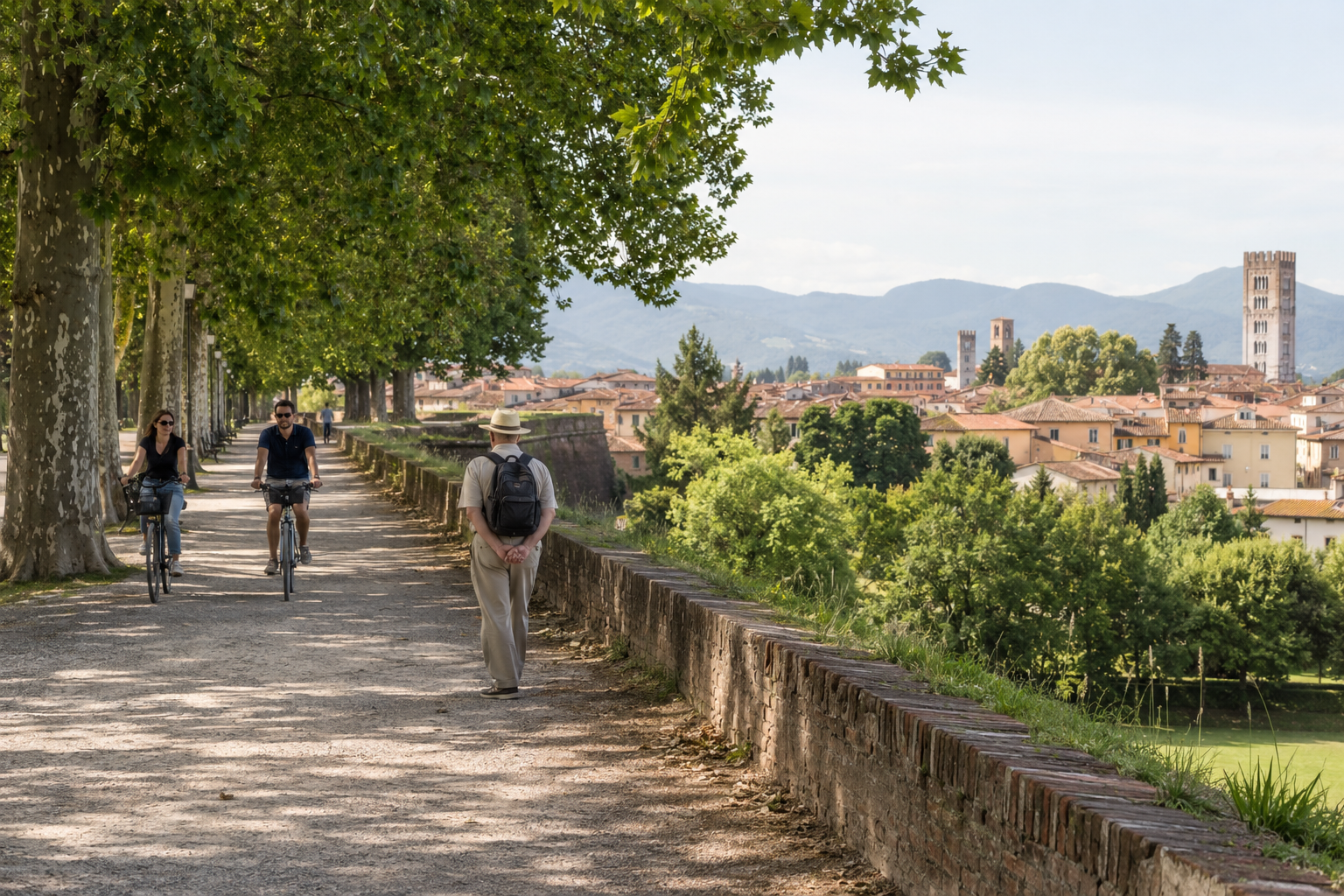
Lucca offers much of what travelers imagine when they picture Tuscany, but it functions as a real town rather than a preserved tourist stage. Its historic center is enclosed by broad Renaissance walls that now form a tree-lined walking and cycling circuit.
Life inside the walls is compact and largely flat. Residents still use neighborhood bakeries, cafés, markets and small grocery stores, while larger supermarkets and practical services are available immediately outside the center.
Lucca’s station makes Pisa, Viareggio, Pistoia and Florence possible without a car. The Garfagnana and smaller Tuscan villages require more planning, but they can be visited by regional transportation, organized excursions or an occasional rental car.
For a month, look inside the walls if atmosphere is the priority. Staying just outside the southern or eastern gates can offer more space, easier access to supermarkets and a shorter route to the station. Compare current Lucca accommodation on Trip.com, paying particular attention to apartment-style properties with laundry and cooking facilities.
Lucca is also a practical base for several carefully paced visits to Florence. Travelers wanting an advance museum reservation can check Uffizi Gallery tickets through Weekend in Italy. This is an affiliate reservation service, not the museum’s official ticket office.
The main disadvantages are summer heat and dramatic accommodation demand during major festivals and events. Compare your dates against the local calendar before booking a nonrefundable month.
For more possible bases, see where to stay in Tuscany.
Parma: The Best Choice for Food and Convenient Train Travel
Parma provides an unusually balanced long-stay experience. It has important art, opera, elegant streets and some of Italy’s most celebrated food traditions, yet it remains a manageable everyday city.
The historic center and Oltretorrente district are walkable, and bicycles are widely used. Parma’s position on the Milan–Bologna railway corridor makes Reggio Emilia, Modena, Bologna and Milan possible as day trips or short overnight excursions.
Food is part of daily life rather than a separate attraction. A month gives visitors time to understand the difference between Parmigiano Reggiano sold at different ages, visit markets, attend a performance at Teatro Regio and explore producers in the surrounding province.
The countryside associated with Parmigiano Reggiano and Prosciutto di Parma is more difficult without a car. An organized food tour or a few rental days can be more sensible than keeping a vehicle for the entire month.
Compare Parma accommodation options on Trip.com, but confirm whether the displayed property is suitable for a long stay. A central hotel room without a kitchen may become restrictive after the first week.
Parma can be hot and humid in summer and cold or foggy in winter. Late spring and early fall offer a more comfortable balance.
Trieste: The Best Seaside Base in Northern Italy
Trieste feels different from almost every other Italian city. Its Adriatic waterfront, grand Habsburg architecture, historic cafés, Italian-Slovenian identity and literary associations create a place that remains interesting well beyond a weekend.
The central districts are walkable, although some residential neighborhoods climb steeply away from the sea. Local buses connect the center with Miramare, the Karst plateau and outlying neighborhoods. The main railway station provides connections toward Venice, Udine and other northeastern destinations.
A month allows time for coffeehouse rituals, seafront walks, museums, day trips to Muggia and excursions into Friuli-Venezia Giulia. Slovenia is close, but remember that Slovenia and Croatia are also within the Schengen Area. Visiting them does not stop or reset the 90-day calculation.
The bora, Trieste’s famous wind, can be forceful, and the city’s character may feel more Central European than conventionally Mediterranean. That difference is precisely what many long-stay visitors appreciate.
Look for accommodation between the station, Borgo Teresiano and the historic center. Compare longer stays in Trieste through Trip.com, checking elevation as well as distance. An apartment that appears close on a map may involve a demanding uphill walk.
Perugia: The Best Base for Experiencing Umbria
Perugia combines a medieval hilltop center with a large student population, museums, cultural events and the practical services of a regional capital. It feels lived-in throughout the year and offers more variety than a smaller Umbrian village.
The historic center is pedestrian-friendly but far from flat. Escalators and the Minimetro help connect the upper city with lower neighborhoods and the main station. Travelers with mobility difficulties should inspect the precise location and building access before renting.
Assisi, Spello, Foligno, Lake Trasimeno and other Umbrian destinations can be reached by combinations of train and bus. A car becomes useful for remote villages, wineries and countryside restaurants, but it is unnecessary for daily life in Perugia.
The city works especially well for travelers taking an Italian-language course or seeking a stronger sense of ordinary Italian life. Its hills, colder winters and occasionally indirect transportation are the principal tradeoffs.
Consult Italy’s train-travel guide before building an ambitious schedule of Umbrian day trips.
Lecce: The Best Southern Base for Fall, Winter or Spring
Lecce is one of southern Italy’s strongest long-stay choices. The historic center contains exuberant Baroque architecture, but the town also has universities, neighborhood markets, bakeries, workshops and an active evening culture.
It is particularly appealing from October through May, when the climate is generally more suitable for walking and the summer crowds have diminished. July and August can be intensely hot, and transportation to coastal destinations becomes busier.
Trains connect Lecce with Brindisi and Bari, while regional services and buses reach some smaller Salento towns. Otranto, Gallipoli, coastal villages and rural masserie require careful timetable planning. Renting a car for selected days can greatly expand the experience.
Lecce itself is not a beach town. It is a cultural base from which the Adriatic and Ionian coasts can be visited. Anyone wanting to walk to the station should consider the western side of the center around Porta Rudiae, while the central lanes offer the greatest atmosphere.
Compare Lecce hotels and apartment-style stays on Trip.com. For a month, air conditioning, heating, a washing machine and protection from street noise matter more than a decorative lobby.
Siracusa: The Best Combination of Sea and Ancient History
Siracusa—Syracuse in English—offers a compelling mix of Greek archaeology, Sicilian food, coastal scenery and daily life. Its historic heart, Ortigia, occupies a compact island connected to the mainland by bridges.
Ortigia is beautiful and highly walkable, but its most atmospheric streets can be noisy and tourist-oriented. For a month, consider both Ortigia and the mainland neighborhoods between the bridges, station and archaeological park. The mainland often provides easier supermarket access and better value.
Siracusa has rail and bus connections to Catania and several southeastern Sicilian destinations. Noto is an accessible excursion, while Ragusa, Modica and smaller coastal places require more careful scheduling. An occasional rental car is useful, but parking in Ortigia can be difficult.
Spring and fall offer the best balance of weather and activity. Winter is quiet and can be rewarding, although some seasonal businesses reduce their hours. Summer brings heat, crowds and higher accommodation demand.
Siracusa is best for travelers comfortable with a slightly less predictable transportation network in exchange for extraordinary surroundings.
Arezzo: The Best Quieter Alternative in Tuscany
Arezzo provides Renaissance art, handsome streets, antique shops and a strong local identity without the constant visitor pressure found in central Florence.
Its station sits close to the historic center and lies on the principal railway route connecting Florence and Rome. Cortona and several other Tuscan towns can also be reached by train, making Arezzo a practical base for travelers who prefer not to drive.
The upper historic streets involve some climbing, but ordinary errands remain manageable. Accommodation near the station is practical, while the higher center offers more character.
Arezzo works particularly well for travelers who have already visited Tuscany’s most famous cities and now want a calmer place in which to establish a routine. It is also worth comparing with the destinations in Italy’s best towns within 90 minutes of Rome, Florence or Milan.
Ferrara: The Best Italian Town for Cycling
Ferrara is flat, bicycle-oriented and large enough to provide real cultural variety without becoming overwhelming. Its Renaissance center, castle, city walls and broad streets make it one of the easiest Italian destinations for relaxed everyday exploration.
The railway places Ferrara between Bologna and Venice, with useful connections toward Padua and other cities in the Po Valley. Bologna is close enough for regular cultural or dining excursions without requiring a change of accommodation.
Summer can be hot, humid and affected by mosquitoes, while winter may bring fog. Spring and early fall are especially pleasant for cycling and walking.
Ferrara is an excellent choice for travelers who value independence, flat terrain and an active local population more than dramatic scenery.
The Best Plan for a One-Month Stay
For approximately 30 days, choose one town and resist the temptation to turn the month into a conventional multi-stop vacation.
The strongest choices are:
- Lucca for a first slow-travel experience in Tuscany
- Parma for food, culture and the easiest railway day trips
- Trieste for waterfront life and a distinctive northern atmosphere
- Lecce for southern Italy during the cooler months
- Perugia or Arezzo for an immersive central Italian stay
- Siracusa for history, sea and a slower Sicilian rhythm
- Ferrara for cycling and easy access to northern cities
A sustainable weekly pattern might include one substantial day trip, one smaller local excursion, two cultural visits and several completely unplanned days. The objective is not to exhaust every possibility but to develop a relationship with the town.
The Best Plan for a Two-Month Stay
Two months are best divided between two contrasting bases rather than four short stays.
Lucca and Lecce
Spend approximately four weeks in each. Lucca provides accessible Tuscany and frequent train travel; Lecce introduces Puglia, Baroque architecture and a warmer southern rhythm.
Trieste and Parma
This combination works especially well in spring or fall. Trieste supplies the sea, cafés and borderland culture, while Parma offers food traditions and convenient rail travel through Emilia-Romagna.
Perugia and Siracusa
Choose this pairing for medieval central Italy followed by the coast and archaeology of southeastern Sicily. The transfer is longer, so consider flying from Rome or another suitable airport rather than attempting to complete the entire journey by regional trains.
A Nearly Three-Month Italian Slow-Travel Itinerary
Travelers subject to the 90-day Schengen limit should build a margin into the itinerary.
One possible 87-day plan is:
- Days 1–28: Trieste
- Days 29–57: Lucca
- Days 58–85: Lecce
- Days 86–87: Departure gateway and international flight
This route moves gradually from northeastern Italy through Tuscany to Puglia and provides three clearly different regional experiences.
An alternative cultural route could combine Parma, Perugia and Siracusa. Whichever plan you choose, calculate the total using calendar days—not nights—and include previous travel anywhere in the Schengen Area during the relevant 180-day window.
A weekend in France, Slovenia, Croatia, Austria or another Schengen country still counts toward the same limit. Briefly leaving the area also does not automatically “reset” the allowance.
How to Choose Accommodation for 30 Days or Longer
Long-stay accommodation should be evaluated differently from a hotel used for three nights.
Before paying, confirm:
- The total price for the exact number of nights
- Whether electricity, gas, heating and air conditioning are included
- The presence of a real kitchen rather than only a kettle
- A washing machine or affordable nearby laundry
- Reliable Wi-Fi and an appropriate workspace if needed
- Elevator access in older buildings
- Mattress size and storage space
- Street noise, restaurant noise and early garbage collection
- Distance from groceries, a pharmacy and public transportation
- Cleaning charges, deposits and cancellation conditions
- The local accommodation tax and the number of nights to which it applies
A stay exceeding 30 days may be handled under different rental, contract or registration procedures than a shorter tourist booking. Ask the owner or agency how the agreement will be documented before sending money.
Never move payment outside a booking platform merely because an unknown host promises a substantial discount. Verify the property, identity of the owner or agency, complete address and written cancellation terms.
Transportation During a Long Stay
A car is unnecessary in all eight centers on this list. It is often cheaper and easier to use trains for intercity travel and rent a vehicle only for selected countryside days.
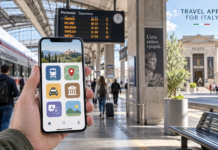
Regional and long-distance timetables vary by date, and strikes can affect travel. Download the useful services listed in the best travel apps for Italy and check each journey shortly before departure.
Do not assume that a national rail pass will save money. A traveler living in one town and making occasional regional trips may spend less by purchasing ordinary tickets as needed.
For a journey lasting several months, a current Italy travel guide on Amazon.com can help compare less familiar destinations. A compact Italian phrasebook is also more useful during a long stay than it may be on a short, highly organized vacation. Choose the most recent edition available.
Budgeting for One, Two or Three Months
Accommodation is usually the largest expense, but the nightly rate shown for a short booking does not always represent the best long-stay price. Compare 28-, 30- and 31-night searches and ask whether weekly cleaning, linen changes and utilities are included.
Cooking several meals at home, using regional trains and choosing one substantial excursion per week can make a long stay more economical than moving between famous cities every few days.
Keep a separate budget for:
- Local accommodation taxes
- Heating or air-conditioning surcharges
- Intercity transportation
- Occasional car rentals
- Museum tickets and tours
- Travel and medical insurance
- Mobile telephone or eSIM service
- Deposits and final cleaning
For cards, ATMs, tipping and local taxes, consult Money in Italy.
How to Make a Long Stay Feel Different from a Vacation
Choose one neighborhood bar and return often enough to be recognized. Shop at the same bakery, learn the market schedule and attend local performances rather than reserving every day for monuments.
An Italian-language class, cooking course, walking group or recurring cultural event can provide structure and social contact. Even basic Italian makes ordinary interactions more rewarding.
Allow for domestic days. Laundry, grocery shopping, reading and cooking are not wasted travel time; they are part of experiencing daily life in another country.
Frequently Asked Questions
Can an American stay in Italy for three months without a visa?
A U.S. citizen may generally visit for up to 90 days within any 180-day period without obtaining a tourist visa. This is not necessarily the same as three calendar months, which may contain 91 or 92 days. Confirm the rules and your passport validity before departure.
Does the 90-day allowance apply only to Italy?
No. It applies across the Schengen Area. Days spent in France, Spain, Germany, Austria, Slovenia, Croatia and other Schengen countries are combined with days in Italy.
Does leaving the Schengen Area for a weekend reset the clock?
No. The calculation uses a rolling 180-day period. Days outside the Schengen Area do not count, but a short departure does not create a new 90-day allowance.
Is one town enough for an entire month?
Yes, provided it has active neighborhoods, practical services, transportation and varied day trips. Lucca, Parma, Trieste and Lecce are particularly strong choices for a first one-month stay.
Do I need a car for slow travel in Italy?
Not for daily life in any of the towns recommended here. A car is useful for reaching rural villages, wineries, beaches and countryside accommodations, but renting one only when needed avoids weeks of parking costs and ZTL concerns.
Can I work remotely while visiting as a tourist?
Visa-free entry for tourism does not automatically grant permission to work in Italy. Anyone intending to work, remain longer than 90 days or establish residence should obtain advice based on their nationality and circumstances before traveling.
Choosing the Right Italian Base
Lucca is the strongest all-around recommendation for a first month. Parma is best for food and railway convenience, Trieste for a distinctive seaside lifestyle, and Lecce for a southern stay outside the hottest months.
With two months, choose two contrasting regions. For a stay approaching three months, three bases provide variety without sacrificing the purpose of slow travel. Keep the entire itinerary within the applicable Schengen allowance and leave a few days of margin for disruptions.
The best long stay is not the itinerary containing the greatest number of places. It is the one that gives you enough time to stop feeling like a visitor.
External Sources
- U.S. Department of State: Italy travel and entry information
- European Commission: official ETIAS and short-stay information
- Trenitalia: official schedules and ticket information
- Italo: official high-speed train information
- Italia.it: official Italian tourism portal
- Visit Tuscany: official regional tourism portal
- Emilia-Romagna Turismo: official regional tourism portal
- Umbria Tourism: official regional tourism portal
- Visit Puglia: official regional tourism portal