
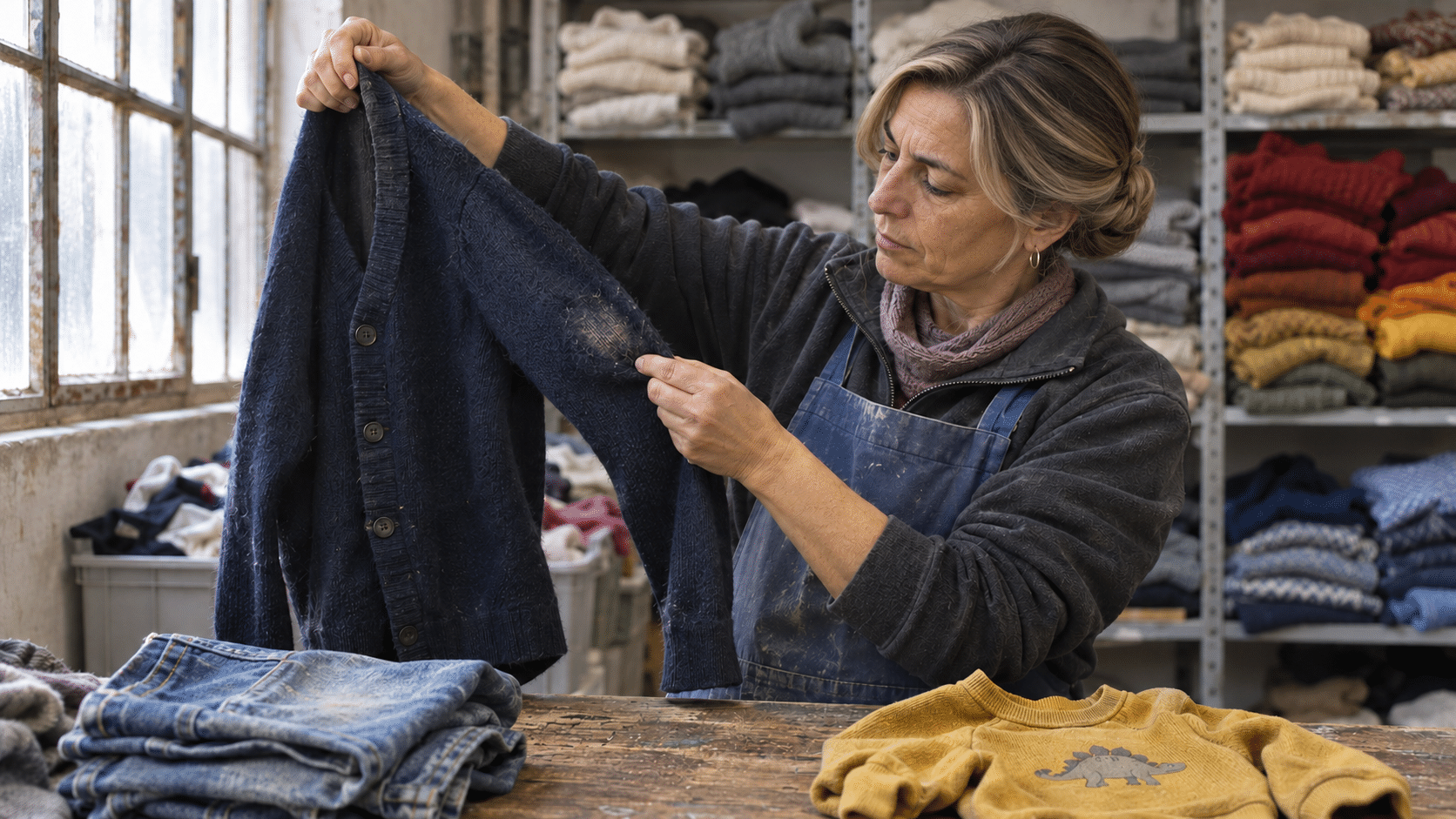
Imagine clearing a shelf and finding three things to give away. There’s a wool cardigan you stopped wearing because the color never suited you, a pair of jeans worn thin between the thighs, and a school sweatshirt your child has outgrown. All three fit into the same bag. Each has a different best destination. The sweatshirt might find another pupil tomorrow. The cardigan could earn money for a charity in a secondhand shop. The jeans pose the question that makes clothing collection difficult in Italy and elsewhere. Who can use what’s left of them, and who pays to get them there?
The answer starts with the writing on the collection bin. It continues at a sorting table, where someone has to decide whether a garment is worth selling whole, what its material might be worth, and what to do if there’s a buyer for neither.
The difference between a clothing drive and a street bin
If a neighborhood group asks for children’s sweatshirts in particular sizes, you know something unusually valuable about your donation. Someone wants that garment. Ask whether the group is still collecting, check the cuffs and zip, and take it to the requested drop-off. The same principle applies to a parish clothing room, often called a guardaroba solidale. A quick call about sizes and seasonal needs can save volunteers from storing winter coats through August.
A municipal textile collection serves a much broader purpose. In Milan, for example, Amsa and the Comune run the service with the cooperative Vesti Solidale. It collects clothing, shoes, accessories and textiles for reuse or recycling. Putting a coat in that system gives the operator several ways to use it. Someone may eventually buy it in a shop. If you specifically want a coat to go free to a person nearby, contact a group distributing clothes directly.
Even neighboring towns give different instructions. Milan’s Amsa guidance calls for transparent bags. In San Giuliano Milanese, Amsa directs residents with torn garments and textile scraps to the municipal collection center on Via della Pace. Before taking a bag out, look up raccolta indumenti usati and the name of your comune. A guide that mentions only capi in buono stato is asking for garments in good condition.
At the sorting table, wearability comes first
In Montemurlo, outside Prato, the textile firm Goritex receives bales from around the world. Prato’s tourism office describes the work of its passatori, skilled sorters who separate material by color and quality. They pick out garments suitable for vintage shops or other secondhand markets. They also identify material that can go back into production and pieces destined for incineration. Several outcomes are possible within a single bale.
Think of the cardigan on that table. Intact elbows, matching buttons and an undamaged neckline make it easier to offer for sale. A hole at one elbow changes the calculation. You might gladly spend half an hour mending a favorite cardigan. A sorter handling other people’s castoffs needs a buyer willing to do the work, or a selling price that covers the repair. Sewing on a button before giving the cardigan away can preserve the value of the whole garment.
The economics show up in collection reports. In its 2024 sustainability report, Humana Italia recorded 10% of its clothing stream going to energy recovery. Burning textiles to produce energy takes the material out of circulation. The figure belongs to one operator in one year, but it illustrates why weighing the bags collected tells us little about how many garments someone wore again.
Resale in Italy and the journey overseas
A secondhand sale can be a good outcome for a donation. It keeps the work already sewn into a coat in use, from its lining to its buttonholes. The selling price can also help cover collection, sorting, transport and shop costs. If the charitable purpose matters to you, look for the operator’s name on the container and check its report for where the clothes go and how it uses the proceeds.
Clothing can also pass through wholesalers and cross several borders. The European Environment Agency recorded roughly 1.4 million tonnes of used textiles exported from the EU in 2023. Africa and Asia received nearly equal shares. Those figures describe trade across the EU. They cannot tell a donor in Milan where an individual jacket ended up.
In some importing markets, traders earn a living selling wearable pieces and customers gain access to affordable clothes. In others, bales undergo another round of sorting before part of the shipment travels onward. Poor-quality pieces can leave traders with unsaleable stock and communities with the disposal bill. The EEA documents dumping and open burning alongside resale and recycling. A customs record can identify the country that received a shipment. Following the least valuable garment beyond that point is much harder.
What Prato can do with an old sweater
Prato’s cenciaioli, the rag merchants and sorters of its textile district, helped develop a trade in recovering wool from discarded cloth. A worn navy sweater has two useful qualities even after its elbows give out. It contains wool, and somebody has already dyed it navy. Sorting similar colors together lets a producer work with the shade already in the fiber.
In mechanical recycling, suitable cloth is pulled apart into loose fibers that can be prepared for spinning. Pulling knitted or woven material apart shortens fibers, which affects the yarn a spinner can make. Material that cannot become clothing yarn may still have a use as wiping cloths or filling. These outcomes recover different amounts of the work and material that went into the original sweater.
Now consider the jeans from the shelf. Their label might list cotton and elastane, while the finished trousers also contain metal rivets, a zip and pocket linings. A collector needs an outlet equipped to handle that combination. For a pair that still fits, ask a sartoria what it would cost to reinforce the thinning seat. A tailor can inspect both the hole and the fabric around it. That tells you more about the prospects for another year of wear than the word “recyclable” on a swing tag.
How to prepare a bag someone can use
- Start with a pocket and condition check. Empty pockets, test zips and look at the garment in daylight. Give wearable clothes clean and completely dry. Keep paired shoes together according to the collector’s instructions.
- Separate the damaged pieces. Check whether the local service accepts worn textiles and where it wants them delivered. For oily workwear or mold-damaged fabric, ask the waste operator for the appropriate route before packing anything with clean clothes.
- Keep the bag under cover. If a container is full, take the bag home or find another authorized collection point. Rain can spoil a bag of saleable clothing before a sorter opens it.
- Describe flaws when giving directly. A missing belt or a shortened trouser leg matters to the next wearer. On a neighborhood exchange, a photograph and an actual measurement can find the person for whom the garment still works.
Buy for the wardrobe you actually wear
Before buying another cardigan, remember why the last one stayed on the shelf. If the color went with only one shirt, take that shirt along when you shop. If hand-washing kept you from wearing it, read the care label in the fitting room. These small checks apply just as much at a vintage market as in an expensive boutique. Italia Mia’s guide to vintage shopping in Italy covers shops and markets where you can try pieces on and examine their condition yourself.
For trousers, sit down and check whether the fabric pulls across the thighs. For knitwear, hold the elbows up to the light. For a coat, put it on over the sweater you expect to wear underneath and reach forward with both arms. An alteration can rescue a good purchase, but include the tailor’s estimate in the price before deciding.
The most revealing question at the checkout may be what happened to the last thing you bought for the same purpose. If you wore it until the cuffs frayed, you know quite a lot about what deserves a place in your wardrobe. If it still has its tags, take another look at it before bringing its replacement home.
External Links
- Amsa — Clothing and textile collection in Milan
- Amsa — Collection instructions for San Giuliano Milanese
- Humana Italia — 2024 sustainability report, clothing flows on pages 84–85 (PDF)
- Prato Turismo — The sorters at Goritex
- European Environment Agency — Europe’s textile value chain in numbers
- European Environment Agency — Management of used and waste textiles