

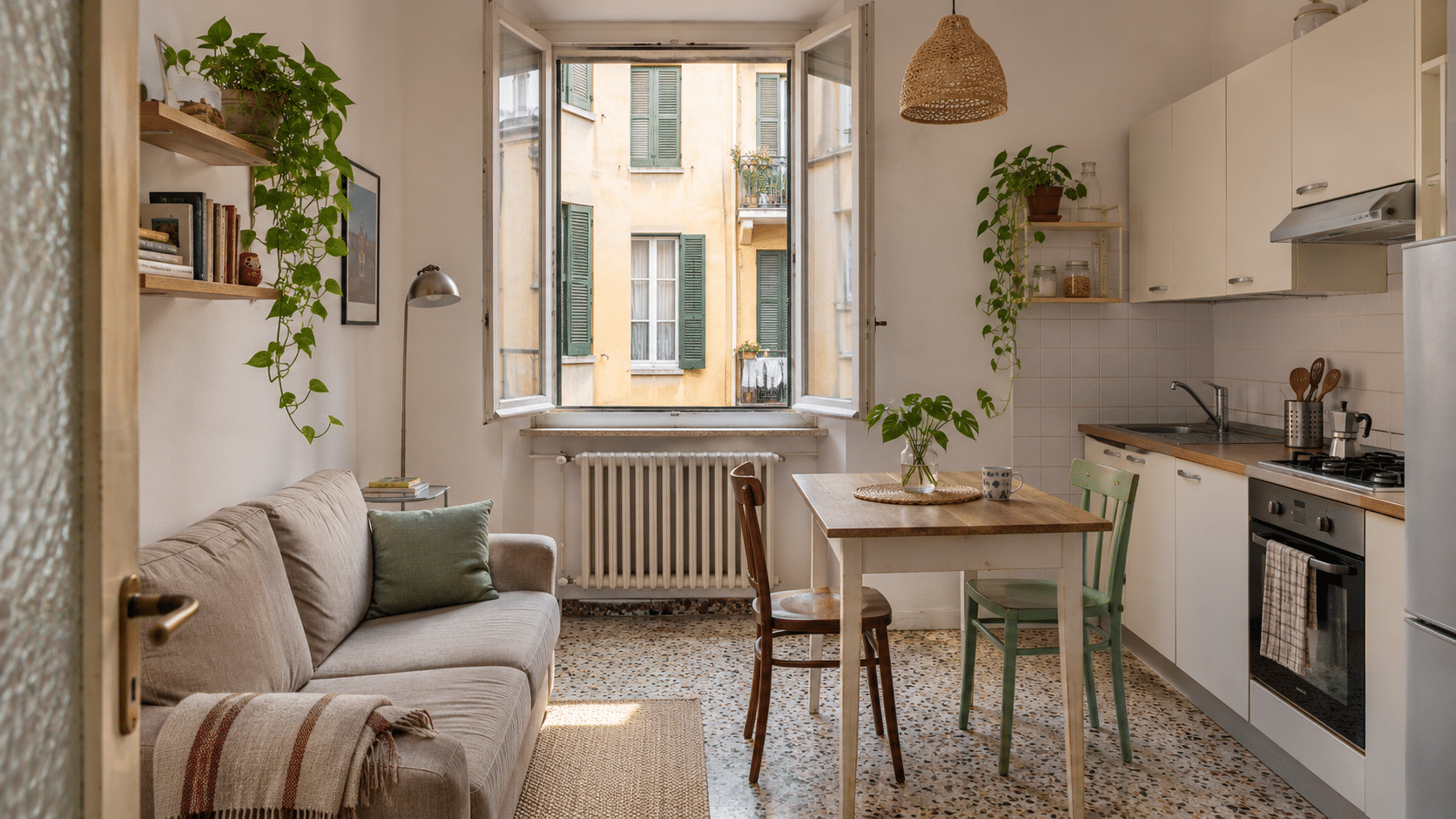
Imagine taking home €1,500 a month and looking for a small apartment in Milan. At the citywide asking rent recorded in October 2026, 45 square metres works out to about €1,013 a month. You would have €487 left for heating, groceries, transport and everything else. Now imagine the job contract that pays for it expires in six months. Would you sign the lease, look for a room, or spend another year at home?
That is the decision behind a familiar statistic. The estimated average age at which young people left the parental home in Italy was 30.2 in 2025, compared with 26.3 across the European Union, according to Eurostat. Italy shared its figure with Spain. France was at 23.8 and Germany at 24.1. Family habits help explain why sharing a home can feel natural. To understand why moving out gets postponed, it helps to look at the rent, the payslip and the date the job ends.
What a small apartment costs in four Italian cities
In October 2026, the residential rents advertised on Immobiliare.it averaged €22.52 per square metre per month in Milan and €9.66 in Palermo. Bologna and Naples were much closer to each other. Applying the same calculation to all four cities makes it easier to see what the difference would mean on one paycheck.
| City | Asking rent per m² per month | Illustrative rent for 45 m² | Share of €1,500 take-home pay |
|---|---|---|---|
| Milan | €22.52 | €1,013 | 68% |
| Bologna | €16.50 | €743 | 50% |
| Naples | €15.77 | €710 | 47% |
| Palermo | €9.66 | €435 | 29% |
The table uses citywide asking rents as a benchmark. The 45-square-metre figures are calculations from the listing data, rounded to the nearest euro. Actual signed rents, the price per square metre of small flats, and what is available in a particular neighborhood can all differ. The budget also needs room for expenses such as utility bills, condominium charges where applicable, and getting to work. Our guide to the cost of living in Italy shows how those costs add up over an ordinary month.
A room in a shared flat can bring the monthly payment within reach. A place farther out can do the same if a reliable bus or train gets you to work. Both options involve a trade-off. Sharing may mean giving up space to work from home or finding roommates whose schedules fit yours. A cheaper flat outside the city can leave you paying for a car if you start before the first train or finish after the last bus. And moving out takes cash up front for a deposit and the first rent payment, with an agency fee in some cases.
How far does an early-career salary go?
In its 2026 report, AlmaLaurea put average monthly take-home pay one year after graduation at €1,491 for first-level graduates and €1,495 for second-level graduates. Real pay, adjusted for inflation, was down 1.4% and 0.9% respectively from the previous survey. The numbers describe employed graduates in the survey one year after finishing their degrees. They give a useful early-career benchmark, while actual first paychecks vary with qualifications, occupation, hours and location.
At roughly that level of pay, the illustrative Bologna flat would take up about half a monthly paycheck. Sharing the rent with a partner could make the same place workable. For someone moving alone, a room or a longer commute may be the practical route. The crucial distinction is between being able to pay a month’s rent and being able to keep paying it when the boiler breaks, shifts are cut, or a new job takes longer to find than expected.
A six-month contract changes the decision
Istat tracked people’s employment status between 2024 and 2025. Among 15- to 34-year-olds who moved into employment over that period, 67.7% entered in fixed-term work, including collaboration arrangements, while 26.6% entered on permanent employee contracts. This measures how young people entered employment during the period, a stage when many are also deciding whether they can afford to leave home.
A fixed-term job can pay enough to cover rent while it lasts. The uncertainty is what happens when it ends. A landlord may want proof of regular earnings or a guarantor, and a renter has to decide whether savings could cover a gap between jobs. Suppose the choice is between commuting from home for six months and paying a deposit to move closer. If the renewal comes late or the next job is in another city, the commute may be worth putting up with. The same choice can come around with each new contract.
Cheaper rent helps when there is work nearby
The difference between Milan and Palermo in the table is about €578 a month for the same amount of space. But the cost of staying in a city also depends on the likelihood of finding work there. In the second quarter of 2026, Istat reported an employment rate of 85.9% for people aged 30 to 34 in northern Italy, compared with 83.5% in central Italy and 60.8% in the Mezzogiorno, which includes the South and the islands. These are broad regional figures, and each city has its own labor market. Naples and Palermo already show how much rents can differ within the same broad part of the country.
Someone who can live with family in a town with few jobs in their field may face a difficult choice. Moving for a promising offer can mean taking on a much bigger rent before knowing whether the new role will last. Staying may make it possible to save, but it can narrow the range of jobs they can accept. The decision comes down to whether the job and an affordable home are within reach of each other.
What living with parents can make possible
Living with family can give a young adult time to save for a deposit, retrain, or get through a spell without work. It can also be a household arrangement that works for both generations. An adult child might contribute to groceries, drive a parent to appointments, or help look after a relative. Someone who gets help with a deposit or has a parent willing to guarantee a lease may be able to move earlier. Even the option of coming home if a job falls through can make it easier to take a chance on another city.
Those options depend on the family’s circumstances. A young person contributing to the household bills may have little left to save, and living together in a crowded flat can come at the cost of privacy. In a household that has room and where people get along, staying longer may be the arrangement everyone prefers. The average age of departure tells us when people typically leave. It cannot tell us whether an individual stayed by choice, waited for a contract renewal, or moved out and came back.
When someone says they’ll move out once the contract is renewed, ask what that renewal would change. It might give them time to build a cushion, help them qualify for a lease, or make it worth moving closer to work. Sometimes it means they can finally sign for a room they can afford and know they’ll still be able to pay for it next winter.
External Links
- Eurostat — When do young people leave the parental home?
- Immobiliare.it — Italian residential asking rents by city
- AlmaLaurea — 2026 report on graduate employment and pay
- Istat — Labor Force Survey transitions between 2024 and 2025
- Istat — November 2026 parliamentary evidence, Table 1 on youth employment by area