

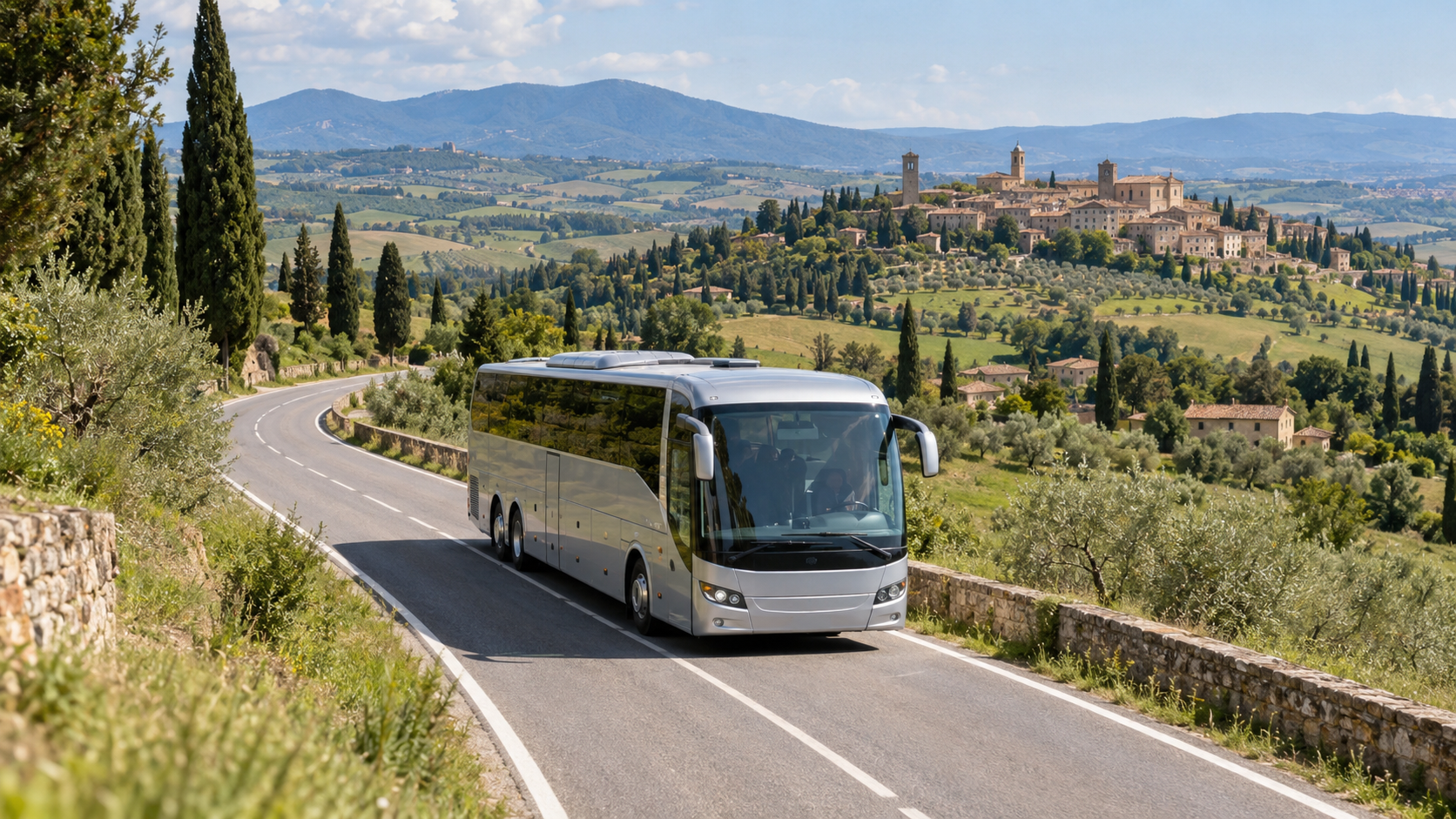
 Traveling around Italy by bus can be affordable, comfortable and surprisingly rewarding. Although high-speed trains remain the fastest choice between major cities, buses reach hill towns, mountain communities, beaches and rural destinations that Italy’s railway network does not always serve.
The challenge is understanding that Italy does not have one unified national bus system. Long-distance coaches, regional buses, airport shuttles and local urban services operate separately, each with its own tickets, timetables and luggage policies.
I recommend using buses selectively: take trains between well-connected cities such as Rome, Florence, Bologna, Milan and Venice, then use buses for destinations where they offer a more direct or practical connection.
Bus Travel in Italy at a Glance
| Type of service | Best for | Typical operators |
|---|---|---|
| Long-distance coaches | Travel between major cities and regions | FlixBus, Itabus, MarinoBus |
| Regional buses | Towns, villages and countryside destinations | Local and regional transport companies |
| Local urban buses | Getting around cities | Municipal transport operators |
| Seasonal services | Beaches, islands and mountain resorts | Regional operators and tourist services |
| Airport coaches | Direct connections between airports and city centers | Terravision, local operators and private shuttle companies |
Long-distance coaches generally use motorways and require advance reservations. Regional buses usually operate on fixed local routes and may require tickets purchased from an app, ticket office, authorized shop or tobacco shop before boarding.
When Traveling by Bus Makes Sense
A bus may be the best option when:
- The destination has no railway station.
- The bus arrives closer to the historic center than the train.
- A direct coach avoids several railway changes.
- You are traveling on a limited budget.
- You want to visit a small town, beach or mountain destination.
- You are traveling overnight and want to save the cost of a hotel.
- Rail service is temporarily disrupted by engineering work or strikes.
For journeys such as Rome–Florence, Milan–Bologna or Florence–Venice, high-speed trains are normally much faster. A coach can still cost less, but the difference in travel time may be considerable.
If you are combining buses and trains, Italia Mia’s guide for first-time visitors to Italy provides additional advice about transportation, accommodation and itinerary planning.
The Principal Long-Distance Bus Companies in Italy
FlixBus
FlixBus operates an extensive network connecting Italian cities, airports and smaller destinations. Its usefulness lies not only in the major routes but also in connections that avoid changing trains.
Tickets are sold online and through the FlixBus app. The fare normally includes a designated baggage allowance, but dimensions, weight limits and special-item rules should always be checked when booking.
Itabus
Itabus connects many important destinations in northern, central and southern Italy. Its modern coaches commonly include reclining seats, power or USB connections, Wi-Fi and onboard toilets, although individual facilities can vary.
The standard ticket generally includes one piece of hand luggage and one suitcase for the luggage compartment. Additional or special luggage should be booked in advance.
MarinoBus
MarinoBus is especially useful for travel between southern Italy and cities in central and northern Italy. It serves numerous destinations in Puglia, Basilicata, Campania and other regions.
The company can be a good alternative when a rail journey would involve inconvenient changes.
Regional Operators
Regional transportation is more fragmented. Useful operators and networks include Autolinee Toscane in Tuscany, Busitalia in several regions, SITA Sud in Campania, Cotral in Lazio, ARST in Sardinia, AST in Sicily and local companies serving the Alps and Dolomites.
Operators, schedules and seasonal routes can change. Always confirm the journey on the regional company’s official website shortly before traveling.
12 Beautiful and Useful Bus Routes in Italy
These routes include scenic local journeys and practical connections to destinations that are not always easy to reach by train.
1. Sorrento–Positano–Amalfi
The bus journey along the Amalfi Coast is one of Italy’s most famous public-transport experiences. The road follows steep cliffs above the Mediterranean, passing terraced hillsides, small beaches and villages seemingly attached to the rock.
SITA Sud buses connect Sorrento with Positano and Amalfi. Because services can become extremely crowded between late spring and early autumn, travel early in the morning and avoid carrying bulky luggage.
The buses are convenient for day trips, but summer traffic can cause substantial delays. Ferries are often a more relaxing alternative when the sea is calm and seasonal services are operating.
For more ideas about the area, explore Italia Mia’s guide to the region of Campania.
Best for: Coastal scenery and visits to Positano and Amalfi
Main caution: Crowding, winding roads and summer traffic
2. Amalfi–Ravello
Ravello sits high above the coast and does not have a railway station. The local bus from Amalfi climbs inland along a steep and twisting road, offering occasional views over the coastline.
Once in Ravello, visitors can explore the historic center, Villa Rufolo and Villa Cimbrone. Check the final return departure before beginning your visit, particularly outside the main tourist season.
Best for: Gardens, historic villas and panoramic views
Main caution: Limited space on busy departures
3. Florence–Siena
The bus is often more convenient than the train for reaching Siena because it arrives closer to the historic center. Services leave from Florence and travel through the Tuscan countryside before reaching Siena.
This is one of the easiest car-free day trips from Florence. However, Siena deserves an overnight stay if you want to experience Piazza del Campo after most day visitors have departed.
Read Tuscany Without a Car for a more complete explanation of train and bus travel throughout the region.
Best for: A day trip or overnight stay in Siena
Main caution: Commuter services can be busy on weekdays
4. Siena–San Gimignano
San Gimignano has no railway station, making the bus one of the most practical ways to visit without a car. Many journeys require a change at Poggibonsi, which is connected by train and bus to other Tuscan destinations.
The final section climbs toward San Gimignano through vineyards and rolling hills. Allow extra time between connections and avoid planning your return around the final available bus.
Italia Mia’s guide to the best places in Tuscany can help you decide whether to combine San Gimignano with Siena, Florence or another Tuscan base.
Best for: Medieval architecture and Tuscan scenery
Main caution: A connection at Poggibonsi may be necessary
5. Perugia–Assisi
The journey between Perugia and Assisi is short enough for a day trip and passes through the green Umbrian landscape. Assisi’s railway station is in Santa Maria degli Angeli, below the historic hill town, so visitors arriving by train normally continue by local bus.
Depending on your starting point and timetable, you can travel by regional bus or combine the train with a local connection up to Assisi.
Italia Mia’s complete guide to Umbria introduces more hill towns that can be incorporated into a regional itinerary.
Best for: Art, religious heritage and Umbrian landscapes
Main caution: Check whether the service stops in lower Assisi or near the historic center
6. Bari–Alberobello
Alberobello’s conical-roofed trulli make it one of Puglia’s most recognizable destinations. Ferrovie del Sud Est operates transportation in this part of the region, with the exact combination of trains and replacement or connecting buses varying according to the schedule and engineering work.
Check whether your chosen departure is a train, bus or combined journey. The departure point in Bari may differ from the main long-distance coach terminal.
For a wider regional itinerary, see Italia Mia’s 20 best places to visit in Puglia and the complete guide to Puglia.
Best for: Trulli and a car-free excursion from Bari
Main caution: Confirm the vehicle type and departure location
7. Lecce–Otranto
Otranto combines a compact historic center, a castle, a remarkable cathedral and clear Adriatic water. Regional and seasonal services connect it with Lecce, although frequency is generally better during summer.
The Salento in Bus network can be particularly useful during the main visitor season, but it should not be treated as a year-round service. Outside summer, verify regional alternatives carefully.
Explore more of the coast with Italia Mia’s guide to the best beaches in Puglia.
Best for: A coastal day trip from Lecce
Main caution: Seasonal timetables and reduced off-season frequency
8. Matera–Bari
Matera is in Basilicata, but Bari is one of its most useful gateways. Several bus and coach services operate between the two cities, including connections involving Bari Airport.
The approach to Matera does not reveal the city’s full drama immediately. The famous Sassi districts appear once you enter the historic center and reach the panoramic viewpoints.
Matera is also a natural addition to a journey through the region of Basilicata.
Best for: Reaching Matera from Bari or Bari Airport
Main caution: Some airport and city services use different departure points
9. Aosta–Courmayeur
This route travels through the upper Aosta Valley toward Mont Blanc, passing mountain villages and increasingly dramatic Alpine scenery.
Courmayeur is a popular base for hiking, skiing and excursions toward Skyway Monte Bianco. Services can become busy during ski weekends and the peak summer hiking season.
Mountain weather can affect travel, so allow extra time before a flight or an important railway connection.
Best for: Alpine scenery, skiing and hiking
Main caution: Weather and seasonal demand
10. Cortina d’Ampezzo–Dobbiaco
A bus journey through the Dolomites offers views of forested valleys, dramatic peaks and mountain communities. Cortina does not have a railway station, so buses are essential for many visitors traveling without a car.
Routes and connections can change seasonally. Some journeys require careful coordination with trains at Calalzo, Dobbiaco or other regional transport hubs.
Best for: Dolomite landscapes and car-free mountain travel
Main caution: Seasonal timetables and weather disruptions
11. Catania–Taormina
Coaches connect Catania, Catania Airport and Taormina. This is often more convenient than taking a train to Taormina-Giardini station and then arranging transportation uphill to the historic center.
Before booking, check the precise Taormina stop. Some services terminate near the bus terminal, while others may serve surrounding areas.
Best for: Reaching central Taormina without renting a car
Main caution: Heavy traffic during summer and special events
12. Cagliari–Villasimius
The regional bus journey from Cagliari toward Villasimius provides access to southeastern Sardinia without a car. The area is known for turquoise water, pale beaches and protected coastal scenery.
A bus is useful for reaching the town, but many individual beaches remain difficult to visit without additional local transportation or a long walk. Summer schedules are normally more useful than winter ones.
Best for: A seaside stay based in Villasimius
Main caution: The town and individual beaches are not always served by the same stops
Long-Distance Bus or Train: Which Should You Choose?
| Journey | Usually the better choice | Why |
|---|---|---|
| Rome–Florence | High-speed train | Considerably faster |
| Milan–Venice | Train | Frequent city-center connections |
| Rome–Siena | Bus | Direct service can be more convenient |
| Florence–Siena | Bus | Arrival closer to Siena’s center |
| Bari–Matera | Bus or coach | Matera is not on Italy’s national rail network |
| Naples–Matera | Long-distance bus | Can avoid complicated train connections |
| Catania–Taormina | Bus or train | Depends on your hotel and arrival point |
| Florence–San Gimignano | Train and bus | San Gimignano has no station |
Prices fluctuate according to demand, departure time and booking date. Rather than publishing fixed fares that soon become obsolete, compare the current total cost, journey duration, arrival point and luggage allowance.
A cheap ticket is not necessarily a good value if the bus arrives late at night in a station far from your accommodation.
How to Buy Bus Tickets in Italy
Long-distance coach tickets are easiest to purchase through the operator’s official website or app. You normally receive a digital ticket or QR code that can be shown on your phone.
Regional tickets may be available through:
- The operator’s official app
- A bus-station ticket office
- Authorized tobacco shops displaying a large “T”
- Newsstands and local bars
- Ticket machines
- Contactless payment onboard, where supported
- The driver, sometimes with a surcharge and only when permitted
Never assume that every bus sells tickets onboard.
Do Bus Tickets Need to Be Validated?
It depends on the type of ticket.
A long-distance ticket tied to a specific departure normally does not require traditional validation. The driver scans the digital or printed ticket.
A paper ticket for a regional or city bus may need to be stamped in the onboard machine immediately after boarding. App-based tickets may need to be activated manually before departure or when boarding.
The safest rule is to read the instructions printed on the ticket or displayed in the app. If you are uncertain, ask the driver before taking your seat. Traveling with an unvalidated ticket can result in a fine even if you paid for it.
Luggage Rules
Long-distance coaches usually include a small carry-on item and one suitcase for the luggage compartment, but limits vary by operator and fare.
Keep the following with you rather than in the luggage hold:
- Passport and travel documents
- Money and credit cards
- Medication
- Mobile phone and electronics
- Keys
- Jewelry and other valuables
Label your suitcase with your name and telephone number. When the coach makes intermediate stops, watch which luggage is being unloaded.
Regional buses may not have a proper luggage compartment. Large suitcases can be awkward or may not be accepted on crowded local services.
Accessibility and Reduced Mobility
Accessibility differs significantly between routes and vehicles. A modern long-distance coach may still require passengers to climb several steps, while smaller regional buses may not have space for an unfolded wheelchair.
Contact the operator before booking if you require:
- A wheelchair-accessible vehicle
- Assistance boarding
- Space for mobility equipment
- Transportation for a service animal
- A seat close to the entrance
- Help transferring between services
Do not rely solely on a generic accessibility symbol. Confirm that the specific departure can accommodate your requirements.
Traveling with Children, Pets and Bicycles
Rules for children, car seats, pets and bicycles vary by operator.
Small pets may be accepted in a carrier on some services, while other companies permit only assistance dogs. A separate reservation or paid seat may be required.
Bicycle space is limited and should never be assumed. Some long-distance services accept conventional bicycles only when a bookable bicycle space is available. Electric bicycles, tandems and oversized bikes may be prohibited.
Check these conditions before purchasing a nonrefundable ticket.
Understanding Italian Bus Stations
Major cities may have several coach stops rather than one central terminal. Rome, Milan, Naples and Florence all have stops outside their principal railway stations.
Before departure:
- Open the exact stop location in a map application.
- Check which side of the road or terminal the bus uses.
- Look for the operator’s name and route number.
- Arrive at least 15–20 minutes early.
- Allow additional time at large terminals.
- Do not rely on the city name alone.
In Venice, long-distance coaches commonly serve Venezia Mestre or Tronchetto rather than the historic center. Confirm your onward connection before booking accommodation.
Bus Travel During Strikes
Transportation strikes occur periodically in Italy. A strike may affect local buses, regional services or several forms of public transportation at once.
Some essential services may operate during legally protected time periods, but these windows differ by city and operator. Check the operator’s official website and Italy’s Ministry of Infrastructure and Transport strike calendar before traveling.
If an important flight, cruise or prepaid tour depends on a bus connection, create a backup plan.
Essential Tips for Traveling Italy by Bus
- Book long-distance journeys early during summer, Easter and Christmas.
- Compare the bus arrival point with your hotel location.
- Take a screenshot of the ticket in case mobile data is unavailable.
- Carry a portable charger.
- Keep valuables in your hand luggage.
- Bring water, particularly on regional routes.
- Pack lightly when using local buses.
- Check Sunday and public-holiday schedules separately.
- Verify the final return departure before taking a day trip.
- Allow extra time along the Amalfi Coast and near major cities.
- Recheck the timetable the evening before departure.
- Never assume a summer tourist route operates in winter.
Common Mistakes to Avoid
Booking the Wrong Stop
A city may have several stops located miles apart. Verify the address rather than selecting the first result bearing the city’s name.
Assuming the Bus Stops Automatically
On local services, press the stop-request button before your destination. At rural stops, signal clearly to the approaching driver.
Depending on the Last Bus
A missed final departure can leave you with an expensive taxi ride or no practical way to return. Whenever possible, plan to take the second-to-last service.
Ignoring Sunday Schedules
Sunday and holiday services can be much less frequent, especially in rural areas.
Expecting Perfect Wi-Fi
Wi-Fi and power outlets may be advertised but do not always work. Download maps, tickets and entertainment before departure.
Treating Estimated Arrival Times as Guaranteed
Traffic, road construction, weather and crowded boarding points can cause delays. Avoid tight transfers between separate tickets.
Frequently Asked Questions
Is traveling by bus in Italy safe?
Bus travel is generally safe. Keep valuables with you, pay attention at busy terminals and use official operators and authorized ticketing channels.
Are buses cheaper than trains?
They often are, particularly when booked early. However, regional train fares may be competitive, while high-speed trains can save several hours.
Can I show my ticket on my phone?
Most long-distance operators accept mobile tickets. Regional systems differ, and app tickets may require activation before boarding.
Do drivers speak English?
Some do, particularly on tourist and long-distance routes, but English should not be assumed on local services. Having the stop name and ticket ready on your phone makes communication easier.
Are overnight buses available?
Yes. Overnight coaches operate on selected long-distance routes, particularly between northern and southern Italy. Check the arrival time and transportation options from the terminal before booking.
Can I take a suitcase?
Long-distance coaches generally accept a suitcase within the operator’s size and weight limits. Local and regional buses may have very limited luggage space.
Is a Eurail or Interrail pass valid on buses?
Usually not on ordinary municipal, regional or private coach services. Certain railway replacement buses may be included, but this must be confirmed for the specific journey.
Useful Official Websites
- FlixBus Italy
- Itabus
- MarinoBus
- Autolinee Toscane
- SITA Sud
- Ferrovie del Sud Est
- ARST Sardinia
- Italian Ministry of Infrastructure and Transport strike calendar
When adding these links in WordPress, select “Open in a new tab” for each external website.
Final Thoughts
Traveling across Italy entirely by bus is possible, but the most effective itinerary usually combines different forms of transportation. Trains are generally best between large, well-connected cities, while buses become invaluable for reaching hill towns, coastal communities, mountain resorts and destinations without railway stations.
My advice is to plan each journey individually. Compare the travel time, departure location, arrival point, luggage rules and frequency—not merely the ticket price.
With realistic connections and a little preparation, Italy’s buses can take you well beyond the standard railway itinerary and into some of the country’s most memorable landscapes.