
On 28 October 1921, eleven identical coffins stood in the basilica at Aquileia. Each held the remains of an unidentified soldier. Maria Bergamas, whose son Antonio had died in the war, was asked to choose one for burial in Rome. Antonio had been born an Austrian subject and volunteered to fight for Italy. His mother’s part in the ceremony gave the Unknown Soldier a family story that people on either side of the former frontier would have understood.
The frontier itself had moved. Trento and Trieste belonged to Italy, the Habsburg Empire had disappeared, and Italian soldiers had come home to towns struggling to feed and employ them. To understand how victory could occasion both a ceremony of national mourning and an angry argument over what the country had gained, it helps to go back to the summer when Italy chose to stay out.
Why Italy declared neutrality in 1914
When Austria-Hungary declared war on Serbia in July 1914, Italy had belonged to the Triple Alliance with Austria-Hungary and Germany for more than thirty years. Yet the alliance was defensive. Rome held that Vienna’s decision to attack Serbia placed Italy under no obligation to fight. On 2 August, the government announced Italy’s neutrality.
There were good reasons to keep it. The state was still absorbing the expense of its recent war against the Ottoman Empire over Libya. Former prime minister Giovanni Giolitti thought Italy might obtain concessions from Vienna by remaining neutral. Many Catholics opposed intervention, as did the Socialist Party. For households dependent on a son’s labour or a father’s wages, mobilisation raised a question that diplomatic promises could scarcely answer. Who would bring in the harvest or pay the rent while he was away?
The case for intervention drew on the unfinished business of the Risorgimento. Trento and Trieste were under Habsburg rule. Italian irredentists wanted these and other lands they called irredente, or unredeemed, to join the kingdom. Some saw war as a final struggle for national independence. Others wanted naval bases and influence across the Adriatic. Those ambitions could point toward quite different borders in districts where Italians, Slovenes, Croats and German speakers lived alongside one another.
The secret bargain that brought Italy into the war
On 26 April 1915, Prime Minister Antonio Salandra and Foreign Minister Sidney Sonnino committed Italy to the Allied side through the secret Treaty of London with Britain, France and Russia. In return for entering the war, Italy was promised territory including Trentino, South Tyrol up to the Brenner Pass, Trieste, much of Istria and parts of Dalmatia. The Brenner frontier would place a largely German-speaking population inside Italy. The negotiators already had military geography as well as national identity in mind.
Most deputies had no part in that bargain. In May, as demonstrators filled the streets and the poet Gabriele D’Annunzio called for intervention, Salandra briefly offered his resignation. King Victor Emmanuel III kept him in office. Parliament granted the government extraordinary powers, and Italy declared war on Austria-Hungary on 23 May. Operations began the following day. The government waited until August 1916 to declare war on Germany. For readers following Italia Mia’s history series, the confrontation between crown, ministers and parliament grew out of the political system described in The Kingdom of Italy, 1861–1914.
Eleven battles on the Isonzo
Much of the Italian front ran through mountain country. In the high Alps, keeping men supplied with food, fuel and warm clothing demanded extraordinary labour. Snow could isolate a position, and avalanches killed men on both sides. Farther east, the Isonzo River, today also known by its Slovene name, Soča, ran toward the Adriatic. Here General Luigi Cadorna concentrated successive Italian offensives. Beyond the river lay Gorizia and the approaches to Trieste.
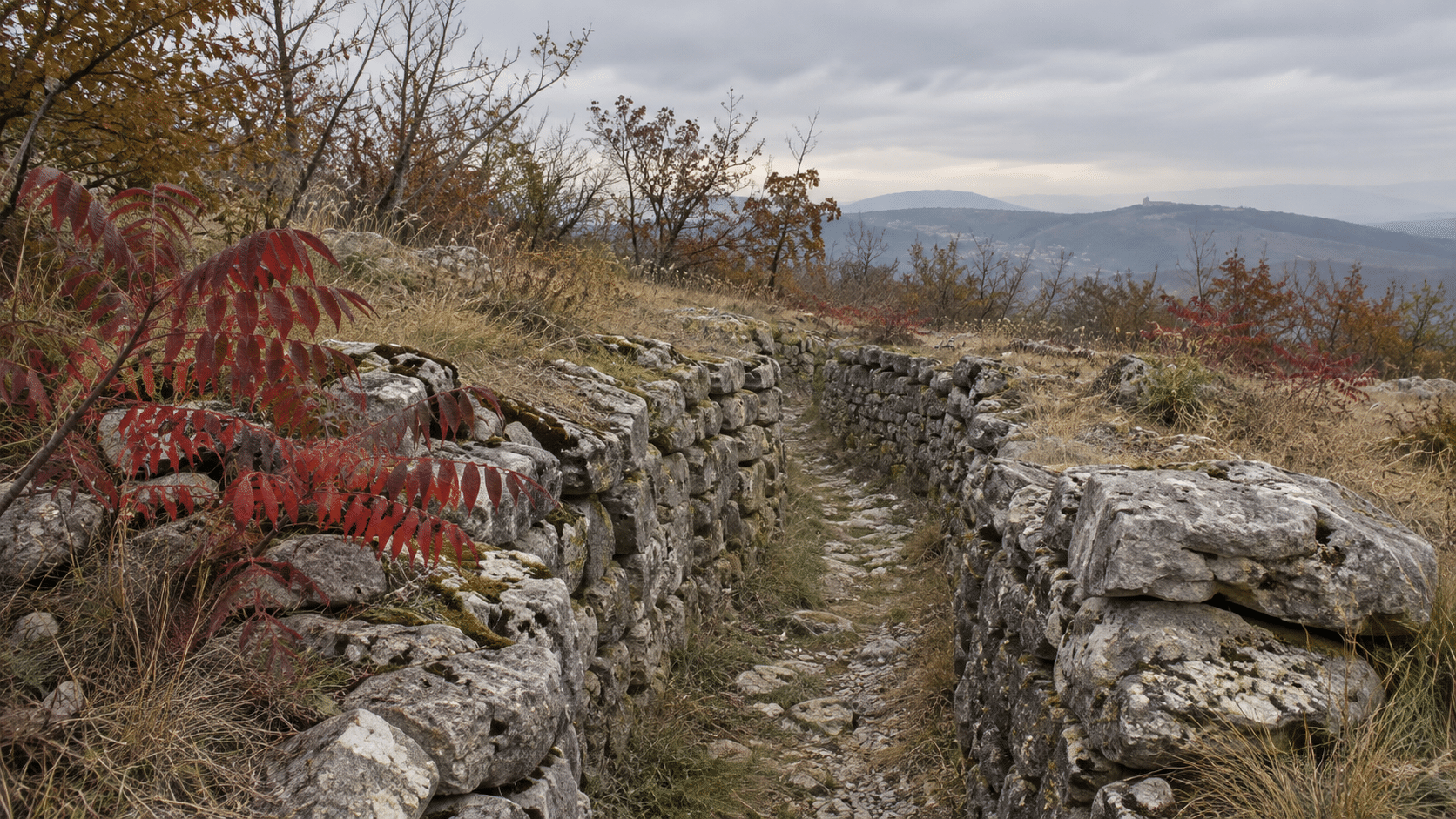
The Carso plateau around Gorizia presented a different hardship from the Alpine snow. Its shallow soil offered little cover, and cutting a trench into limestone was slow work. Drinking water had to be brought up to men surrounded by bare rock. In August 1916, during the sixth battle of the Isonzo, Italian troops captured Gorizia. For families reading the news at home, a city on the map had at last changed hands. For the infantry, the next line of defended heights still lay ahead. By September 1917, the army had fought eleven battles on the river.
Bread in Turin and refugees in Veneto
Far from the front, the demands of war reached into kitchens and factories. Women took paid industrial jobs, cared for the wounded and shouldered more agricultural work as men were called up. A factory wage could give a woman greater independence even as rising prices reduced what she could buy. The working day continued in the bread queue.
In August 1917, bread shortages in Turin set off protests in which women played a prominent part. Workers stopped work, barricades went up, and authorities used troops to suppress the uprising. It took place two months before the military disaster at Caporetto. Long before the front collapsed, the cost of sustaining it had become a political issue in one of Italy’s principal industrial cities.
Then, on 24 October, German and Austro-Hungarian forces broke through around Caporetto, now Kobarid in Slovenia. The retreat carried the Italian army back to the Piave River. Hundreds of thousands of soldiers fell into captivity. Civilians fled westward alongside the retreating troops, while families who stayed behind in Friuli and parts of Veneto endured occupation, requisitions and hunger. In Italian, una Caporetto still means a crushing defeat. For a family separated on the road west, the name could have a much more precise meaning.
From the Piave to Vittorio Veneto
General Armando Diaz replaced Cadorna. He inherited an army that had lost men, equipment and confidence, but now had a shorter line to defend. The command paid closer attention to food, rest and leave. British and French troops arrived to support the front. For conscripts who had spent years being told why Italy needed territory across the border, defending towns inside the kingdom gave the fighting a more immediate purpose.
Italian forces and their allies held the Piave during the Austro-Hungarian offensive of June 1918. On 24 October, a year to the day after Caporetto, Italy began the offensive remembered as Vittorio Veneto. As Allied forces crossed the Piave and advanced, the Habsburg monarchy was coming apart. National movements claimed authority over parts of the empire, and its army struggled to hold together.
Representatives signed the armistice at Villa Giusti, near Padua, on 3 November. It took effect on 4 November 1918. That timing explains why Italian commemorations fall a week before the 11 November armistice with Germany. More than 600,000 Italian servicemen had died. For many survivors, the tasks ahead included finding a livelihood with a permanent injury or learning what had happened to a relative last seen during the retreat.
Who called it a “mutilated victory”?
The peace settlements brought Italy Trentino, South Tyrol, Trieste and Istria, among other gains. They also brought a dispute over the Adriatic. The new Kingdom of Serbs, Croats and Slovenes had claims of its own, and US president Woodrow Wilson had never signed the Treaty of London. The port of Fiume, now Rijeka in Croatia, exposed the contradictions in Italy’s position. Italian delegates invoked the wartime treaty to claim parts of Dalmatia, but appealed to the nationality of Fiume’s Italian-speaking urban population to claim a city the treaty had left out.
D’Annunzio gave nationalist anger its enduring phrase, vittoria mutilata, or “mutilated victory.” In September 1919 he led volunteers into Fiume. Italy and its Adriatic neighbour agreed in the 1920 Treaty of Rapallo to establish Fiume as a free state. Italian forces subsequently expelled D’Annunzio. Italy annexed the city in 1924 under a later agreement. Calling the victory “mutilated” expressed a political demand about where the border should run. A German-speaking family in South Tyrol or a Slovene family near Trieste had every reason to read the new map differently.
Returning soldiers also had pressing concerns about jobs, pensions and land. Inflation eroded savings. Strikes, factory occupations and rural disputes spread during the biennio rosso, the “two red years” of 1919–20. Benito Mussolini drew on nationalist resentment, while Fascist squads used violence against unions, cooperatives and elected local authorities. Veterans could be found among the Fascists’ opponents as well as their recruits. Their wartime service had settled very little about the Italy in which they wanted to live.
The soldier who returned to Rome
On 4 November 1921, the coffin Maria Bergamas had chosen was laid to rest at the Vittoriano in Rome. The other ten soldiers remained at Aquileia. That detail is easy to miss when visiting the famous tomb in Piazza Venezia. The capital received one soldier to represent the country’s dead. Aquileia kept ten graves for families who could never know whether one of them belonged to someone they had loved.
External Links
As an Amazon Associate, Italia Mia earns from qualifying purchases.
- Mark Thompson, The White War — Amazon. Start here for a narrative that connects the political campaign for intervention with the soldiers’ experience on the Isonzo.
- Emilio Lussu, A Soldier on the Southern Front — Amazon. A Sardinian officer’s memoir of the Asiago plateau, particularly sharp on the distance between an order given and an order obeyed.
- Italian Front — International Encyclopedia of the First World War
- Vittoria Mutilata — International Encyclopedia of the First World War
- Women and Anti-war Protest in Italy — University of Florence
- The burial ceremony of the Unknown Soldier — VIVE, Italian Ministry of Culture