
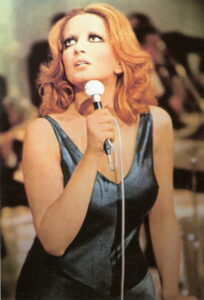
Mina has spent nearly half a century away from the concert stage, yet she has never stopped being part of Italian musical life. New recordings still arrive, older performances still circulate, and singers continue to measure themselves against her command of a song. Few performers have remained so present while choosing to be so rarely seen.
Born Anna Maria Mazzini in 1940, Mina became a star during the rise of Italian television. She could sing rock and roll with youthful abandon, turn a demanding melody into something apparently effortless, and make an intimate lyric feel as if she were addressing one person. Her career also tells a larger story about changing attitudes toward women, celebrity and popular music in Italy.
Early Life and the Breakthrough at La Bussola
Mina was born in Busto Arsizio, near Milan, on March 25, 1940, and grew up in Cremona. That city gave her the enduring nickname “La Tigre di Cremona,” although her repertoire has always been far broader than the force suggested by the name.
As a young woman, she listened to American rock and roll, jazz and the popular music arriving from abroad. In the summer of 1958, friends encouraged her to sing at La Bussola, the nightclub on the Tuscan coast run by Sergio Bernardini. The impromptu appearance helped set her professional career in motion.
Her early records brought a new physical energy to Italian pop. “Tintarella di luna” made her a symbol of the late 1950s, but she quickly showed that she could handle ballads, swing and intricate arrangements without losing her identity as a singer. Her place among the artists who reshaped the era is clear in Italia Mia’s guide to 100 famous Italian songs.
Mina and the Golden Age of Italian Television
Television made Mina familiar to millions of Italians. On programs including Studio Uno and, later, Teatro 10, she was more than a guest arriving to promote a record. She could command a studio, work with an orchestra, exchange songs with another performer and hold the camera’s attention through the smallest change of expression.
Her 1972 appearance with Lucio Battisti on Teatro 10 remains one of Italian television’s great musical encounters. They moved through each other’s songs, showing how confidently Mina could enter another artist’s musical world while retaining her own voice. Their medley is available to watch on RaiPlay.
She could be playful, imposing or remarkably still. What connected those performances was her attention to the words: she found the character and emotional situation inside a song before showing the audience what her voice could do.
The 1963 Scandal and Her Return to Rai
In 1963, Mina’s relationship with actor Corrado Pani, who was married, and the birth of their son Massimiliano became the subject of intense public scrutiny. She was kept off Rai television for a period at a time when a woman’s private life could threaten her professional career in ways rarely applied equally to men.
Mina returned to Rai screens in 1964. The episode belongs in her biography because it reveals the social pressures under which she worked. It should not define her: her records continued to reach listeners, and she went on to become one of television’s most commanding performers.
The Art of Interpreting a Song
Mina’s catalogue is too large to reduce to a few hits. Its range becomes clearer when her performances are heard alongside the artists who wrote or arranged the music.
With “Il cielo in una stanza,” she helped bring Gino Paoli’s intimate song to a broad audience. On “E se domani,” she let uncertainty build through her phrasing rather than turning every line into a climax. “Se telefonando” gave her a more unusual challenge: a melody by Ennio Morricone, with words by Ghigo De Chiara and Maurizio Costanzo, that changes direction while remaining instantly memorable.
Her recording of “La canzone di Marinella” introduced many listeners to Fabrizio De André. She broadened the song’s audience without erasing its author’s voice. “Parole parole,” her exchange with actor Alberto Lupo, required a different skill: timing, wit and the ability to make a familiar romantic argument feel like a conversation happening in the moment.
Songs such as “Grande grande grande” and “Ancora ancora ancora” reveal further sides of her. Yet even this selection is only an introduction. Mina’s work extends through jazz standards, international songs, ambitious albums and collaborations across generations. Her versatility helps explain why she remains central to any account of Italy’s most influential female singers.
Leaving the Stage, Continuing to Record
Mina’s final concerts took place at Bussoladomani in 1978. She subsequently withdrew from public performance, but she did not retire from music. The distinction matters: the years after 1978 are a substantial part of her career.
Attila, released in 1979, belongs to that new period. Throughout the following decades, she continued to record songs across styles and generations. Without concerts or regular television appearances, albums became the principal way her audience encountered new work.
Her 1998 album with Adriano Celentano brought together two performers who had helped transform Italian popular entertainment. Their voices had different characters, and the pleasure of hearing them together lay partly in that difference.
New Recordings in the 21st Century
Mina’s recording career did not end with the classic albums. Mina Fossati, made with songwriter Ivano Fossati, appeared in 2019. She followed it with Ti amo come un pazzo in 2023 and Gassa d’amante in 2024. In 2026, she released the single “A costo di morire.”
These releases allow listeners to follow an evolving artist rather than relying entirely on archive footage and familiar hits. Her voice has changed with age, as voices do, but her attention to wording, character and emotional detail remains central to the recordings.
For a wider view of the musical world around her, Italia Mia’s history of Italian singer-songwriters follows many of the writers and performers whose work shaped Italian song. Its account of changing styles provides useful context for Mina’s long career as an interpreter.
Where to Begin Listening and Watching
A new listener can begin with a short sequence: “Tintarella di luna,” “Il cielo in una stanza,” “E se domani,” “Se telefonando,” “Parole parole” and “Ancora ancora ancora.” Heard in that order, the recordings trace a path from the exuberance of Mina’s early career to a more mature dramatic style.
Next, watch her Teatro 10 performance with Battisti. Seeing how she responds to another musician adds something a studio recording alone cannot convey. Then listen to Mina Fossati and Gassa d’amante as albums, allowing time for songs beyond the best-known singles.
Readers building a broader playlist can continue with Italia Mia’s guide to the most famous Italian singers and bands and its selection of classic Italian songs.
Why Mina Still Matters
Mina changed expectations of what an Italian pop singer could do. She brought remarkable vocal technique to songs intended for a broad public, yet technique alone does not explain her longevity. Her decisive quality is interpretation: she finds the point of view inside a lyric and makes the listener believe it.
Her television performances remain part of Italy’s shared visual memory. Her withdrawal from the stage became a famous choice, but it did not preserve her in the past. Mina kept working, and the music kept moving. That continuing presence is why an account of Italian music through the decades still has room for her newest recordings.
External Sources
RaiPlay’s Mina television archive
RaiPlay on Mina’s return to television in 1964
Mina’s official Gassa d’amante album page