
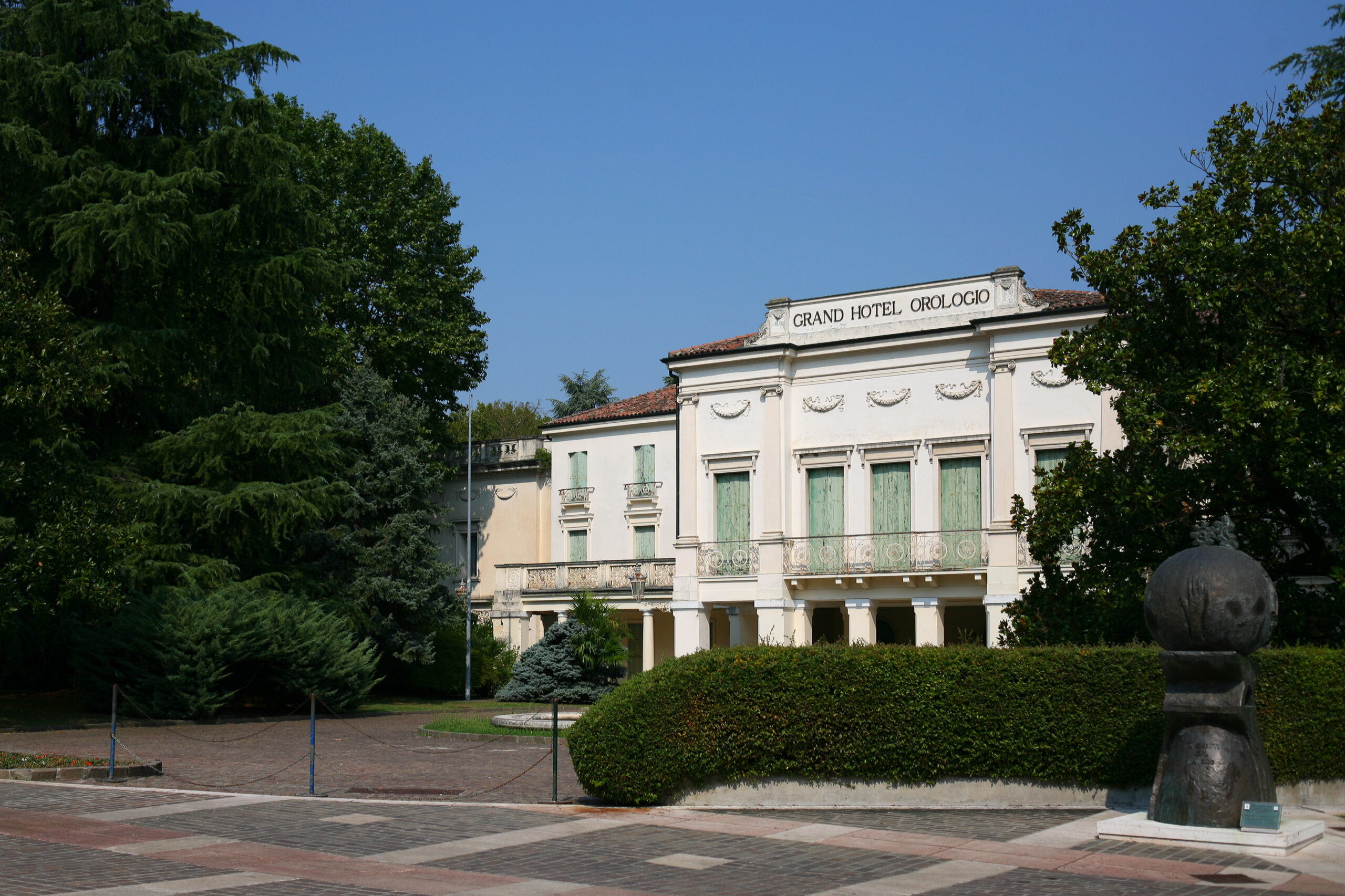
Di Paolobon140 – Opera propria, CC BY-SA 4.0, https://commons.wikimedia.org/w/index.php?curid=71974557
Abano Terme is one of northern Italy’s best-known spa destinations, but reducing the town to its thermal hotels would be a mistake. Located in the province of Padua, at the foot of the Euganean Hills, Abano combines thermal bathing, historic villas, attractive pedestrian areas, good food, wine, cycling and easy access to some of Veneto’s most interesting towns.
For visitors looking for a destination that combines relaxation with sightseeing, Abano Terme is particularly appealing. You can spend the morning in a thermal pool, take an afternoon excursion into the hills, visit a medieval village the following day and return to your hotel for another evening of warm mineral water and wellness treatments.
The town is also an excellent base for exploring the Veneto. Padua is close by, while Venice, Vicenza and Verona are practical excursions for travelers with a car or those prepared to use the region’s excellent rail connections.
For a broader introduction to the region, see Italia Mia’s guide to the Region of Veneto, which covers Padua, Venice, Verona and other destinations throughout the region.
Why Visit Abano Terme?
Abano Terme has been associated with thermal waters for more than 2,000 years. The town’s name is traditionally connected with Aponus, an ancient deity associated with thermal and healing waters, while the surrounding Euganean basin has developed into one of Europe’s major thermal destinations.
Today, the Abano-Montegrotto thermal area is particularly famous for thermal pools, mud treatments, hydrotherapy and wellness programs. The official tourism organization describes Abano and Montegrotto as the largest thermal area in Europe and emphasizes the combination of thermal tourism, nature, culture, sport and food and wine.
This makes Abano different from a conventional Italian resort. The attraction isn’t a single monument or spectacular landscape. Instead, the appeal lies in the combination of wellness and slow travel.
You can walk through town in the morning, have lunch at a traditional restaurant, visit a Venetian villa in the afternoon and finish the day in a thermal pool.
Italy has a long tradition of thermal tourism, and Abano is one of the most important examples. Italia Mia also discusses the country’s major thermal destinations in its article about Italian spas and thermal destinations.
The Thermal Waters of Abano
Thermal tourism is obviously the principal reason many visitors come to Abano.
The thermal waters originate from rainwater and other precipitation that penetrates deep into the ground. According to the local thermal tourism authority, the water travels through an underground system before returning toward the Euganean basin, where geological conditions contribute to its high temperature and mineral content.
The town’s hotels are therefore much more than ordinary accommodation. Many have their own thermal pools, indoor and outdoor swimming pools, mud-treatment facilities, massage services, saunas and wellness areas.
A typical stay might include:
- Thermal swimming pools
- Hot-water hydrotherapy
- Thermal mud treatments
- Massages
- Beauty treatments
- Relaxation areas
- Indoor and outdoor pools
- Medical or rehabilitative treatments
- Wellness packages
One of the advantages of Abano is that you don’t necessarily need to be interested in intensive spa treatments. Many hotels sell packages designed simply around relaxation and wellness.
For a first visit, a three- or four-night stay can be enough to experience the thermal facilities while leaving time for excursions.
Walking Around Abano Terme
Abano itself deserves some time rather than being treated merely as a place to sleep.
The center has pedestrian areas, shops, cafés, hotels and gardens. The town’s central area is particularly pleasant for an evening stroll when the temperature is cooler. The Veneto tourism authority highlights the pedestrian center, historic and modern buildings, hotels with gardens and the central park surrounding the Montirone area.
The Montirone area is particularly important historically because it represents one of the places associated with the ancient thermal tradition of Abano.
Don’t expect the historic center of Abano to resemble medieval towns such as San Gimignano or Siena. Its character is different: it is a purpose-built spa town whose architecture reflects several different periods of thermal tourism.
That contrast is part of its identity.
Monteortone and the Sanctuary of the Madonna della Salute
One of the more interesting excursions close to Abano is Monteortone, a small locality on the slopes of the Euganean Hills.
The Santuario della Madonna della Salute is associated with the area’s religious and thermal history and sits at the foot of Monte Ortone. It provides a peaceful alternative to the busy spa hotels and central streets.
Santuario della Madonna della Salute
The surrounding landscape also begins to demonstrate how quickly the urban environment of Abano gives way to the green slopes of the Euganean Hills.
For visitors who enjoy walking, this is an excellent way to combine a little exercise with sightseeing without committing to a demanding mountain hike.
The Euganean Hills: Abano’s Greatest Asset
The greatest reason to visit Abano beyond the thermal waters is undoubtedly the Parco Regionale dei Colli Euganei.
The Euganean Hills are a distinctive group of hills of volcanic origin rising from the relatively flat landscape of the Veneto. Their geological origins have created a landscape quite different from the surrounding plains, with vineyards, forests, olive groves, historic villas, medieval villages and panoramic viewpoints.
The area is also a protected natural environment and a UNESCO MAB Biosphere Reserve.
The official park authority maintains a substantial network of walking and cycling routes. There are trails ranging from relatively easy tourist walks to demanding excursions for experienced hikers.
This makes the hills suitable for very different types of travelers.
You don’t have to be an experienced hiker. A leisurely walk through a village, vineyard landscape or park can be enough to appreciate the area.
Hiking in the Euganean Hills
For serious walkers, the possibilities are extensive.
The park lists numerous official routes, including:
- Monte Venda
- Monte Lozzo
- Monte Cecilia
- Monte Ricco
- Monte Calbarina
- Monte Gallo
- Villa Draghi
- Alta Via dei Colli Euganei
The official trail network includes routes of different lengths and difficulty levels, so visitors should check the classification before setting out.
The Villa Draghi Trail, for example, is listed as approximately two hours, while some of the longer routes are intended for experienced hikers.
Cyclists have equally good opportunities. The park’s Colli Euganei loop route connects the wider area around Padua, Este, Abano and Montegrotto and is approximately 63 kilometers long.
Arquà Petrarca
One of the most rewarding excursions from Abano is Arquà Petrarca, one of the most beautiful medieval villages in the Euganean Hills.
The village is strongly associated with Francesco Petrarch, the great Italian poet and humanist. Petrarch visited Abano during his lifetime and later became attached to Arquà, where he spent the final years of his life.
Arquà is an ideal destination for a slow afternoon.
Its narrow streets, stone buildings, small squares and hillside setting make it particularly attractive for walking and photography. The village also provides an opportunity to combine literature, history and landscape.
Petrarch’s connection with the area can be explored further through Italia Mia’s article on Italian literature and the early Renaissance.
Allow at least a couple of hours for Arquà, more if you want to enjoy lunch or a drink while taking in the landscape.
Padua: The Essential City Excursion
One of the biggest advantages of staying in Abano is the proximity of Padua.
Padua is an important university city with an extraordinary artistic heritage. Among its major attractions are the Scrovegni Chapel, famous for Giotto’s frescoes, the monumental Basilica of Saint Anthony and Prato della Valle, one of Europe’s great urban squares.
Padua is close enough to make a half-day excursion possible, although a full day is preferable if you want to explore the city properly.
Italia Mia’s guide to the Veneto includes Padua among the region’s principal cultural destinations.
For travelers interested in combining thermal relaxation with art and history, the Abano-Padua combination is particularly effective.
Este and Its Medieval Atmosphere
Another excellent excursion is Este, a historic walled town on the southern side of the Euganean Hills.
Este has a long history extending back to antiquity and is particularly associated with the House of Este, one of Italy’s most influential ruling dynasties.
The town is an excellent place for a relaxed walk through its historic center, with cafés, shops, churches and remnants of its defensive past.
The tourist authority for Padua specifically recommends Este, together with Monselice, Montagnana and Arquà Petrarca, as cultural excursions from the thermal area.
Monselice
Monselice is another fascinating destination within easy reach of Abano.
The town is dominated by its hill, historic religious sites and castle complex. The climb through the historic area provides increasingly attractive views over the surrounding Veneto countryside.
Monselice is especially worthwhile for visitors who enjoy a mixture of medieval architecture, religious history and panoramic scenery.
The town also fits naturally into a day devoted to the southern Euganean Hills, potentially combined with Este.
Battaglia Terme and the Surrounding Area
Battaglia Terme lies southeast of Abano and is another of the communities forming part of the Euganean thermal landscape.
The area combines thermal tourism with waterways, historic buildings and access to the hills. Nearby attractions include historic villas and gardens.
The Euganean Hills park identifies a number of historic residences throughout the territory, including Villa Selvatico Sartori at Battaglia Terme, Villa Draghi at Montegrotto Terme and Villa Bembiana in Abano Terme.
These villas illustrate another important aspect of the region: the Euganean Hills became a favored setting for wealthy Venetian families who built country residences surrounded by gardens and agricultural estates.
Montegrotto Terme
Abano and Montegrotto Terme are effectively two halves of the same thermal destination.
Montegrotto has its own hotels, thermal pools and wellness facilities, but it also offers attractions of its own.
One interesting option is Terme Preistoriche Resort & Spa, which combines thermal facilities with the wider spa tradition of the area.
The official tourism organization treats Abano and Montegrotto as a single thermal territory, and visitors can easily include both towns in the same holiday.
Galzignano Terme
For a quieter experience, head toward Galzignano Terme.
The town sits farther into the Euganean landscape and is particularly attractive to visitors interested in gardens, countryside, golf and thermal wellness.
The nearby regional park provides opportunities for walking, while the surrounding hills offer vineyards and panoramic views.
The area is also home to the historic Villa Barbarigo Pizzoni Ardemani, whose gardens are among the notable historic garden attractions identified by the Euganean Hills park authority.
Teolo and the Western Euganean Hills
Teolo is another good destination for exploring the more rural side of the Euganean Hills.
Here the landscape becomes increasingly agricultural and wooded, with vineyards, small villages, churches and hill roads.
It is a particularly good area for drivers who enjoy scenic routes rather than simply traveling from one major attraction to another.
The Euganean Hills are also known for local wine production. Visitors can stop at wineries and restaurants to sample wines produced in the hills, making a countryside excursion as much a gastronomic experience as a sightseeing trip.
Villas, Gardens and Historic Residences
The Euganean Hills are unusually rich in historic villas.
The park authority lists numerous historic residences, including Villa Bembiana in Abano Terme, Villa Draghi in Montegrotto, Villa Vescovi in Torreglia, Villa Barbarigo in Galzignano and several historic residences around Este, Monselice and Baone.
Some are open to visitors while others have restricted access, so it is advisable to check opening arrangements before planning a visit.
For travelers who enjoy Italian architecture, gardens and aristocratic history, these villas provide an excellent complement to the thermal experience.
Food and Wine Around Abano Terme
A visit to Abano should not be limited to spa cuisine.
The surrounding Veneto countryside has a substantial culinary tradition, with dishes based on pasta, rice, vegetables, meat, freshwater fish and seasonal ingredients.
One regional specialty worth seeking out is bigoli in salsa, a thick handmade pasta traditionally served with a savory anchovy and onion sauce. The local tourism organization specifically identifies bigoli in salsa among the characteristic foods of the Euganean area.
Other foods worth trying include:
- Bigoli
- Risotto
- Polenta
- Local cured meats
- Seasonal mushrooms
- Veneto-style cod
- Local cheeses
- Euganean Hills wines
- Traditional pastries and desserts
And, of course, gelato remains an easy choice after an afternoon of sightseeing. Italia Mia’s history of Italian gelato explores the country’s regional gelato traditions.
For a restaurant experience in Abano, Osteria Ristorante Al Filò is one local option for traditional Italian cooking, while Da Vinci Bistrot offers a more contemporary bistro atmosphere.
Where to Stay
Abano has an unusually large selection of hotels built around the thermal industry.
The most important decision is not simply the number of stars. Consider what you actually want from the stay.
A hotel focused heavily on thermal treatments may be ideal if your priority is wellness. A hotel closer to the pedestrian center may be preferable if you want to walk to restaurants, cafés and shops.
Examples include:
- Grand Hotel Trieste & Victoria
- Hotel Plaza
- Hotel Terme All’Alba
- Hotel Premiere Abano
For a spa-centered holiday, look carefully at what is included in the room rate. Some properties include thermal pool access while others charge separately for particular treatments or services.
Abano as a Base for Exploring Veneto
Abano’s strategic position is one of its greatest advantages.
Padua is close, while the wider Veneto region provides access to Venice, Vicenza, Verona and Treviso.
The official Abano tourism organization also promotes excursions to the region’s major cities of art, including Padua, Venice, Verona and Vicenza.
This means that Abano can work for two completely different kinds of vacation.
The first is a dedicated spa holiday, where you spend most of your time at the hotel and make only occasional excursions.
The second is a Veneto sightseeing holiday, using Abano as a comfortable base while combining thermal relaxation with day trips.
The second option is particularly attractive for travelers who don’t want to change hotels every night.
How to Get to Abano Terme
Abano is conveniently located for both motorists and travelers arriving by train.
By car, the main approach is via the A4 motorway, with the Padova Ovest exit recommended for travelers coming from Milan or Venice. Travelers using the A13 from Bologna can use the Terme Euganee exit.
By train, the closest station is Terme Euganee-Montegrotto, while Padua station offers extensive connections along the Milan-Venice railway corridor. Bus connections link Padua with Abano.
For international visitors, Venice Marco Polo is the principal nearby airport, with Treviso and Verona also within reasonable traveling distance.
When Is the Best Time to Visit?
Abano can be visited throughout the year because the thermal facilities remain attractive regardless of the weather.
Spring is particularly good for walking and cycling because the countryside is green and temperatures are generally comfortable.
Summer works well if you want to combine thermal facilities with outdoor activities, although the hottest days can make strenuous hiking uncomfortable.
Autumn is excellent for food, wine and countryside excursions, with the changing colors of the hills adding another dimension to the landscape.
Winter is perhaps the most atmospheric season for a spa holiday. Cold or rainy weather outside makes a warm thermal pool particularly appealing.
For travelers primarily interested in wellness, winter and the shoulder seasons can be especially attractive.
How Long Should You Stay?
A two-night stay gives you a taste of Abano but can feel rushed.
Three or four nights is better.
A possible four-day combination would be:
Day 1: Arrive, check into a thermal hotel and spend the afternoon at the spa.
Day 2: Explore Abano Terme in the morning, followed by an afternoon in Padua.
Day 3: Drive through the Euganean Hills, visiting Arquà Petrarca and perhaps Este or Monselice.
Day 4: Spend the morning at the thermal pools and take a leisurely lunch before departure.
For a week-long holiday, you can add hiking, cycling, wineries, historic villas, Venice or Vicenza.
A Destination for Slow Travel
Abano Terme is particularly well suited to the modern concept of slow travel.
There is no need to race from monument to monument. The town encourages visitors to slow down.
A typical day might begin with breakfast, continue with a thermal pool and massage, followed by lunch and an afternoon drive through the Euganean Hills. You might stop at a village for coffee, visit a winery, walk through a historic garden and return to the hotel before dinner.
That combination of wellness, nature, culture and gastronomy is what makes Abano more interesting than a conventional spa resort.
Abano Terme and the Euganean Hills: The Perfect Combination
The greatest strength of Abano is its location.
The thermal waters provide the primary reason to visit, but the Euganean Hills transform the destination into something considerably more versatile.
Within a relatively small area, visitors can experience thermal bathing, medieval villages, Renaissance and Venetian villas, vineyards, hiking trails, cycling routes, historic towns and excellent food.
The official Padua tourism organization describes the thermal area and Euganean Hills as a destination where wellness, nature, wine and cultural excursions can be combined, with Este, Monselice, Montagnana and Arquà Petrarca all accessible from the area.
For anyone looking for an Italian destination that offers relaxation without isolation and sightseeing without the crowds of Venice or Florence, Abano Terme deserves serious consideration.
It is a place where the holiday can be as active or as leisurely as you choose—and where a day spent doing very little can be just as rewarding as a day spent exploring the Veneto.
Internal Links
- Region of Veneto: A Journey Through Italy’s Romantic Canals, Historic Cities and Breathtaking Landscapes
- Top Italian Destinations and Italian Cities
- Italy and Its Culture
- Italian Literature: The Early Renaissance
- The History of Italian Gelato
External Links
- Thermae Abano Montegrotto – official tourism portal
- Veneto Tourism – Abano Terme
- Turismo Padova – Thermal Area and Euganean Hills
- Parco Regionale dei Colli Euganei
- Abano Terme official tourism portal