
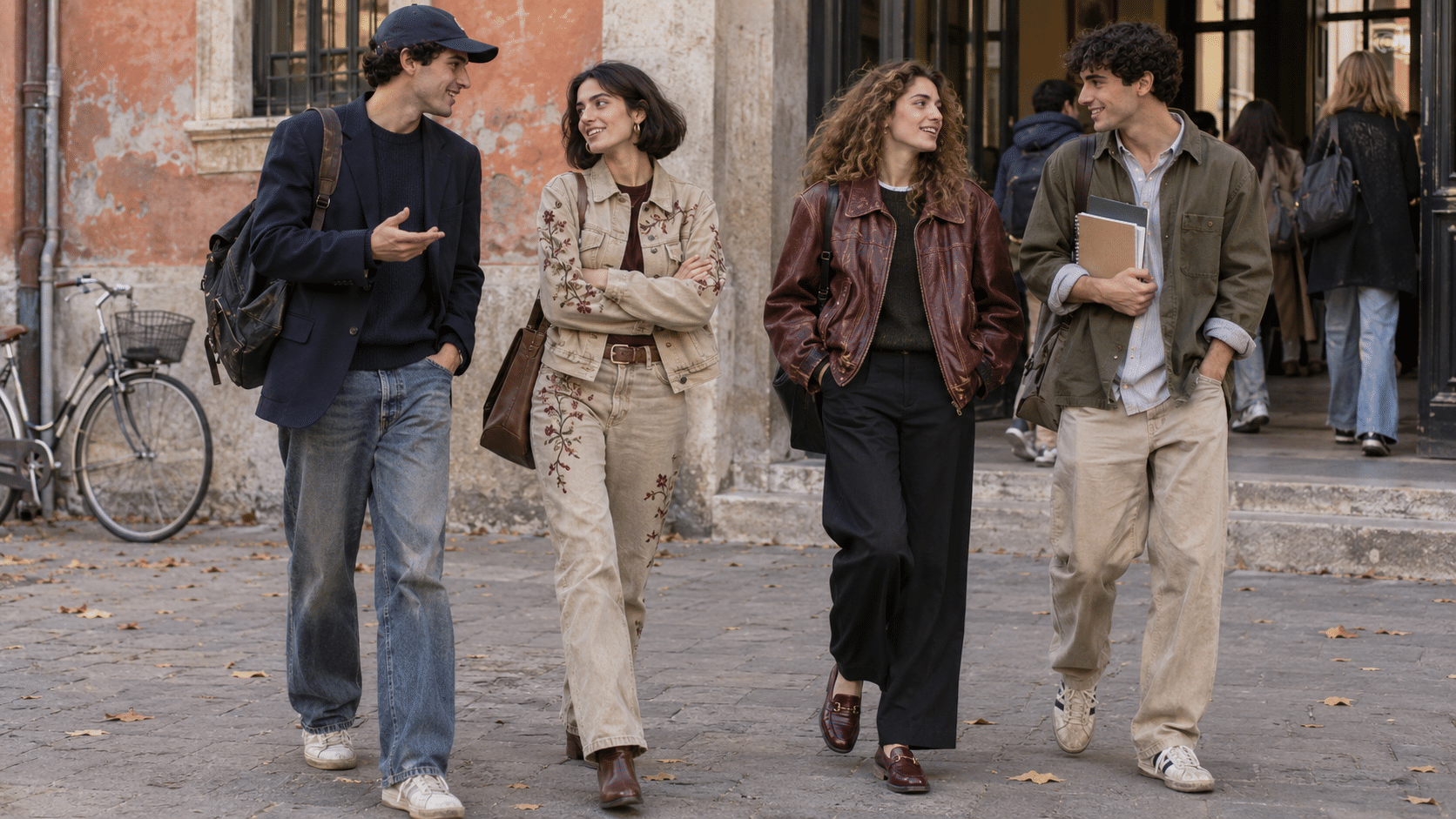
Maya Lilian Kunz chose embroidered beige denim for the start of the academic year in Florence. The Polimoda student liked vintage because it gave her a chance to find something she was unlikely to see on a classmate. Asked what drew her to the outfit, she told fellow student Julie Nunes, “I really like classic items with a twist.”
The jacket and jeans someone wears to class can tell you a little about their taste. They tell you considerably less about their budget. A jacket might be the most expensive purchase a student makes that year, a find at a clothing swap, or something an older sibling left at home. Recent campus reporting and surveys from Italy offer a look at all three parts of the story: what students choose to wear, how they acquire it and how much money actually changes hands.
What students wear to class in Milan and Florence
In her June 2026 account of student outfits in Milan, style writer Alessia Spampinato picked out a navy blazer worn with a sweater, light-wash jeans, a baseball cap and a backpack. The interesting choice was the cap. Take it and the backpack away, and the jacket and knitwear could pass for office clothes. Worn together, the pieces made sense for someone on the way to class. Another look paired a raincoat and loafers with jeans and a white shirt. Denim did much of the work in both outfits, leaving room for a change of shoes or outerwear to give each a different feel.
In Florence, three students wearing black to the same event offered three quite different explanations. At Polimoda’s 2025 welcome gathering, fashion business student Felicitas Lollert said she wanted people meeting her for the first time to notice her personality. Fashion design student Shayaan Khan had thrifted his entire outfit and liked its slightly punk character. Nerija Kanapkaite, who studied fashion art direction, explained that she had grown tired of the industry’s use of color. Dressing in black let her concentrate on the shape and construction of each piece.
A fashion school’s welcome event is a particular occasion, and these students had good reason to think about what they wore that day. What makes their accounts worth reading is that a photograph could easily have grouped all three under a single trend. It took a classmate asking questions to discover what each saw in the clothes. For anyone following Italian fashion, Khan’s outfit also raises a question that street-style photographs rarely answer. How much of what ends up on campus has already belonged to somebody else?
How students shop secondhand in Italy
In March 2025, journalist Agostino Forgione asked 74 university students about buying new and used clothing. Almost half, 46%, said they bought all their clothing new. About one in five said that roughly every fifth garment they bought was secondhand. At the other end of the survey, 5% bought most of their clothes used. It was a small sample, but the students’ explanations bring out something the percentages alone miss.
Some of those who bought exclusively new said they already wore clothes handed down by relatives. Their answers made perfect sense. Asked about their last purchase, they could point to a new garment. Asked what was hanging in their wardrobe, they could also point to pieces someone else had worn first. Family hand-me-downs are easy to overlook in any account of secondhand fashion built around sales.
For other students, the obstacle was finding somewhere nearby to shop. Buying online gave them more choice, but several respondents worried about judging size and condition from a listing. A photograph can show the color of a denim jacket reasonably well. Whether the shoulders sit comfortably over a sweater, or whether the cuffs are worn through rather than simply faded, is easier to establish with the jacket in hand.
Students also drew different conclusions about what represented good value. In Forgione’s survey, 18% said they were spending about the same amount on clothing as three years earlier while buying more pieces secondhand. Meanwhile, 69% of the full sample had ordered from a major online fast-fashion platform at least once. Among those who used such platforms, some said more expensive clothes were beyond their budget. Others simply liked the particular garment they had found. The appeal of an individual piece mattered to vintage buyers, too.
Where students swap clothes on campus
Students arriving at the Politecnico di Torino in October 2026 had a chance to browse secondhand clothes before they had even learned where to shop in the city. On October 2, the university held a swap party as part of its welcome program for the international student community. According to the Politecnico’s account of the exchange, about 100 people brought more than 300 items. Clothing and accessories accounted for more than 240 of them. There were also books, games, plants and things for the home.
Most items changed hands directly. Some of the clothing left at the end went to Progetto Abito, a Turin organization that distributes donated clothes. For a newcomer, the exchange offered two things an online listing could not: the chance to examine an item and the chance to meet the person passing it on. It also put clothes alongside the other things a student might need when moving into a room for the semester.
Other universities have given the same idea distinctly local settings. In Venice, fashion master’s students organized a clothing and accessories exchange in the Tolentini cloister as part of a joint initiative by Iuav and Ca’ Foscari. In Padua, the University of Padua’s swap at Palazzo del Bo asked participants to register up to four items and describe them in advance. They dropped the pieces off before the doors opened, giving organizers time to arrange the room. Someone who had hesitated to order a secondhand garment online could see the fabric, seams and wear for themselves.
How much do university students in Italy spend on clothes?
One of the most useful figures comes from the University of Bologna’s 2026 sustainability report. The university asked about spending during 2025 in the province where each student’s course was based. Across its five campuses, it estimated that 68.7% of students had spent money on clothing, footwear, laundry or dry cleaning locally. Among those who reported spending in that category, the average came to €229 for the year. The campus averages ranged from €218 in Ravenna to €285 in Rimini.
The wording matters for anyone trying to turn €229 into a student clothing budget. A Bologna student who paid a local cleaner to clean a winter coat contributed to the figure. A student who went home to another province and bought a coat there made a purchase outside the survey’s scope. The figures tell us what students spent around their place of study, including the cost of caring for things they already owned. They cannot tell us the price of everything those students wore.
For a broader comparison, the SITA Ricerca Fashion Consumer Panel estimated that Italy’s Generation Z spent about €400 per person on clothing, accessories and footwear in 2024. That population includes young people who work as well as those who study. Its spending categories and geographic scope also differ from Bologna’s. One telling detail is the list of brands the researchers singled out: Nike, Adidas, Levi’s and Zara. Familiar international labels have a place in the same wardrobes that make room for embroidered vintage denim and a secondhand jacket.
Asked what students in Italy wear, the easiest answer is a list of garments. The more revealing question is where a particular piece came from. In Florence, Khan could explain how he had thrifted a whole outfit in the color he wanted. In Turin, hundreds of pieces arrived on campus in the hands of people ready to pass them on. And among the students Forgione surveyed, some of the clothes already getting a second life had made the shortest journey of all, from one family member’s wardrobe to another.